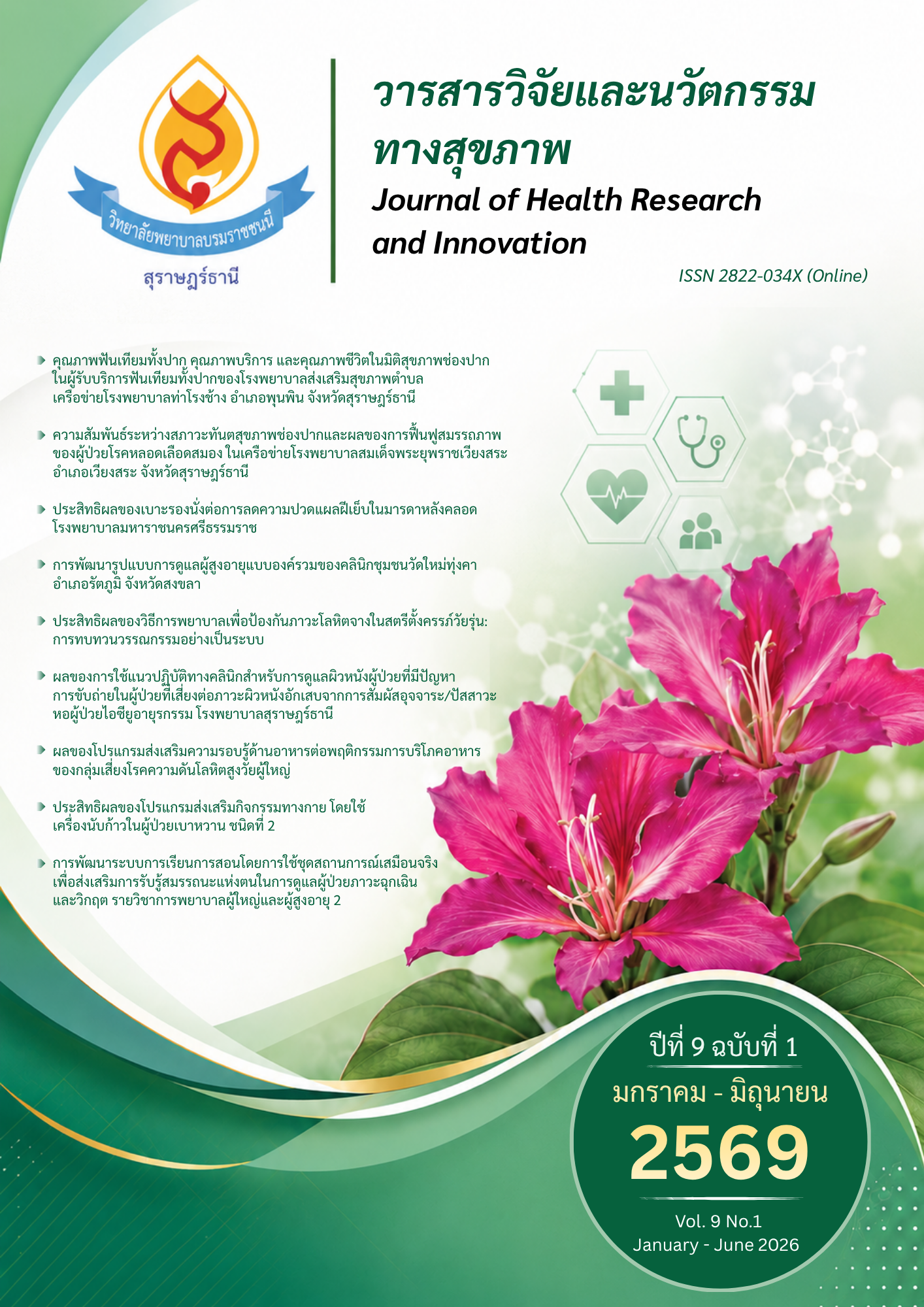
ผลของโปรแกรมส่งเสริมความรอบรู้ด้านอาหารต่อพฤติกรรมการบริโภคอาหาร ของกลุ่มเสี่ยงโรคความดันโลหิตสูงวัยผู้ใหญ่
คำสำคัญ:
ความรอบรู้ด้านอาหาร, พฤติกรรรมการบริโภค, กลุ่มเสี่ยงความดันโลหิตสูงบทคัดย่อ
งานวิจัยนี้เป็นการวิจัยแบบกึ่งทดลองกลุ่มตัวอย่างกลุ่มเดียว วัดผลก่อนและหลังการทดลอง ในสัปดาห์ที่ 1,4 และ 8 มีวัตถุประสงค์ เพื่อศึกษาเปรียบเทียบคะแนนพฤติกรรมการบริโภคอาหารก่อนและหลังได้รับโปรแกรมส่งเสริมความรอบรู้ด้านอาหารของกลุ่มเสี่ยงโรคความดันโลหิตสูงในวัยผู้ใหญ่กลุ่มตัวอย่างได้จากการสุ่มแบบจับฉลาก ตามเกณฑ์การคัดเข้าเป็นวัยผู้ใหญ่กลุ่มเสี่ยงความดันโลหิตสูง อาศัยอยู่ในพื้นที่รับผิดชอบของโรงพยาบาลส่งเสริมสุขภาพตำบลท่าอุแท อำเภอกาญจนดิษฐ์ จังหวัดสุราษฎร์ธานี จำนวน 30 คน เครื่องมือที่ใช้ในการวิจัยเป็นแบบสอบถาม และโปรแกรมส่งเสริมความรอบรู้ด้านอาหารต่อพฤติกรรมการบริโภคอาหารของกลุ่มเสี่ยงโรคความดันโลหิตสูงในผู้ใหญ่ จัดเป็นกิจกรรมระยะเวลา 8 สัปดาห์ เครื่องมือวิจัยผ่านการตรวจสอบโดยผู้ทรงคุณวุฒิจำนวน 3 ท่าน ได้ค่าดัชนีความตรงเชิงเนื้อหาเท่ากับ .84 มีแบบประเมินพฤติกรรมการบริโภคอาหารมีค่าความเที่ยงเท่ากับ .83 วิเคราะห์ข้อมูลโดยใช้สถิติเชิงพรรณนา และสถิติ One-way Repeated Measures ANOVA ผลการวิจัยพบว่า หลังได้รับโปรแกรมของกลุ่มเสี่ยงโรคความดันโลหิตสูงในวัยผู้ใหญ่กลุ่มตัวอย่างมีค่าเฉลี่ยพฤติกรรมการบริโภคมากกกว่าก่อนเข้าร่วมโปรแกรมฯ อย่างมีนัยสำคัญทางสถิติที่ระดับ .001
เอกสารอ้างอิง
Arahang, S. (2017). Health literacy and health behaviors in hypertensive risk groups. Journal of Nursing and Health Care, 35(3), 154-162.
Best, J. W. (1981). Research in education (4th ed.). Prentice-Hall.
Cohen, P., Kasen, S., Chen, H., Hartmark, C., & Gordon, K. (2003). Variations in patterns of developmental transitions in the emerging adulthood period. Developmental Psychology, 39(4), 657–669. https://doi.org/10.1037/0012-1649.39.4.657
Chotchai, T., Seedaket, S., Taearak, K., Panyasong, S., & Buajun, A. (2020). Factors related to health literacy in prevention of hypertension among group at risk in Samran Sub-district, Muaeng District, Khon Kaen Province. The Southern College Network Journal of Nursing and Public Health, 7(1), 45–56. (in Thai)
Department of Disease Control. (2026, May 17). Department of Disease Control reveals 1 in 3 people worldwide have hypertension, recommends regular blood pressure checks, knowing symptoms, knowing values, and preventing stroke and heart disease. https://ddc.moph.go.th/brc/news.php?news=56872 (in Thai)
Department of Health. (2025). Report on the new incidence rate of hypertension per hundred thousand population [Dashboard]. Health Data Center (HDC). Retrieved May 25, 2026, from https://dashboard.anamai.moph.go.th/dashboard/ht/index?year=2025
Department of Health Service Support. (2017). Family volunteer manual (FVM): Care group for chronic non-communicable diseases (NCDs) patients. Agricultural Co-operative Federation of Thailand Printing House. (in Thai)
Fingland, D., Thompson, C., & Vidgen, H. A. (2021). Measuring food literacy: Progressing the development of an international food literacy survey using a content validity study. International Journal of Environmental Research and Public Health, 18(3), Article 1141. https://doi.org/10.3390/ijerph18031141
Jaemtim, N., & Yuenyong, S. (2019). The use of online media and perceptions of eHealth literacy among the elderly in Suphanburi Province. Journal of Baromarajonani College of Nursing, Nakhonratchasima, 25(2), 168-180.
Jancharoen, K., Wanwilai, P., & Chaiwongnakapan, C. (2017). Effects of health behavior modification program on health behavior and blood pressure level of hypertension risk groups. The Southern College Network Journal of Nursing and Public Health, 4(2), 114–128. (in Thai)
Kaewmanee, A. (2025). Effect of the Food Literacy Promotion Program on Dietary Behaviors Among at Risk Group of Hypertension in Kamphaengsaen Hospital. Journal of Health Innovation and Safety, 2(2), 1–14.
Kasai, N., & Nusuk, N. (2025). The effect of a family participation program on health behavior modification of hypertension risk groups, Mae Moh District, Lampang Province. Academic Journal of Nursing and Public Health, 1(2), 61-75.
Krause, C., Sommerhalder, K., Beer-Borst, S., & Abel, T. (2018). Just a subtle difference? Integrating health literacy and food literacy. Health Promotion International, 33(4), 678–689. https://doi.org/10.1093/heapro/daw105
Mackert, M., Mabry-Flynn, A., Champlin, S., Donovan, E. E., & Pounders, K. (2016). Health literacy and health information technology adoption: The potential for a new digital divide. Journal of Medical Internet Research, 18(10), e264. https://doi.org/10.2196/jmir.6349
Maikham, S., Aungwattana, S., & Sripetchwandee, N. (2024). Effect of a food literacy enhancing program on dietary behaviors among groups at risk of hypertension in communities. Nursing Journal CMU, 51(3), 200–214. (in Thai)
Makkaew, A., Moonsart, S., & Boonruangrod, M. (2018). Motivation for hypertension prevention among risk groups using Keller’s ARCS model. Journal of Nursing and Health Care, 36(2), 89–98. (in Thai)
Malaysian Adults Study. (2025). Critical health literacy and hypertension management in working-age populations. Asian Journal of Public Health, 14(1), 22–35.
Meher, M., Pradhan, S., & Pradhan, S. R. (2023). Risk factors associated with hypertension in young adults: A systematic review. Cureus, 15(4), e37467. https://doi.org/10.7759/cureus.37467
Nakling, Y., & Tadsri, P. (2017). Effects of self-efficacy enhancement on blood pressure control behaviors. Journal of Nursing and Health Sciences, 11(3), 85–97. (in Thai)
Nutbeam, D. (2008). The evolving concept of health literacy. Social Science & Medicine, 67(12), 2072–2078. https://doi.org/10.1016/j.socscimed.2008.09.050
Prasittimett, C., Promseeda, P., & Sriraksa, S. (2023). Factors related to health literacy and disease prevention behaviors in patients with hypertension. Journal of Nursing and Health, 17(2), 28–41.
Strategy and Planning Division, Office of the Permanent Secretary, Ministry of Public Health. (2018). 20-year national strategic plan (2017 - 2036) for public health (Revised edition No. 2, 2018). Ministry of Public Health. (in Thai)
Sueto, N., Jirapongsuwan, A., Rawiworrakul, R., & Tipayamongkholgul, M. (2019). The effect of a program to promote blood pressure control among 35- to 59-year-old patients with uncontrolled hypertension. Journal of Public Health Nursing, 32(2), 96–114. (in Thai)
Taggart, J., Williams, A., Dennis, S., Newall, A., Shortus, T., & Zwar, N. (2012). A systematic review of interventions in primary care to improve health literacy for chronic disease behavioral risk factors. BMC Family Practice, 13, Article 49. https://doi.org/10.1186/1471-2296-13-49
Tanhui, N., Sangthong, P., Thohman, M., Nowsuwan, K., & Singweratham, N. (2023). The effect of health literacy program according to the 3E2S principle on health literacy, preventive behaviors, and blood pressure levels among people in hypertensive risk group. Journal of Nursing and Public Health Research, 3(2), 96–111. (in Thai)
Techakanta, P., Tamdee, D., & Sriphetwandee, N. (2024). Effects of a food literacy enhancement program on dietary behaviors among adults with uncontrolled hypertension. Southern College of Nursing and Public Health Network Journal, 11(3), e26877. (in Thai)
Thai Hypertension Society. (2024). 2024 Thai guidelines on the treatment of hypertension by the Thai Hypertension Society. Trick Think. (in Thai)
Thanyapraneetkul, N. (2024). Factors predicting the risk of NCDs (diabetes and hypertension) among working-age clients at the Health Promotion Hospital, Health Center 5, Ratchaburi. Medical Journal of District 4-5, 43(3). (in Thai)
Thongma, N. (2020). Relationship between health literacy and hypertension prevention behaviors. Journal of Health Science and Nursing, 34(2), 45–58. (in Thai)
Visedkaew, K., & Muktabhant, B. (2020). Association between nutrition literacy and the consumption of snacks and sweetened beverages among undergraduate students in the health sciences faculties of Khon Kaen University. Srinagarind Medical Journal, 35(2), 183–192.
Wang, J.-G., Li, Y., Chia, Y.-C., Cheng, H.-M., Minh, H. V., Siddique, S., Sogunuru, G. P., Tay, J. C., Teo, B. W., Tsoi, K., Turana, Y., Wang, T.-D., Zhang, Y.-Q., & Kario, K. (2021). Telemedicine in the management of hypertension: Evolving technological platforms for blood pressure telemonitoring. The Journal of Clinical Hypertension, 23(3), 435–439. https://doi.org/10.1111/jch.14194
World Health Organization. (1998). Health promotion glossary. https://iris.who.int/server/api/core/bitstreams/402acba9-d79c-4dad-89ae-5085cb528400/content
World Health Organization. (2025, March 16). Hypertension. https://www.who.int/news-room/fact-sheets/detail/hypertension
World Health Organization. (2026, May 17). World Hypertension Day 2026. https://www.who.int/news-room/events/detail/2026/05/17/default-calendar/world-hypertension-day-2026
Yuan, X., Wang, Y., & Zhang, J. (2026). Association between nutrition literacy and hypertension control: Chain mediating association of diet-control intention and salt-restriction tools utilization. Frontiers in Nutrition, 13, 1722719. https://doi.org/10.3389/fnut.2026.1722719
ดาวน์โหลด
เผยแพร่แล้ว
รูปแบบการอ้างอิง
ฉบับ
ประเภทบทความ
สัญญาอนุญาต
ลิขสิทธิ์ (c) 2026 วิทยาลัยพยาบาลบรมราชชนนี สุราษฎร์ธานี

อนุญาตภายใต้เงื่อนไข Creative Commons Attribution-NonCommercial-NoDerivatives 4.0 International License.
บทความที่ได้รับการตีพิมพ์เป็นลิขสิทธิ์ของวารสารวิทยาลัยพยาบาลบรมราชชนนี สุราษฎร์ธานี
ข้อความที่ปรากฏในบทความแต่ละเรื่องในวารสารวิชาการนี้เป็นความคิดเห็นส่วนตัวของผู้เขียนแต่ละท่านไม่เกี่ยวข้องกับวิทยาลัยพยาบาลบรมราชชนนี สุราษฎร์ธานี และคณาจารย์ท่านอื่นๆในวิทยาลัยฯ แต่อย่างใด ความรับผิดชอบองค์ประกอบทั้งหมดของบทความแต่ละเรื่องเป็นของผู้เขียนแต่ละท่าน หากมีความผิดพลาดใดๆ ผู้เขียนแต่ละท่านจะรับผิดชอบบทความของตนเองแต่ผู้เดียว