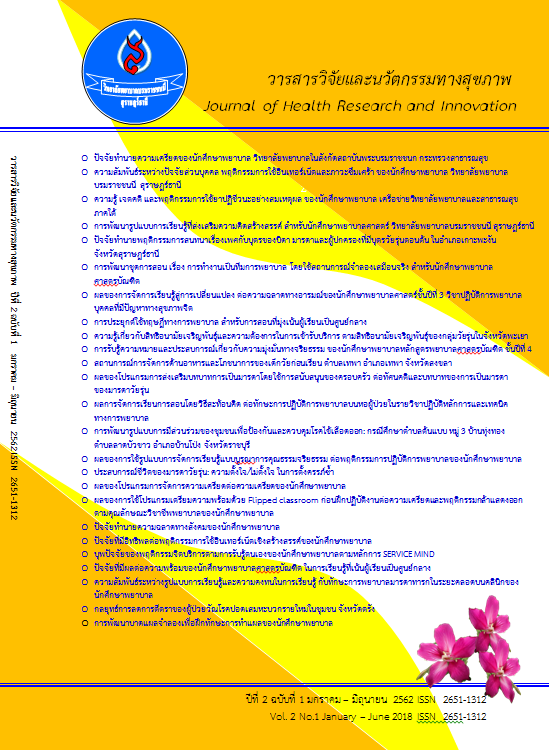
ความสัมพันธ์ระหว่างปัจจัยส่วนบุคคล พฤติกรรมการใช้อินเทอร์เน็ต และภาวะซึมเศร้า ของนักศึกษาพยาบาล วิทยาลัยพยาบาลบรมราชชนนี สุราษฎร์ธานี
คำสำคัญ:
ภาวะซึมเศร้า, การใช้อินเทอร์เน็ต, การเสพติดอินเทอร์เน็ตบทคัดย่อ
การวิจัยนี้เป็นการวิจัยเชิงพรรณนา(Descriptive study) มีวัตถุประสงค์เพื่อศึกษาความสัมพันธ์ระหว่าง ปัจจัยระดับชั้นปี พฤติกรรมการเสพติดอินเทอร์เน็ต และ ภาวะซึมเศร้าของนักศึกษาพยาบาลวิทยาลัยพยาบาลบรมราชชนนีสุราษฎร์ธานี ได้ทำการศึกษาในกลุ่มตัวอย่างทั้งสิ้น 491 คน เครื่องมือที่ใช้ในการวิจัยเป็นแบบวัดพฤติกรรมการเสพติดอินเทอร์เน็ต (Internet) ของ Kimberly S. Young (1998) (Young’s Internet addict Test: YIAT20) ใช้สำหรับประเมินพฤติกรรมการใช้อินเทอร์เน็ตที่มากเกินไป แบบวัดพฤติกรรมดังกล่าวมีการทดลองใช้กับกลุ่มตัวอย่างที่มีลักษณะใกล้เคียงกับกลุ่มตัวอย่างจริง ซึ่งได้หาความเชื่อมั่นของเครื่องมือโดยวิธีหาค่าสัมประสิทธ์แอลฟ่าของครอนบาคเท่ากับ .89 และแบบคัดกรองภาวะซึมเศร้า (2Q) 2 คำถาม และ แบบประเมินภาวะซึมเศร้า (9Q) ด้วย 9 คำถามของกรมสุขภาพจิต
ผลการวิจัยพบว่ากลุ่มตัวอย่างส่วนใหญ่มีการเชื่อมต่ออินเทอร์เน็ตผ่านทางโทรศัพท์มือถือ คิดเป็นร้อยละ 95.92 กลุ่มตัวอย่างมีการใช้อินเทอร์เน็ตเฉลี่ย 3-4 ชั่วโมงต่อวัน การใช้งานอินเทอร์เน็ตมากที่สุด 3 อันดับแรกคือ Line Face book และ You Tube คิดเป็นร้อยละ 97.35 97.15 และ 91.45 ตามลำดับปัญหาที่พบจากการใช้อินเทอร์เน็ตได้แก่ปัญหาสุขภาพกายและสุขภาพจิต พบว่า ร้อยละ 1.63 ของกลุ่มตัวอย่างผู้มีปัญหาสุขภาพกายและจิต เป็นผู้เสพติดอินเทอร์เน็ต นอกจากนี้พบว่า ร้อยละ 84.52 เป็นผู้ที่ใช้อินเทอร์เน็ตมากเกินไปและเป็นกลุ่มเสี่ยงต่อการเสพติดอินเทอร์เน็ต โดยร้อยละ 5.10 ของกลุ่มตัวอย่างมีภาวะซึมเศร้า ความสัมพันธ์ระหว่างชั้นปีกับความสามารถในการควบคุมการใช้งานอินเทอร์เน็ตด้วยตนเอง และการเกิดภาวะซึมเศร้า พบว่า ร้อยละของนักศึกษาในชั้นปีที่ต่ำกว่ามีแนวโน้มในการควบคุมการใช้งานอินเทอร์เน็ตด้วยตนเองน้อยกว่าชั้นปีที่สูงขึ้นอย่างมีนัยสำคัญทางสถิติที่ระดับ .05
จากผลการวิจัยดังกล่าวบ่งชี้ว่าวิทยาลัยพยาบาลบรมราชชนนีสุราษฎร์ธานี ควรมีกิจกรรมการส่งเสริมและให้ความรู้เกี่ยวกับการใช้อินเทอร์เน็ตอย่างสร้างสรรค์เพื่อใช้เป็นแนวทางในการป้องกันปัญหาสุขภาพจิตในโอกาสต่อไป
เอกสารอ้างอิง
Department of Mental Health. (2019). Understanding Depressive in Thai Adolescent. Retrieved 2019 Mar 22. from http://www.dmh.go.th/new-dmh/view.asp?id=29585.(in Thai)
Department of Mental Health. (2017). Annual report 2017. Bangkok, Department of Mental, Health Ministry of public health. (in Thai)
Department of Mental Health. (2017). Annual report 2017. Bangkok, Department of Mental, Health Ministry of public health.(in Thai)
Hongsrisuwan, N. (2016). Depression. Journal of Health Science, 19(38), 105-117.(in Thai)
Kanjanasil, J., et al. (2008). The Prevalence of Stress and Depression among Pharmacy Students at Mahasakham University. Isan Journal of Pharmaceutical Sciences, 4(2), 66-72. (in Thai)
Lamphet, S. (2016). Behavior and Impact of using Social Network of Secondary School Students in Nonthaburi Province. Suthiparithat Journal, 30(93), 116-130. (in Thai)
Limsrijarean, K., Handee, N & Juntupka, S. (2014). Prevalence and Associated Factors of Depression in Second to Sixth Years Medical Students, Faculty of Medicine in Assoc Thailand, 59(1), 29-40.(in Thai)
Nantaweth, R . (2007). Factors affecting Internet Addiction Behavior of Upper Secondary School Students in Bangkok Metropolish. Faculty of Education,Cholalongkorn University. (in Thai)
National Statistical office Thailand. (2015). Statistic Internet Used in Thailand. Bangkok, National Statistical office Thailand, Ministry of Digital Economy and Society.(in Thai)
Thongkumbunjong, V., et al. (2011). Causal Factors and Effect of Internet Dependency Behavior of High School Students in Bangkok Metropolis. Journal of Behavioral Science, 17(2), 103-120.(in Thai)
Vathanasil, D., et al. (2015). Factor Predicting Depression among Health Science Students. Faculty of Nursing Buapha University, 23(4), 1-20.(in Thai)
Virachatyanukul, S. (2016). Effect of Internet Addiction on Students’ Academic Performance of The Second Year Students, Faculty of Business Administration, Bangkok University. HCU Journal of Health Science, 18(36), 47-63. (in Thai)
Vitsunuyotin, T., et al. (2013). The Prevalence of Attention Deficit/ Hyperactivity Disorder in Thailand. Journal of Mental Health of Thailand, 21(2), 66-75. (in Thai)
Wanchaitanawong, W., & Choopan, K. (2014). A Survey of Internet Utilization and Impacts of Internet Utilization on Students of Boromarajonnani College of Nursing, Chiang Mai. Journal of Nursing and Education, 7(3), 124-132. (in Thai)
Young, K.S. (1996). Internet Addiction: The Emergence of a New Clinical Disorder. Retrieved October 25, 2017. from http://www.chabad4israel.org/tznius4israel/newdisorder.pdf.
ดาวน์โหลด
เผยแพร่แล้ว
รูปแบบการอ้างอิง
ฉบับ
ประเภทบทความ
สัญญาอนุญาต
บทความที่ได้รับการตีพิมพ์เป็นลิขสิทธิ์ของวารสารวิทยาลัยพยาบาลบรมราชชนนี สุราษฎร์ธานี
ข้อความที่ปรากฏในบทความแต่ละเรื่องในวารสารวิชาการนี้เป็นความคิดเห็นส่วนตัวของผู้เขียนแต่ละท่านไม่เกี่ยวข้องกับวิทยาลัยพยาบาลบรมราชชนนี สุราษฎร์ธานี และคณาจารย์ท่านอื่นๆในวิทยาลัยฯ แต่อย่างใด ความรับผิดชอบองค์ประกอบทั้งหมดของบทความแต่ละเรื่องเป็นของผู้เขียนแต่ละท่าน หากมีความผิดพลาดใดๆ ผู้เขียนแต่ละท่านจะรับผิดชอบบทความของตนเองแต่ผู้เดียว