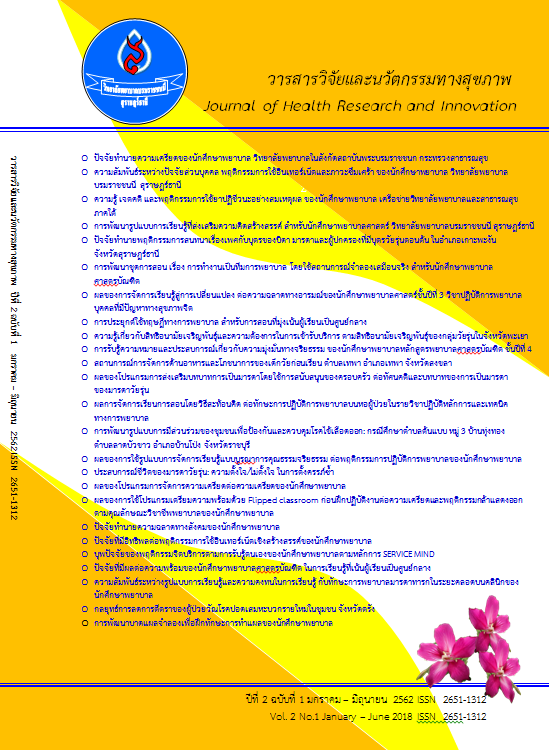
การพัฒนารูปแบบการเรียนรู้ที่ส่งเสริมความคิดสร้างสรรค์ สำหรับนักศึกษาพยาบาลศาสตร์ วิทยาลัยพยาบาลบรมราชชนนี สุราษฎร์ธานี
คำสำคัญ:
ทักษะความคิดสร้างสรรค์, นักศึกษาพยาบาล, รูปแบบการเรียนรู้ที่ส่งเสริมความคิดสร้างสรรค์บทคัดย่อ
งานวิจัยนี้มีวัตถุประสงค์เพื่อพัฒนารูปแบบการเรียนรู้ที่ส่งเสริมความคิดสร้างสรรค์ สำหรับนักศึกษาพยาบาลศาสตร์ วิทยาลัยพยาบาลบรมราชชนนี สุราษฎร์ธานี กลุ่มตัวอย่างคือ นักศึกษาพยาบาลศาสตรบัณฑิต ที่ศึกษาในปีการศึกษา 2560 จำนวน 30 คน คัดเลือกกลุ่มตัวอย่างโดยใช้วิธีการสุ่มอย่างง่าย มีการดำเนินการ 3 ขั้นตอน คือ 1) การร่างรูปแบบ 2) การตรวจสอบร่างรูปแบบ และ 3) การปรับปรุงรูปแบบ สถิติที่ใช้วิเคราะห์ข้อมูล ได้แก่ ค่าเฉลี่ย ค่าส่วนเบี่ยงเบนมาตรฐาน ร้อยละ และสถิติทดสอบที
ผลการวิจัยพบว่า รูปแบบการเรียนรู้ที่ส่งเสริมความคิดสร้างสรรค์ ประกอบด้วย 5 ขั้นตอน ได้แก่ 1) ขั้นกระตุ้นความสนใจ 2) ขั้นตั้งปัญหาและแบ่งกลุ่มตามความสนใจ 3) ขั้นค้นคว้าและคิด 4) ขั้นนำเสนอ และ 5) ขั้นประเมินผล ทักษะความคิดสร้างสรรค์ ประกอบด้วย 3 ด้าน ได้แก่ 1) การคิดคล่องแคล่ว 2) การคิดยืดหยุ่น และ 3) การคิดริเริ่ม โดยหลังทดลองใช้รูปแบบแบบกลุ่มเดียววัดก่อนและหลัง กลุ่มตัวอย่างมีค่าเฉลี่ยทักษะความคิดสร้างสรรค์รายด้านทุกด้านสูงกว่าก่อนการทดลองอย่างมีนัยสำคัญที่ระดับ .01 และมีความพึงพอใจต่อรูปแบบในระดับมาก ผลการประเมินประสิทธิภาพของรูปแบบ พบว่า รูปแบบมีประสิทธิภาพเป็นไปตามเกณฑ์ที่กำหนดคือ E1/E2 เท่ากับ 81.34/82.57 หลังการทดลองผู้วิจัยได้ปรับปรุงรูปแบบ ได้แก่ แผนการสอน เนื้อหาที่มีความทันสมัย และระยะเวลา เพื่อให้เหมาะสมกับการจัดการเรียนการสอน และมีการดำเนินการตามรูปแบบครบ 5 ขั้นตอน ต่อไป
เอกสารอ้างอิง
Claxton, Guy and Lucas, Bill. (2004). Be Creative: Essential Steps to Revitalize Your Work and Life. London: BBC Books.
River, C., (1980). Becoming a More Creative Person. Englewood Cliffs, New Jersey: Prentice-Hell.
Buachai, C., (2014). Academic articles: Application of Dr. Edward de Bono's ideas for the design of publications that are of interest. Veridian E-Journal, 7(1), January-April 2014, Human Science Edition Social Sciences and Arts. Searched on 5 March 2017, from http://www.ejournal.su.ac.th/upload/854.pdf (in Thai)
Promwong C. (2013). Media performance testing or instruction set. Silpakorn Journal of Research Studies, Year 5, Issue 1, January-June. (in Thai)
Guilford, J.P. (1967). The Nature of Human Intelligence. McGraw-Hill, Book Company.
Prasertsi P., Viriyanon R., and Khruahong T. (2015). The construction of a ring body training kit for the development of creative thinking in the work of jewelry jewelry. 2. Journal of Industrial Education King Mongkut's North Bangkok. Year 6, Issue 1 January - June. (in Thai)
Chantra R., and Sarakshetrin A. (2017). Learning Skills in 21st Century of Nursing Students at Boromarajonani College of Nursing, Suratthani. The Southern College Network Journal of Nursing and Public Health Volume 4, Issue 1 January – April. (in Thai)
Asavaphum S. (2015). Creativity and learning management that promotes creativity. Journal of Educational Administration Bua Bundit Ubon Ratchathani Rajabhat University. 15th year, special edition (October-December). (in Thai)
Phanwiang S. (2007). Development of art teaching activities according to the multi-touch concept. To promote creativity And the ability to paint and paint Prathom Suksa 3. Thesis - Master of Education. Sakon Nakhon Rajabhat University.(in Thai)
Serirat S., Sitanon P., Hirankitti S. (1995). Administrative terms. Bangkok: Development. (in thai)
Puphahong S. (2014). Development of creative thinking activities using the concept of Torrance through the art of ASEAN culture. For students in grade 5. Master of Education degree. In Curriculum and Instruction. Naresuan University. (in Thai)
Radakan S. (2012).Creativity for value management. Type 1. Bangkok: Kasetsart University Press. (in Thai)
Panich W.(2012). Way to create learning for students in the 21st century. Bangkok: Sodsri-Saritwong Foundation. (in Thai)
Rachaipanich W. (2013). Creative base learning. Searched on 1 December 2015, From http://www.jsfutureclassroom.com/cbl.html (in Thai)
ดาวน์โหลด
เผยแพร่แล้ว
รูปแบบการอ้างอิง
ฉบับ
ประเภทบทความ
สัญญาอนุญาต
บทความที่ได้รับการตีพิมพ์เป็นลิขสิทธิ์ของวารสารวิทยาลัยพยาบาลบรมราชชนนี สุราษฎร์ธานี
ข้อความที่ปรากฏในบทความแต่ละเรื่องในวารสารวิชาการนี้เป็นความคิดเห็นส่วนตัวของผู้เขียนแต่ละท่านไม่เกี่ยวข้องกับวิทยาลัยพยาบาลบรมราชชนนี สุราษฎร์ธานี และคณาจารย์ท่านอื่นๆในวิทยาลัยฯ แต่อย่างใด ความรับผิดชอบองค์ประกอบทั้งหมดของบทความแต่ละเรื่องเป็นของผู้เขียนแต่ละท่าน หากมีความผิดพลาดใดๆ ผู้เขียนแต่ละท่านจะรับผิดชอบบทความของตนเองแต่ผู้เดียว