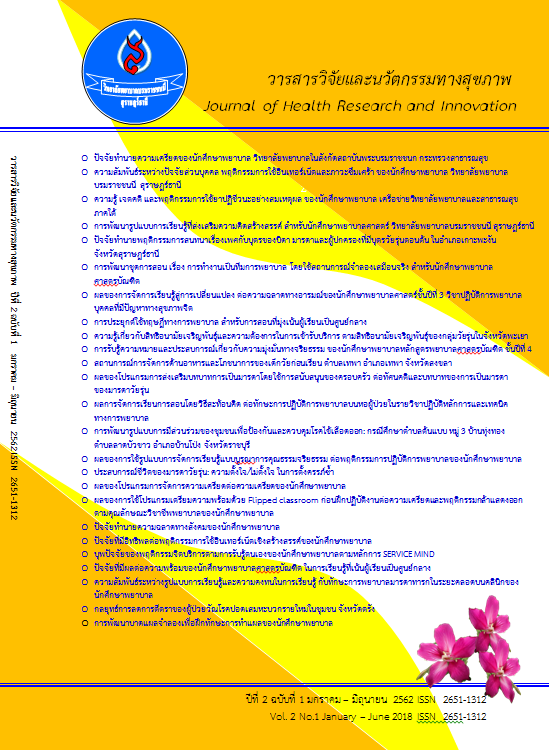
Factors Influencing creative internet use of nursing students
Keywords:
technology skill, attitude, Creative internet use, nursing studentsAbstract
The purposes of this descriptive research were 1) to study the creative internet use among nursing students and 2) to study the influencing factors of creative internet use among nursing students. 252 samples were the first and second year nursing students who were selected by purposive sampling. Data were collected using questionnaires and analyzed using descriptive statistics and multiple regression analysis.
The study found that most participants were female (94%) and in Gen Z (89.3%). The purposes of using internet were to connect to other people through Facebook, Instagram and Twitter (46.4%) and for recreation (39.3%). According to their attitude, they were positively agree with the use of internet (Mean=3.22, SD =0.41). Participants had technology skills (Mean=3.22, SD =0.41) and creative internet-use behaviors (Mean=3.19, SD =0.36) in high and moderate level respectively. Inflecting factors for the creative internet use were attitude (β=0.21, p=0.01) and technology skills (β=0.29, p=<0.01).
Inclusion, attitude and technology skills were influential on the creative internet use. As a result, academic institute should promote positive attitude in internet use among nursing students and improve their technology skills in order to promote their creative internet use. So, they will be benefit for the use of the internet in their study and their everyday life.
References
Brown, J. (2006). Socialites and word-of-mouth referral behavior. Journal of Consumer Research, 14 (December), 350-362
Chaveesuk, S. & Wong jaturapat, S. (2012). Unified Theory of acceptance and use of technology. KMITL Information Technology Journal. Retrieved May 3, 2019 from file:///C:/Users/ASUS/Downloads/2-29-1-PB.pdf 74 (in Thai)
Sarawanawong, C., (2017). Social media use behavior of undergraduate students Kasetsart University. Journal of Science. Prof. Wor. 10 (2): 16–31 (in Thai)
Bang Tha Mai, E., (2017). Development of teaching and learning activities on social networks online for Promote the use of creative internet for tertiary students. University Journal Fine Arts. 37 (1): 93-118, 256 (in Thai)
Kivunja, C., (2015). The effective of social media technologies in academia: A pedagogical bliss of digital fad. International. Journal of Higher Education, 4(4), 33-44.
Murthy, D. (2013). Twitter: Social communication in the twitter age. Cambridge, UK: Polity Press.
Wongananton, P., (2014). Internet use behavior of children and youth. Nursing Journal The Salvation Army, 15 (2) 173-178. (in Thai)
Pengjaroen, S., Vutmetee, Y., & Ritmontri, S., (2016). Factors affecting attitude on using social network of senior students at Kastsart, Bangkhen University. Vajira Nursing Journal, 18(2),63-74 (in Thai)
Phichayawee Faculty of Medicine. (2011). Attitude study Utilization and satisfaction of communication through Social network Case study: Students and staff of Chalermkarnchana College, Phetchabun Province. (Independent study, Master of Science, Business University). (in Thai)
Sarawanawong, J., Fyeted, K., Ngernpoolsap, D. & Chantrdee, W. (2017). Online Social Media Usage Behaviors of Undergraduate Student, Kasetsart University. Journal of Library and Information Science Srinakharinwirot University, 10(2), 16-31. (in Thai)
Thongmoon, T., & Vichitthammarot, P., (2017). Study of factors affecting acceptance and use Social network in Thai society. Journal of social communication innovation, 5 (2), 114-124. (in Thai)
Tapscott, D. (2008) .Growth up digital: How the net Generation is Changing Your World. McGraw-Hill.
Thailand Zocial Awards. (2018). 5 key point from Thailand Zocial Awards 2018 that a content creator need to know. Retrieved May 3, 2019 from https://www.rainmaker.in.th/thailand-zocial-awards-2018-for-content-editor/
Downloads
Published
How to Cite
Issue
Section
License
Published articles are copyrighted by the Journal of Boromarajonani College of Nursing, Suratthani.
The content appearing in each article in this academic journal represents the personal opinions of the respective authors and is not affiliated with Boromarajonani College of Nursing, Suratthani, or any other faculty members of the institution. Each author bears full responsibility for all components of their respective article. In the event of any errors, each author shall be solely responsible for their own article.