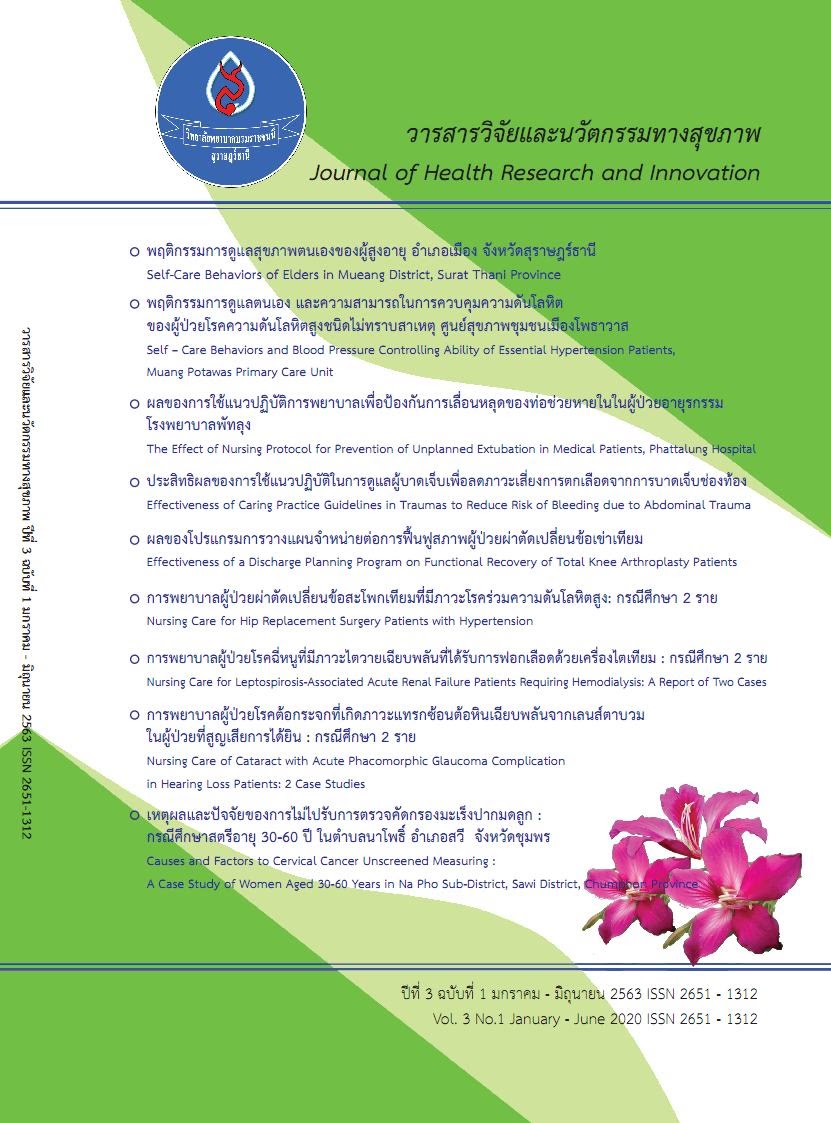
Self – Care Behaviors and Blood Pressure Controlling Ability of Essential Hypertension Patients, Muang Potawas Primary Care Unit
Keywords:
Hypertension, Self – Care Behavior, Blood Pressure ControllingAbstract
This crossectional research was aimed to study the knowledge of hypertension, self – care behaviors, blood pressure controlling ability, and study the related to blood pressure controlling ability of hypertension patients, to refer from hospital/ treatment at Wat Photharwas Primary Care Unit, 194 hypertension patients were selected by simple random sampling. Data was collected by questionnaires and medical records, then analyzed by descriptive statistics and Chi-square test. The results were as followings.
64.9% of hypertension patients had good level of hypertension knowledge, followed by medium level and low level at 25.8 and 9.3%, respectively. They had medium level of self – care behaviors at 49.5% followed by good level and low level at 47.4 and 3.1%, respectively. 37.6% of them could control blood pressure. Self – care behaviors were significantly associated with blood pressure controlling ability (P-value < 0.05), but hypertension knowledge and received social support were not associated with blood pressure controlling ability. Hypertension patients had complications at 4.6%, which were kidney disease, heart disease and paresis at 3.6%, 0.5% and 0.5%, respectively.
According to the results, should promote to modify self-care behaviors of hypertension patients, In order to be able to control more blood pressure.
References
Chitiwong, S., (2017). Self – care Behaviors and Hypertension Controlling Ability of Hypertension Patients, Napalai Hospital. Research report. (in Thai)
Chumi, P. 2020. Chronic non-communicable disease situations. (Online) 2020. [Retrieved May 19, 2020] Available URL http://110.164.147.155/kmhealth_new/Documment/blood/ knowlage/17.pdf
Cohen, S. & Will, T. A. (1995). Stress, Social Support and the Buffering Hypothesis. Psychological Bulletin. 98(2) 310-357.
Eakplakorn. W., et al. (2016). Report of the 5th thai health survey by physical exam 2014. Health Systems Research Institute. Nonthaburi: Graphic and design font publishe. (in Thai)
Jitdumrong, s., Plangsanor, s., & Chankhong, s., (2012). Hypertension controlling ability and self – care behavior s of patients who could and could not control blood pressure, Lumthamenchai Hospital, Nakhonratchasima Province. Research report. (in Thai)
Joint National Committee (JNC). The seventh report of the Joint National Committee on prevention, detection, evaluation, and treatment high blood pressure: National high blood pressure education program. (Online) (2017). [Retrieved March 13, 2020] Available URL: http///www.nhbl.nih.gov/ guidelines/ hypertension/ Express.pdf.
Kaplan, N. M. (2002). Kaplan’s clinical hypertension. (8th ed.). Philadelphia: Lippincott Williams & Wilkins.
Lawence, J. A., Catherin, M. C., & David, W. H. (2013). Effects of comprehensive lifestyle modification on blood pressure control. Journal of the American Medical Association. 289(16), 2083.
Muang Potawas Primary Care Unit. (2019). Hypertension patient report. Suratthani: Muang Potawas Primary Care Unit. (in Thai)
Nutaro, A. & Dangdomyut. P. (2013). Relaxation: Concepts and Practices. The Journal of Psychiatric Nursing and Mental Health, 17(1), 1-12. (in Thai)
Sueto. N., Jirapongsuwan. A., Rawiworrakul. R., & Tipayamongkholgul. M. (2019). The effect of a program to promote blood pressure control among 35 to 59 - years-old patients with uncontrolled hypertension. Journal of Public Health Nursing, 32(2), 96-114. (in Thai)
Sueto. N., Jirapongsuwan. A., Rawiworrakul. R., & Tipayamongkholgul. M. (2019). The effect of a program to promote blood pressure control among 35 to 59 - years-old patients with uncontrolled hypertension. Journal of Public Health Nursing, 32(2), 96-114. (in Thai)
Yamane, T. (1967) Statistics: An Introductory Analysis. London : John Weather Hill,Inc.
Downloads
Published
How to Cite
Issue
Section
License
Published articles are copyrighted by the Journal of Boromarajonani College of Nursing, Suratthani.
The content appearing in each article in this academic journal represents the personal opinions of the respective authors and is not affiliated with Boromarajonani College of Nursing, Suratthani, or any other faculty members of the institution. Each author bears full responsibility for all components of their respective article. In the event of any errors, each author shall be solely responsible for their own article.