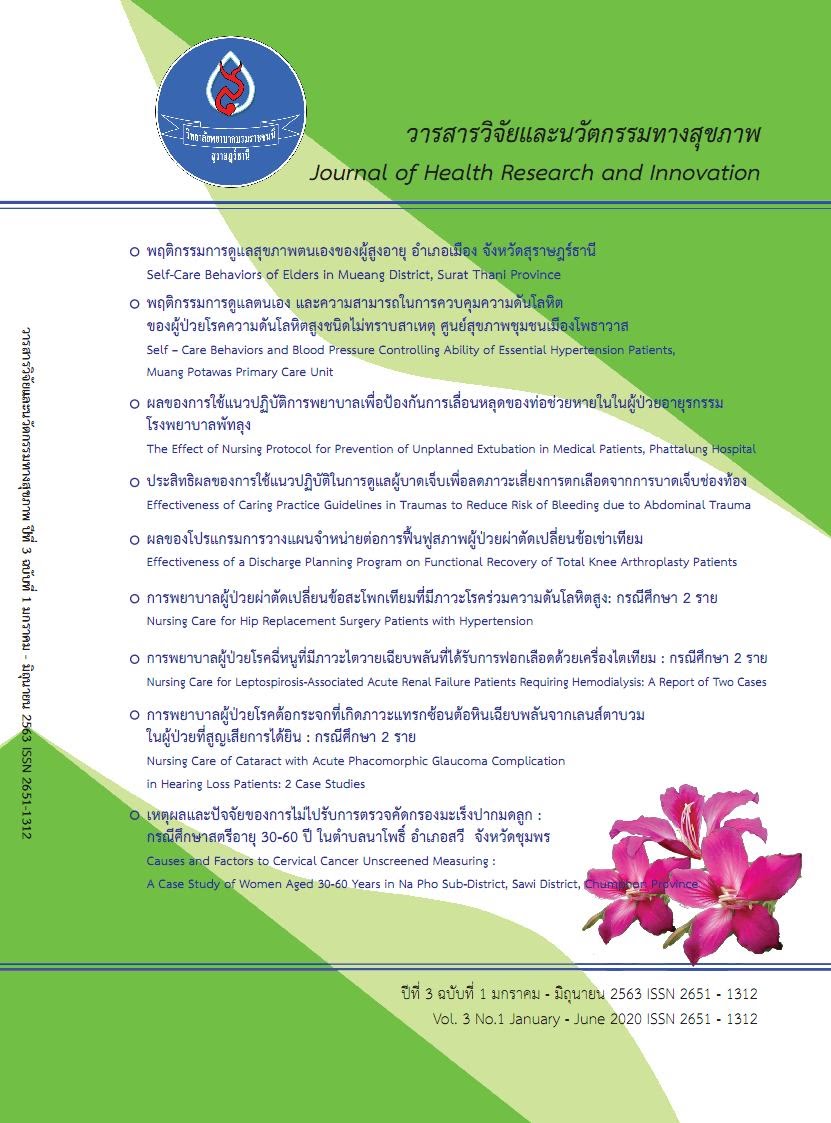
ผลของโปรแกรมการวางแผนจาหน่ายต่อการฟื้นฟูสภาพผู้ป่วยผ่าตัดเปลี่ยนข้อเข่าเทียม
คำสำคัญ:
ผ่าตัดเปลี่ยนข้อเข่าเทียม, การฟื้นฟูสภาพ, โปรแกรมการวางแผนจำหน่ายบทคัดย่อ
การศึกษาครั้งนี้เป็นการวิจัยกึ่งทดลองเพื่อศึกษาผลของโปรแกรมการวางแผนจาหน่าย ต่อการฟื้นฟูสภาพผู้ป่วยผ่าตัดเปลี่ยนข้อเข่าเทียม คัดเลือกกลุ่มตัวอย่างแบบเฉพาะเจาะจงโดยเป็นผู้ป่วยที่เข้ารับการผ่าตัดเปลี่ยนข้อเข่าเทียม จำนวน 40 ราย ในโรงพยาบาลศูนย์สุราษฎร์ธานี แบ่งเป็นกลุ่มที่ได้รับโปรแกรมการวางแผนจำหน่าย จำนวน 20 คน และกลุ่มที่ได้รับการพยาบาลตามปกติ จำนวน 20 คน เครื่องมือที่ใช้ในการวิจัย ได้แก่ โปรแกรมการวางแผนจำหน่ายผู้ป่วยผ่าตัดเปลี่ยน ข้อเข่าเทียม การหาคุณภาพของเครื่องมือ (CVI) เท่ากับ 1.00 เก็บรวบรวมข้อมูลโดยใช้แบบสอบถาม แบบประเมินความปวดและแบบประเมินการฟื้นฟูสภาพ การหาค่าความเชื่อมั่นของเครื่องมือ เท่ากับ .97 วิเคราะห์ข้อมูลโดยใช้สถิติพรรณนา และเปรียบเทียบข้อมูลระหว่างกลุ่มทดลองและกลุ่มควบคุม ใช้สถิติทีอิสระและเปรียบเทียบข้อมูลภายในกลุ่มทดลองระหว่างก่อนและหลังทดลองด้วยสถิติทีคู่
ผลการวิจัย: พบว่า กลุ่มที่ได้รับโปรแกรมการวางแผนจำหน่ายมีค่าคะแนนเฉลี่ยในการฟื้นฟูสภาพมากกว่ากลุ่มที่ได้รับการพยาบาลตามปกติอย่างมีนัยสำคัญทางสถิติที่ระดับ .001 (t = -7.525, p<.001) และค่าคะแนนเฉลี่ยการฟื้นฟูสภาพหลังได้รับโปรแกรมมากกว่าก่อนได้รับโปรแกรมอย่างมีนัยสำคัญทางสถิติที่ระดับ .001 (t=24.15, p<.001) ความปวดหลังผ่าตัดเปลี่ยนข้อเข่าเทียมมีความแตกต่างกันอย่างมีนัยสำคัญทางสถิติที่ระดับ .001 (t=-3.15, p<.001) โดยพบว่ากลุ่มที่ได้รับโปรแกรม การวางแผนจำหน่าย มีค่าคะแนนเฉลี่ยของความปวดน้อยกว่ากลุ่มที่ได้รับการพยาบาลตามปกติ โดยพบว่ากลุ่มที่ได้รับโปรแกรมการวางแผนจาหน่าย มีค่าคะแนนเฉลี่ยของระยะเวลาการนอนโรงพยาบาลน้อยกว่ากลุ่มที่ได้รับการพยาบาลตามปกติ (t=-2.87, p<.001)
ข้อเสนอแนะ: พยาบาลสามารถนำโปรแกรมการวางแผนจำหน่ายสาหรับผู้ป่วยผ่าตัดเปลี่ยน ข้อเข่าเทียม ไปประยุกต์ใช้ในการดูแลผู้ป่วยที่ได้รับการผ่าตัดกระดูกและข้อกลุ่มอื่นๆต่อไป
เอกสารอ้างอิง
Arnold, J. B., Walters, J. L., & Ferrar, K. E. (2016). Does Physical Activity Increase After Total Hip or Knee Arthroplasty for Osteoarthritis? A Systematic Review. J Orthop Sports Phys Ther, 46(6), 431-442. doi:10.2519/jospt.2016.6449
Baloch, N., Zubairi, A. J., Rashid, R. H., Hashmi, P. M., & Lakdawala, R. H. (2015). Effect of continuous passive motion on knee flexion range of motion after total knee arthroplasty. J Pak Med Assoc, 65(11 Suppl 3), S32-34.
Bauer, M., Fitzgerald, L., Haesler, E., & Manfrin, M. (2009). Hospital discharge planning for frail older people and their family. Are we delivering best practice? A review of the evidence. J Clin Nurs, 18(18), 2539-2546. doi:10.1111/j.1365-2702.2008.02685.x
Baumann, C., Rat, A. C., Osnowycz, G., Mainard, D., Cuny, C., & Guillemin, F. (2009). Satisfaction with care after total hip or knee replacement predicts self-perceived health status after surgery. BMC Musculoskelet Disord, 10(1), 150. Do 10.1186/1471-2474-10-150
Brandes, M., & Rosenbaum, D. (2014). Letter to the editor: Do activity levels increase after total hip and knee arthroplasty? Clin Orthop Relat Res, 472(9), 2889-2890. doi:10.1007/ s11999-014-3742-3
Crotty, M., Whitehead, C. H., Gray, S., & Finucane, P. M. (2002). Early discharge and home rehabilitation after hip fracture achieves functional improvements: a randomized controlled trial. Clin Rehabil, 16(4), 406-413.
Dailiana, Z. H., Papakostidou, I., Varitimidis, S., Liaropoulos, L., Zintzaras, E., Karachalios, T., Malizos, K. N. (2015). Patient-reported quality of life after primary major joint arthroplasty: a prospective comparison of hip and knee arthroplasty. BMC Musculoskelet Disord, 16, 366. doi:10.1186/s12891-015-0814-9
De Luca, M. L., Ciccarello, M., Martorana, M., Infantino, D., Letizia Mauro, G., Bonarelli, S., & Benedetti, M. G. (2018). Pain monitoring and management in a rehabilitation setting after total joint replacement. Medicine, 97(40), e12484-e12484. doi:10.1097/MD. 0000000000012484
Eamchunprathip, S., Tnaarak, S., & Tepapal, T. (2017). Discharge Planning for Orthopedic Patients. Nursing Journal of the Ministry of Public Health, 27 (3), 9-18. (in Thai)
Feng, J. E., Novikov, D., Anoushiravani, A. A., & Schwarzkopf, R. (2018). Total knee arthroplasty: improving outcomes with a multidisciplinary approach. Journal of multidisciplinary healthcare, 11, 63-73. doi: 10.2147/JMDH.S140550
Fritz, J., Lurie, B., & Potter, H. G. (2015). MR Imaging of Knee Arthroplasty Implants. Radiographics : a review publication of the Radiological Society of North America, Inc, 35(5), 1483-1501. doi: 10.1148/rg.2015140216
Konopka, J. F., Lee, Y.-Y., Su, E. P., & McLawhorn, A. S. (2018). Quality-Adjusted Life Years After Hip and Knee Arthroplasty: Health-Related Quality of Life After 12,782 Joint Replacements. JB & JS open access, 3(3), e0007-e0007. doi: 10.2106/JBJS.OA.18.00007
Korean Knee Society. (2012). Guidelines for the management of postoperative pain after total knee arthroplasty. Knee Surg Relat Res. 24 (4), 201-7. Retrieved from PubMed PMCID: PMC3526756.
Lausawatchaikul, P., Chatriyanuyok, B. (2011). Outcomes of Using Evidence-Based Clinical Nursing Practice Guideline for Patients with Hip Arthroplasty: A Retrospective Comparative Study. Rama Nurs J, 17, 20-35. (in Thai)
Orem DE. (2001). Nursing concept of practice. 6th ed. St. Louis.
Painupong, I., Sae-Sia, W., & Kupantawee, N. (2015). Pain Management Programme and Self-Empowerment Exercise Activity: Their Impact on Elderly Total Knee Arthroplasty Patients’ Recovery. Thai Journal of Nursing Council, 30(1), 99-111. (in Thai)
Rattanaporn Saelim, R., Vongwisanupong, N., & Triprakong, S. (2014). Effectiveness of a Discharge Planning Programme on Self-Care Knowledge and Bahaviour of Peripheral Arterial Occlusion Patients at Songkhla Nakharin Hospital. Thai Journal of Nursing Council, 29(2), 101-113. (in Thai)
Rodríguez-Merchán, E. C. (2019). Total knee arthroplasty using hinge joints: Indications and results. EFORT open reviews, 4(4), 121-132. doi: 10.1302/2058-5241.4.180056
Suratthani Hospital. Nursing Service. (2019). Total Knee Arthroplasty statistics 2560-2562. Suratthani : Hospital.
Saelim, R., Vongwisanupong, N., & Triprakong, S. (2014). Effectiveness of a Discharge Planning Programme on Self-Care Knowledge and Behavior of Peripheral Arterial Occlusion Patients at Songkhla Nakharin Hospital. Thai Juornal of Nursing Council, 29(2), 101-113. (in Thai)
Tungtrongjit, Y., Weingkum, P., & Saunkool, P. (2012). The effect of preoperative quadriceps exercise on functional outcome after total knee arthroplasty. J Med Assoc Thai. 95(10), 58-66. (in Thai)
National Health Security Office. (2018). National Health Security Office Board. Clinical practice of knee surgery. Searched 26 June 2561, From https://www.nhso. go.th/frontend/NewsInformationDetail. Aspx ?newsid=MjA0OQ
ดาวน์โหลด
เผยแพร่แล้ว
รูปแบบการอ้างอิง
ฉบับ
ประเภทบทความ
สัญญาอนุญาต
บทความที่ได้รับการตีพิมพ์เป็นลิขสิทธิ์ของวารสารวิทยาลัยพยาบาลบรมราชชนนี สุราษฎร์ธานี
ข้อความที่ปรากฏในบทความแต่ละเรื่องในวารสารวิชาการนี้เป็นความคิดเห็นส่วนตัวของผู้เขียนแต่ละท่านไม่เกี่ยวข้องกับวิทยาลัยพยาบาลบรมราชชนนี สุราษฎร์ธานี และคณาจารย์ท่านอื่นๆในวิทยาลัยฯ แต่อย่างใด ความรับผิดชอบองค์ประกอบทั้งหมดของบทความแต่ละเรื่องเป็นของผู้เขียนแต่ละท่าน หากมีความผิดพลาดใดๆ ผู้เขียนแต่ละท่านจะรับผิดชอบบทความของตนเองแต่ผู้เดียว