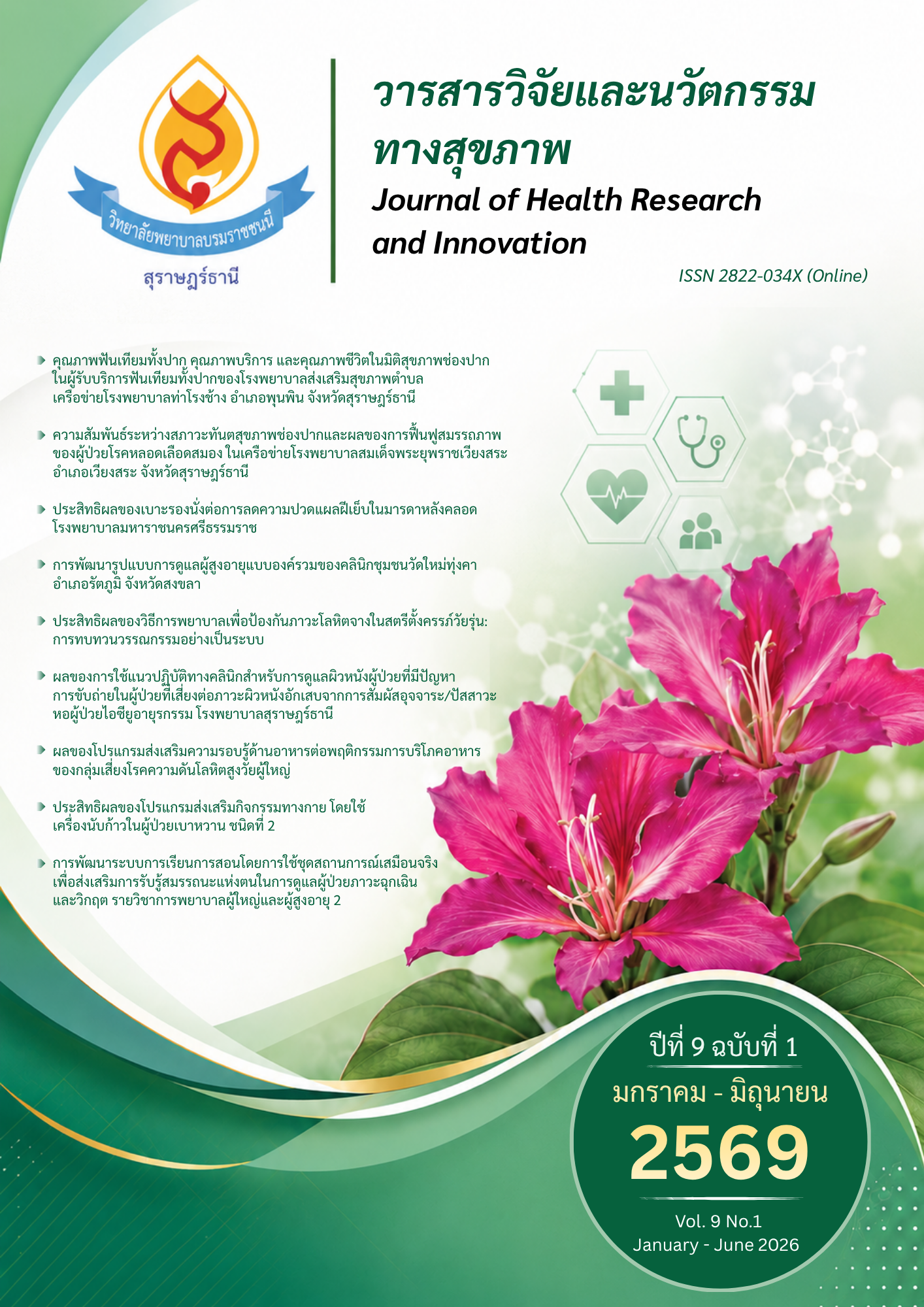
Development of Simulation-Based Education to Enhance Nursing Students' Self-Efficacy in Emergency and Critical Care for the Adult and Elderly Nursing II Course
Keywords:
Simulation-based education, Nursing education, Self-efficacy, Clinical decision-making, Emergency and critical care nursingAbstract
This quasi-experimental study aimed to compare nursing students’ knowledge and perceived self-efficacy in emergency and critical care nursing before and after participation in a simulation-based instructional program and to evaluate their satisfaction with the program. The sample consisted of 57 third-year nursing students at the Faculty of Nursing, Thaksin University, enrolled in the Adult and Elderly Nursing II course during the 2024 academic year. Participants were selected through purposive sampling.
The intervention comprised 10 simulation scenarios implemented using a high-fidelity patient simulator. Data were collected using a knowledge test on emergency and critical care nursing practice, a perceived self-efficacy questionnaire, and a satisfaction evaluation form. All instruments were validated by three experts and demonstrated reliability coefficients ranging from .88 to .96. Data were analyzed using descriptive statistics and paired t-tests.
The results showed that, following participation in the program, students’ mean scores for knowledge and perceived self-efficacy in emergency and critical care nursing were significantly higher than those before the intervention (p < .001). In addition, overall satisfaction with the program was at the highest level (Mean=109.20, SD.=6.86).
These findings indicate that simulation-based instruction using a series of scenarios and a high-fidelity patient simulator effectively enhances nursing students’ knowledge and perceived self-efficacy. Nursing education institutions may adopt this approach to strengthen pre-clinical preparation and improve students’ clinical competencies.
References
Bandura, A. (1997). Self-efficacy: The exercise of control. W. H. Freeman.
Foronda, C. L., Fernandez-Burgos, M., Nadeau, C., Kelley, C. N., & Henry, M. N. (2020). Virtual simulation in nursing education: A systematic review spanning 1996 to 2018. Simulation in Healthcare, 15(1), 46–54. https://doi.org/10.1097/SIH.0000000000000411
Jeffries, P. R. (2021). The NLN Jeffries simulation theory (2nd ed.). Wolters Kluwer.
Kim, I. (2024). The effects of simulation-based practical education on nursing students' self-efficacy, performance confidence, and educational satisfaction. Physical Therapy Rehabilitation Science, 13(1), 18–25. https://doi.org/10.14474/ptrs.2024.13.1.18
Kumkong, M., Leejareon, P., Aramrom, Y., & Jitviboon, A. (2016). Effects of simulation-based learning on perceived self-efficacy in providing nursing care for advanced life support to patients with critical illness or emergency condition among nursing students. The Southern College Network Journal of Nursing and Public Health, 3(3), 52–64. (in Thai)
Masoumian Hosseini, T., Ahmady, S., & Edelbring, S. (2022). Teaching clinical decision-making skills to undergraduate nursing students via web-based virtual patients during the COVID-19 pandemic: A new approach to the CyberPatient™ simulator. Journal of Contemporary Medical Sciences, 8(1), 31–37.
Mohamed, S. A., & Fashafsheh, I. H. (2019). The effect of simulation-based training on nursing students' communication skills, self-efficacy and clinical competence for nursing practice. Open Journal of Nursing, 9(8), 855–869. https://doi.org/10.4236/ojn.2019.98064
Ngamman, S., Rinrit, P., & Kaboon, P. (2021). The development of teacher skills in the 21st century and the integration of innovation. MCU Buddhasothorn Review Journal, 1(2), 79–93. (in Thai)
Shin, S., Park, J. H., & Kim, J. H. (2021). Effectiveness of patient simulation in nursing education: A meta-analysis. Nurse Education Today, 99, 104809. https://doi.org/10.1016/j.nedt.2021.104809
Srichanphan, W., Tathan, S., & Fuekfun, K. (2021). Effects of simulation-based learning on perceived self-efficacy of nursing students in caring for patients with septic shock. Journal of the Royal Thai Army Nurses, 22(1), 283–293. (in Thai)
Tiffany, J. M., & Hoglund, B. A. (2016). Using virtual simulation to teach inclusivity: A case study. Clinical Simulation in Nursing, 12(4), 115–122. https://doi.org/10.1016/j.ecns.2015.12.003
Wiwatkamonchai, A., Tormduangkaew, P., Yossurin, P., & Sitthisongkram, S. (2024). Effects of pre-practice preparation using simulation-based learning on the self-confidence in knowledge, practical skills, and attitudes of second year nursing students. Journal of Nursing and Public Health Research, 4(3), 1–18. (in Thai)
Wong, M. F. F., & Dhaliwal, J. J. K. (2025). High-fidelity simulation and virtual technology in nursing: Stand-alone or combined approaches? A systematic review. Nurse Educator. Advance online publication. https://doi.org/10.1097/NNE.0000000000001968
Downloads
Published
How to Cite
Issue
Section
License
Copyright (c) 2026 Boromarajonani College of Nursing, Suratthani

This work is licensed under a Creative Commons Attribution-NonCommercial-NoDerivatives 4.0 International License.
Published articles are copyrighted by the Journal of Boromarajonani College of Nursing, Suratthani.
The content appearing in each article in this academic journal represents the personal opinions of the respective authors and is not affiliated with Boromarajonani College of Nursing, Suratthani, or any other faculty members of the institution. Each author bears full responsibility for all components of their respective article. In the event of any errors, each author shall be solely responsible for their own article.