The Implementation of a Community-Based Elderly Health Care Model through Network Participation
Keywords:
Elderly Care, Community Network Participation, Older adultsAbstract
This action research aimed to apply a community-based elderly healthcare model through participatory collaboration with local networks. The participants were purposively selected and divided into two groups: 1) the network group, consisting of 176 individuals including village health volunteers, community leaders, pre-elderly individuals, and elderly persons; and 2) a group of 108 elderly individuals who implemented the model. Research instruments included the community-based elderly healthcare model, an elderly health assessment form, and a semi-structured open-ended questionnaire. Qualitative data were analyzed through content analysis and categorization, while quantitative data were analyzed using descriptive statistics.
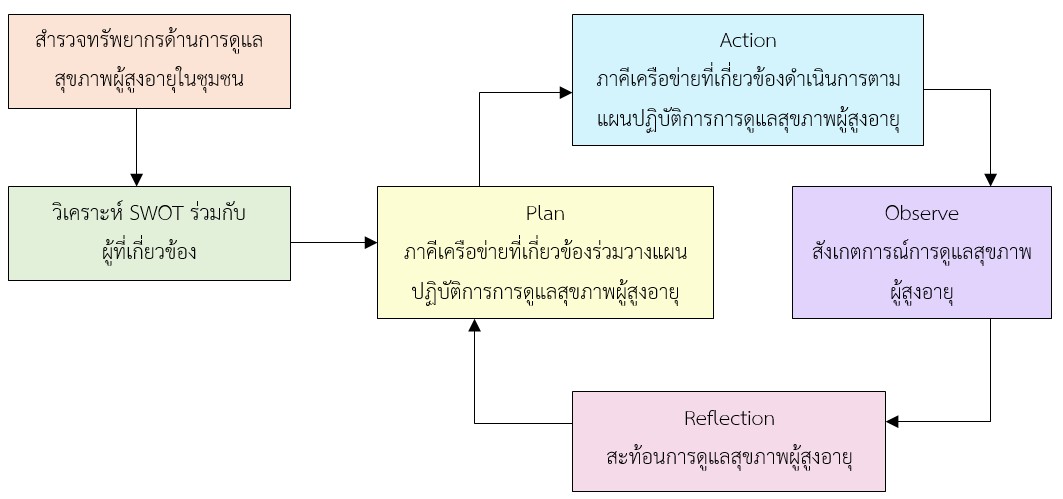
The research found that the top three health problems among older adults were hypertension, diabetes, and osteoarthritis. Only 50.85% engaged in regular exercise, and just 38.35% participated in elderly club activities. The community-based elderly healthcare model, implemented through network collaboration, included three main components: 1) establishment of elderly clubs, 2) health education based on community-specific issues—organized by the club committee and covering topics such as cognitive stimulation, depression prevention, and monthly recreational activities, and 3) promotion of social engagement, home visits for dependent elderly, basic health screening, and tailored health education. Four additional activity groups were implemented: exercise, organic gardening, religious practices, and volunteer work. The outcomes showed improved overall health among the elderly, a reduction in complications of underlying diseases, an increase in the percentage of those with normal cognitive function from 83.33% to 91.67%, and a decrease in depression rates from 16.67% to 12.04%. These findings suggest that the model serves as an effective approach for promoting elderly health through participatory and targeted community-based activities.
References
กรมการแพทย์ กระทรวงสาธารณสุข โดยสถาบันเวชศาสตร์สมเด็จพระสังฆราชญาณสังวรเพื่อผู้สูงอายุ. (2564). คู่มือคัดกรองและประเมินสุขภาพผู้สูงอายุ พ.ศ. 2564 กระทรวงสาธารณสุข. สืบค้นเมื่อ 10 มกราคม 2565 จาก https://agingthai.dms.go.th/agingthai/wp-content/uploads/2021/02/book-2564-02_2.pdf.
กรมกิจการผู้สููงอายุุ. (2566). สถานการณ์ผู้สูงอายุุไทยุ พ.ศ. 2565. กรุงเทพฯ: บริษัท อัมรินทร์คอร์เปอเรชั่นส์ จำกัด มหาชน.
ณปภัช สัจนวกุล และคณะ. (2565). เอกสารสรุปการวิจัย (Research Brief) เรื่องการสูงวัยในถิ่นที่อยู่ข้อเสนอตัวแบบนโยบายจากบทเรียนต่างประเทศ. กรุงเทพฯ: มหาวิทยาลัยมหิดล สถาบันวิจัยประชากรและสังคม.
ศิริพร จิรวัฒน์กุล และคณะ. (2563). การจัดการความขัดแย้งในการทำงานร่วมกันของภาคีเครือข่ายในการดูแลผู้สูงอายุ: กรณีศึกษาจังหวัดขอนแก่น. วารสารวิจัยสาธารณสุขศาสตร์ มหาวิทยาลัยขอนแก่น, 13(2), 39-50.
สังวาล จ่างโพธิ์.(2564). การพัฒนารูปแบบการดูแลสุขภาพผู้สูงอายุโดยชุมชนมีส่วนร่วม ตำบลบ้านโพธิ์ อำเภอเมือง จังหวัดนครราชสีมา. วารสารวิจัยและพัฒนาด้านสุขภาพ, 7(2), 165-183.
สำนักงานกองทุนสนับสนุนการสร้างเสริมสุขภาพ. (2560). คู่มือการดูแลสุขภาพผู้สูงอายุแบบองค์รวม. กรุงเทพฯ: สำนักงานกองทุนสนับสนุนการสร้างเสริมสุขภาพ.
สำนักงานกองทุนสนับสนุนการสร้างเสริมสุขภาพ. (2562). โครงการสร้างเสริมสุขภาพผู้สูงอายุในชุมชน. สืบค้นเมื่อ 10 มกราคม 2565 จาก https://www.thaihealth.or.th.
สำนักงานสภาพัฒนาการเศรษฐกิจและสังคมแห่งชาติ. (2566). รายงานวิเคราะห์สถานการณ์ความยากจน และความเหลื่อมล้ำในประเทศไทย ปี 2565. กรุงเทพฯ: กองพัฒนาข้อมูลและตัวชี้วัดสังคม.
สุรีย์ บุญญานุพงศ์ และคณะ. (2562). การพัฒนารูปแบบการบูรณาการการดูแลผู้สูงอายุโดยชุมชนท้องถิ่น. วารสารวิจัยระบบสาธารณสุข, 13(3), 278-291.
สุวิมลรัตน์ รอบรู้เจน. (2560). การพัฒนารูปแบบการดูแลสุขภาพผู้สูงอายุ สำหรับผู้ดูแลผู้สูงอายุ อำเภอวารินชำราบ จังหวัดอุบลราชธานี. วารสารมหาวิทยาลัยนราธิวาสราชนครินทร์, 9(3), 57-69.
อารี พุ่มประไวทย์ และจรรยา เสียงเสนาะ. (2560). การมีส่วนร่วมของชุมชนในการพัฒนาพฤติกรรมการสร้างเสริมสุขภาพของผู้สูงอายุ. วารสารเครือข่ายวิทยาลัยพยาบาลและการสาธารณสุขภาคใต้, 4(3), 160-175.
Greenfield, E. A. (2016). Support from Neighbors and aging in place: Can NORC programs make a difference?. The Gerontologist, 56(4), 651-659. https://doi.org/10.1093/geront/gnu162
Kemmis, S., Mctaggart, R., & Nixon, R. (2014). The action research planner: Doing critical participatory action research. Singapore: Springer.
Kim, Y., Bae, S., Chang, H. H., & Kim, S. W. (2023). Long COVID prevalence and impact on quality of life 2 years after acute COVID-19. Scientific Reports, 13(1), 11207. https://doi.org/10.1038/s41598-023-36995-4
Stuck, A. E., Siu, A. L., Wieland, G. D., Adams, J., & Rubenstein, L. Z. (1993). Comprehensive geriatric assessment: A meta-analysis of controlled trials. Lancet (London, England), 342(8878), 1032-1036. https://doi.org/10.1016/0140-6736(93)92884-v
United Nations, Department of Economic and Social Affairs, Population Division. (2020). World Population Ageing 2019. New York: the United Nations.
Downloads
Published
How to Cite
Issue
Section
License
Copyright (c) 2025 Journal of Nursing and Public Health Research

This work is licensed under a Creative Commons Attribution-NonCommercial-NoDerivatives 4.0 International License.
1. บทความหรือข้อคิดเห็นใด ๆ ที่ปรากฏในวารสารวิจัยการพยาบาลและการสาธารณสุข ที่เป็นวรรณกรรมของผู้เขียน บรรณาธิการไม่จำเป็นต้องเห็นด้วย
2. บทความที่ได้รับการตีพิมพ์ถือเป็นลิขสิทธิ์ของ วารสารวิจัยการพยาบาลและการสาธารณสุข