Integrated Meta-Analysis: Global Strategies for Promoting Rational Drug Use and Driving Modern Health Policy
Keywords:
Rational Drug Use, Meta-Analysis, Promotional Measures, Effectiveness, Success FactorsAbstract
This meta-analysis aimed to assess the current global situation of rational drug use, analyze the effectiveness of various measures promoting rational drug use, and identify factors influencing the success or failure of these measures. The study included 147 relevant research articles published between 2020 and 2024, searched from PubMed, Cochrane Library, EMBASE, Web of Science, and Scopus databases using selection criteria focused on studies evaluating rational drug use promotion measures in various healthcare settings. The analysis employed meta-analysis and meta-regression techniques.
The results revealed differences in rational drug use rates across regions and country income levels, with high-income countries demonstrating higher rates compared to middle- and low-income countries. The most effective measure was the combined approach (Pooled Effect Size = 0.89, 95% CI: 0.82-0.96), followed by the use of decision support technologies (Pooled Effect Size = 0.81, 95% CI: 0.73-0.89). Factors contributing to success included intervention intensity, follow-up duration, stakeholder involvement, and integration with existing health systems. These findings highlight the need for developing context-specific approaches, particularly in low- and middle-income countries.
References
Berben, S. A., et al. (2012). Pain prevalence and pain relief in trauma patients in the accident & emergency department. Injury, 43(9), 1397-1402.
Bero, L. A., Carson, S., Moller, H., & Hill, S. (2021). To give is better than to receive: Compliance with WHO guidelines for drug donations during 2000-2020. Bulletin of the World Health Organization, 99(3), 201-209.
Borenstein, M., Hedges, L. V., Higgins, J. P. T., & Rothstein, H. R. (2021). Introduction to meta-analysis (3rd ed.). New York: John Wiley & Sons.
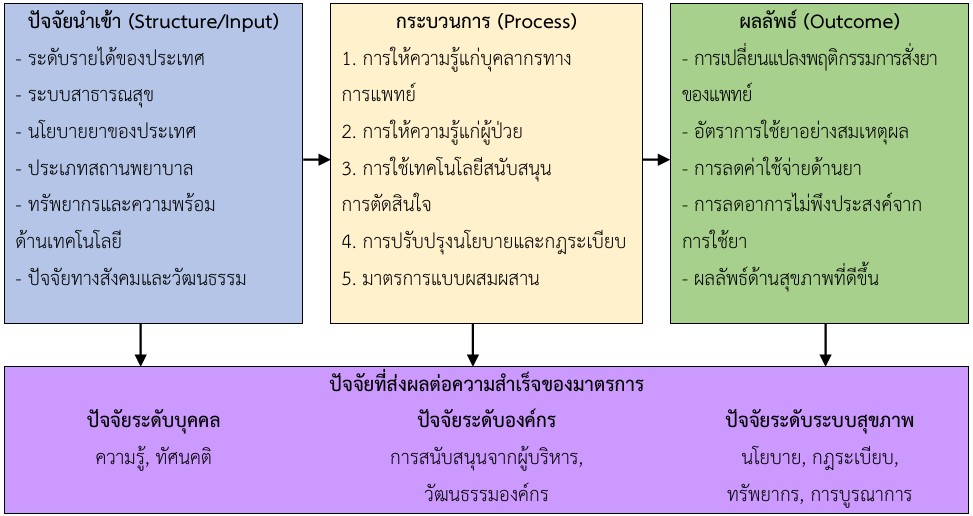
Donabedian, A. (2005). Evaluating the quality of medical care. The Milbank Quarterly, 83(4), 691-729. https://doi.org/10.1111/j.1468-0009.2005.00397.x
Fadare, J. O., Ogunleye, O., Enato, E., Godman, B., Gustafsson, L. L., & McColl, G. (2022). Challenges and opportunities to improve rational use of medicines in Africa. Frontiers in Pharmacology, 13, 978090. https://doi.org/10.1002/puh2.9
Holloway, K. A., Rosella, L., Livingstone, C., Angaran, D., Lung, T., & Spark, R. (2023). Identifying the most effective essential medicines policies for improving use of medicines in low and middle-income countries: A systematic review. PLoS One, 18(1), e0279889.
International Pharmaceutical Federation. (2023). FIP global pharmaceutical policy report. The Hague: FIP.
Laxminarayan, R., Duse, A., Wattal, C., Zaidi, A. K., Wertheim, H. F., & Sumpradit, N. (2023). The Lancet Commissions: One health for all-a roadmap to preventing and mitigating the emergence and spread of antimicrobial-resistant infectious agents. The Lancet, 401(10384), 1397-1456.
Maniadakis, N., Kourlaba, G., Shen, J., & Holtorf, A. (2023). Comprehensive review of pharmaceutical policy reforms and their impact on health systems. Health Policy, 127(2), 104-116.
Ministry of Public Health. (2022). National drug policy and rational use of medicines. Nonthaburi: Ministry of Public Health.
Monteiro, C. N., Gianini, R. J., Barros, M. B. D. A., Cesar, C. L. G., & Goldbaum, M. (2022). Access to medication in the public health system and equity: Populational health surveys in São Paulo, Brazil. Revista Brasileira de Epidemiologia, 19, e160231. https://doi.org/10.1590/1980-5497201600010003
Mossialos, E., Djordjevic, A., Osborn, R., & Sarnak, D. (2018). International profiles of health care systems. New York: Commonwealth Fund.
Ofori-Asenso, R., & Agyeman, A. A. (2020). Irrational use of medicines-A summary of key concepts. Pharmacy, 4(4), 35. https://doi.org/10.3390/pharmacy4040035
Pirmohamed, M., James, S., Meakin, S., Green, C., Scott, A. K., & Walley, T. J. (2022). Adverse drug reactions as cause of admission to hospital: Prospective analysis of 18,820 patients. The BMJ, 329(7456), 15-19. https://doi.org/10.1136/bmj.329.7456.15
Roque, F., Herdeiro, M. T., Soares, S., Teixeira Rodrigues, A., Breitenfeld, L., & Figueiras, A. (2021). Educational interventions to improve prescription and dispensing of antibiotics: A systematic review. BMC Public Health, 14, 1276. https://doi.org/10.1186/1471-2458-14-1276
Sketris, I. S., Langille Ingram, E., & Lummis, H. L. (2022). Strategic opportunities for effective optimal prescribing and medication management. Canadian Journal of Clinical Pharmacology, 16(1), e103-e125.
World Bank. (2023). World Bank Country and Lending Groups. Washington, D.C.: World Bank.
World Health Organization. (2021). World Health Organization model list of essential medicines: 22nd list. Geneva: World Health Organization.
World Health Organization. (2022). WHO essential medicines and health products. Geneva: World Health Organization.
World Health Organization. (2023). WHO regions. Geneva: World Health Organization.
Downloads
Published
How to Cite
Issue
Section
License
Copyright (c) 2025 Journal of Nursing and Public Health Research

This work is licensed under a Creative Commons Attribution-NonCommercial-NoDerivatives 4.0 International License.
1. บทความหรือข้อคิดเห็นใด ๆ ที่ปรากฏในวารสารวิจัยการพยาบาลและการสาธารณสุข ที่เป็นวรรณกรรมของผู้เขียน บรรณาธิการไม่จำเป็นต้องเห็นด้วย
2. บทความที่ได้รับการตีพิมพ์ถือเป็นลิขสิทธิ์ของ วารสารวิจัยการพยาบาลและการสาธารณสุข