
A Study of the Prevalence and Effects of Antidepressant Treatment in Patients with Opioid Use Disorder Undergoing Long-Term Methadone Maintenance Therapy
Keywords:
Prevalence, Depression, Antidepressants, Long-term Methadone Maintenance Therapy, Opioid Use DisorderAbstract
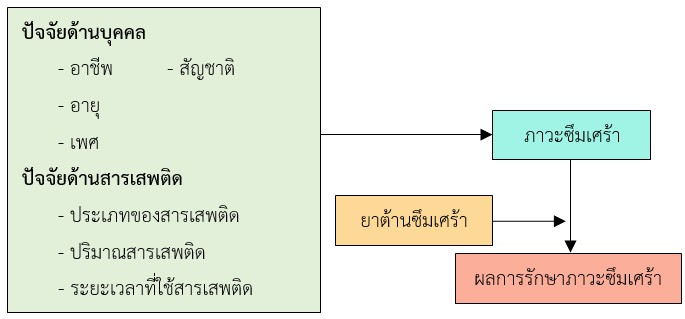
This retrospective cross-sectional analytical study aimed to investigate the prevalence of depression, the effects of antidepressant treatment, and to analyze the factors associated with depression among patients with opioid use disorder undergoing long-term methadone maintenance therapy. The study population included all patients receiving treatment for substance use disorder at the Long-Term Methadone Clinic, Mae Wang Hospital, Chiang Mai Province, between January 1, 2021 and May 31, 2024. Research instruments included the Patient Health Questionnaire-9 (PHQ-9) for assessing depression, a general demographic data form, a methadone treatment record form, a depression assessment form, and a record of antidepressant treatment. Data were analyzed using descriptive statistics and logistic regression to determine the association between patient-related factors and depression among individuals receiving methadone maintenance therapy for opioid use disorder.
The results showed that the majority of the participants were male (94.10%) with a mean age of 38.90 years. The most commonly used opioid was heroin (93.10%), followed by opium (6.90%). The prevalence of depression among patients with opioid use disorder undergoing long-term methadone maintenance therapy was 14.20%. Of those, 82.76% had mild depression, 13.79% had moderate depression, and 3.45% had severe depression. Treatment with antidepressant medications significantly reduced depression scores (p-value < 0.001), with the mean depression score decreasing from 10.69 (S.D. = 3.44) to 1.62 (S.D. = 3.54) after treatment. An analysis of factors associated with depression found no statistically significant associations with gender, age, nationality, occupation, type and amount of opioid used, duration of opioid use, or average daily methadone dosage (p-value > 0.05). These findings highlight the importance of routine depression screening for all patients undergoing methadone maintenance therapy, to ensure appropriate mental health care and timely antidepressant treatment.
References
คณะกรรมการป้องกันและปราบปรามยาเสพติด. (2566). แผนปฏิบัติการภายใต้นโยบายและแผนระดับชาติว่าด้วยการป้องกัน ปราบปราม และแก้ไขปัญหายาเสพติด ประจำปีงบประมาณ พ.ศ. 2566. กรุงเทพฯ: สำนักงานคณะกรรมการป้องกันและปราบปรามยาเสพติด กระทรวงยุติธรรม.
ธรณินทร์ กองสุข, สุวรรณา อรุณพงค์ไพศาล, ศุภชัย จันทร์ทอง, เบญจมาศ พฤกษ์กานนท์, สุพัตรา สุขาวห และจินตนา ลี้จงเพิ่มพูน. (2561). ความเที่ยงตรงตามเกณฑ์การวินิจฉัยโรคซึมเศร้าของแบบประเมินอาการซึมเศร้า 9 คำถาม ฉบับปรับปรุงภาษากลาง. วารสารสมาคมจิตแพทย์แห่งประเทศไทย, 63(4), 321-334.
ธิติ ดวงสร้อยทอง และนันทา ชัยพิชิตพันธ์. (2565). ปัจจัยที่มีความสัมพันธ์กับผลลัพธ์การบำบัดรักษาผู้ป่วยเมทาโดนระยะยาว สถาบันบำบัดรักษาและฟื้นฟูผู้ติดยาเสพติดแห่งชาติบรมราชชนนี. วารสารกรมการแพทย์, 47(4), 113-121.
อังกูร ภัทรากร และคณะ. (2556). มาตรฐานการบำบัดด้วยเมทาโดนระยะยาวของประเทศไทย. กรุงเทพฯ: โรงพิมพ์แห่งจุฬาลงกรณ์มหาวิทยาลัย.
American Psychiatric Association. (2013). Diagnostic and statistical manual of mental disorders, Fifth Edition. Washington: American Psychiatric Association Publishing.
Armstrong, G., Nuken, A., Samson, L., Singh, S., Jorm, A. F., & Kermode, M. (2013). Quality of life, depression, anxiety and suicidal ideation among men who inject drugs in Delhi, India. BMC Psychiatry, 13, 151. https://doi.org/10.1186/1471-244X-13-151
Baharudin, A., Mislan, N., Ibrahim, N., Sidi, H., & Nik Jaafar, N. R. (2013). Depression in male patients on methadone maintenance therapy. Asia-Pacific Psychiatry : Official Journal of the Pacific Rim College of Psychiatrists, 5(Suppl 1), 67-73. https://doi.org/10.1111/appy.12069
Carpenter, K. M., Brooks, A. C., Vosburg, S. K., & Nunes, E. V. (2004). The effect of sertraline and environmental context on treating depression and illicit substance use among methadone maintained opiate dependent patients: A controlled clinical trial. Drug and Alcohol Dependence, 74(2), 123-134. https://doi.org/10.1016/j.drugalcdep.2003.11.015
Dean, A. J., Bell, J., Mascord, D. J., Parker, G., & Christie, M. J. (2002). A randomised, controlled trial of fluoxetine in methadone maintenance patients with depressive symptoms. Journal of Affective Disorders, 72(1), 85-90. https://doi.org/10.1016/s0165-0327(01)00419-0
Li, J., Gu, J., Lau, J. T., Chen, H., Mo, P. K., & Tang, M. (2015). Prevalence of depressive symptoms and associated factors among people who inject drugs in China. Drug and Alcohol Dependence, 151, 228-235. https://doi.org/10.1016/j.drugalcdep.2015.03.028
Li, L., Tuan, N. A., Liang, L. J., Lin, C., Farmer, S. C., & Flore, M. (2013). Mental health and family relations among people who inject drugs and their family members in Vietnam. The International Journal on Drug Policy, 24(6), 545-549. https://doi.org/10.1016/j.drugpo.2013.06.007
Malik, E., Adelson, M., Sason, A., Schreiber, S., & Peles, E. (2019). Outcome of patients with high depressive symptoms on admission to methadone maintenance treatment. Journal of Dual Diagnosis, 15(4), 281-290. https://doi.org/10.1080/15504263.2019.1656353
Iqbal, M. N., Levin, C. J., & Levin, F. R. (2019). Treatment for substance use disorder with co-occurring mental illness. Focus (American Psychiatric Publishing), 17(2), 88-97. https://doi.org/10.1176/appi.focus.20180042
Petrakis, I., Carroll, K. M., Nich, C., Gordon, L., Kosten, T., & Rounsaville, B. (1998). Fluoxetine treatment of depressive disorders in methadone-maintained opioid addicts. Drug and Alcohol Dependence, 50(3), 221-226. https://doi.org/10.1016/S0376-8716(98)00032-5
Sun, H. M., et al. (2015). Methadone maintenance treatment programme reduces criminal activity and improves social well-being of drug users in China: A systematic review and meta-analysis. BMJ Open, 5(1), e005997. https://doi.org/10.1136/bmjopen-2014-005997
Teoh Bing Fei, J., Yee, A., Habil, M. H., & Danaee, M. (2016). Effectiveness of methadone maintenance therapy and improvement in quality of life following a decade of implementation. Journal of Substance Abuse Treatment, 69, 50-56. https://doi.org/10.1016/j.jsat.2016.07.006
Torrens, M., Fonseca, F., Mateu, G., & Farré, M. (2005). Efficacy of antidepressants in substance use disorders with and without comorbid depression. A systematic review and meta-analysis. Drug and Alcohol Dependence, 78(1), 1-22. https://doi.org/10.1016/j.drugalcdep.2004.09.004
United Nations Office on Drugs and Crime. (2023). World drug report 2023 : Executive summary. New York: United Nations.
Wahab, S., Chun Keat, T., Azmi, A. D., Mahadevan, R., Muhamed Ramli, E. R., & Kian Boon, L. (2021). Risk of depression among MMT patients: Does coping strategies and perceived social support play a role?. Substance Abuse : Research and Treatment, 15, 11782218211049407. https://doi.org/10.1177/11782218211049407
Yin, W., et al. (2015). Factors associated with depression and anxiety among patients attending community-based methadone maintenance treatment in China. Addiction (Abingdon, England), 110(Suppl 1), 51-60. https://doi.org/10.1111/add.12780
Downloads
Published
How to Cite
Issue
Section
License
Copyright (c) 2025 Journal of Nursing and Public Health Research

This work is licensed under a Creative Commons Attribution-NonCommercial-NoDerivatives 4.0 International License.
1. บทความหรือข้อคิดเห็นใด ๆ ที่ปรากฏในวารสารวิจัยการพยาบาลและการสาธารณสุข ที่เป็นวรรณกรรมของผู้เขียน บรรณาธิการไม่จำเป็นต้องเห็นด้วย
2. บทความที่ได้รับการตีพิมพ์ถือเป็นลิขสิทธิ์ของ วารสารวิจัยการพยาบาลและการสาธารณสุข