The Relationship Between Health Beliefs and COVID-19 Prevention Behaviors among Pregnant Women Attending Antenatal Services at Hospitals in Chiang Mai Province
Keywords:
Pregnant Women, Health Beliefs, Preventive Behaviors, COVID-19, Health PromotionAbstract
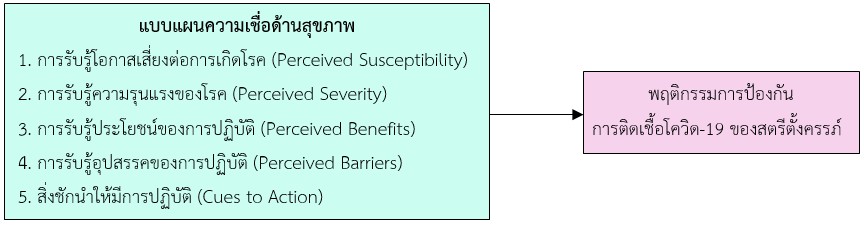
This cross-sectional descriptive study aimed to examine health beliefs regarding COVID-19 prevention, COVID-19 preventive behaviors, and the relationship between health beliefs and preventive behaviors among pregnant women attending antenatal care clinics in hospitals in Chiang Mai Province. The sample consisted of 380 pregnant women receiving antenatal care services at 23 hospitals in Chiang Mai, selected through simple random sampling. Data were collected using two questionnaires: one assessing health beliefs related to COVID-19 prevention and the other measuring COVID-19 preventive behaviors among pregnant women. Data were analyzed using mean, standard deviation, and Spearman’s rank correlation coefficient.
The results revealed that the overall health beliefs regarding COVID-19 prevention among pregnant women were at a high level (Mean = 3.10, S.D. = 0.21). When considering each dimension, it was found that perceived benefits of appropriate preventive practices, perceived susceptibility to infection, perceived cues to action, and perceived severity and complications of the disease were all at a high level, with mean scores and standard deviations of 3.57 (S.D. = 0.44), 3.39 (S.D. = 0.43), 3.31 (S.D. = 0.43), and 3.21 (S.D. = 0.52), respectively. In contrast, perceived barriers to practicing appropriate COVID-19 prevention were at a moderate level (Mean = 2.72, S.D. = 0.56). Preventive behaviors against COVID-19 among pregnant women were found to be at a high level (Mean = 2.92, S.D. = 0.27). Furthermore, there was a statistically significant low positive correlation between overall health beliefs and COVID-19 preventive behaviors (rs = 0.151, p-value < 0.01). These findings can be applied to promote appropriate health belief patterns among pregnant women, thereby enhancing their correct and appropriate COVID-19 preventive behaviors, which may contribute to better health outcomes for both mothers and their unborn children.
References
กมลนัทธ์ วุฒิสาร, สุพิศ สิริอรุณรัตน์ และตติรัตน์ เตชะศักดิ์. (2560). ความสัมพันธ์ระหว่างความเชื่อด้านสุขภาพกับพฤติกรรมการรับประทานอาหารของหญิงตั้งครรภ์ที่มีน้ำหนักเกินก่อนการตั้งครรภ์. วารสารโรงพยาบาลชลบุรี, 42(1), 19-26.
กรมควบคุมโรค. (2563). โรคติดเชื้อไวรัสโคโรนา 2019 (COVID-19). สืบค้นเมื่อ 14 เมษายน 2566 จาก https://ddc.moph.go.th/viralpneumonia/index.php.
กรมอนามัย. (2564). การดูแลหญิงตั้งครรภ์ หลังคลอดและทารกแรกเกิดภายใต้สถานการณ์การแพร่ระบาดของ COVID-19. สืบค้น 25 เมษายน 2564 จาก https://covid19.anamai.moph.go.th.
ธานี กล่อมใจ, จรรยา แก้วใจบุญ และทักษิกา ชัชวรัตน์. (2563). ความรู้และพฤติกรรมของประชาชนเรื่องการป้องกันตนเองจากการติดเชื้อไวรัสโคโรนา 29 สายพันธุ์ใหม่ 2019. วารสารการพยาบาลการสาธารณสุข และการศึกษา, 21(2), 29-39.
พงศ์พัชรา พรหมเผ่า, พินทอง ปินใจ และสุรางคนา ไชยรินคำ. (2563). ความเชื่อด้านสุขภาพของผู้ดูแลเด็กต่อพฤติกรรมการป้องกันการติดเชื้อในศูนย์เด็กเล็ก:กรณีศึกษาศูนย์เด็กเล็กจังหวัดพะเยา. วารสารการพยาบาลการสาธารณสุขและการศึกษา, 21(1), 68-78.
ศูนย์ข้อมูลโควิด-19. (2564). สถานการณ์การแพร่ระบาดของ COVID-19 ในประเทศไทย. สืบค้นเมื่อ 25 เมษายน 2564 จาก https://www.facebook.com/informationcovid19locale=th_TH.
สมถวิล บงกชมาส. (2555). ประสิทธิผลของแบบแผนความเชื่อด้านสุขภาพร่วมกับกระบวนการกลุ่มและตัวแบบที่มีชีวิต ในการป้องกันภาวะโลหิตจางจากการขาดธาตุเหล็กของหญิงตั้งครรภ์ โรงพยาบาลบ้านโป่ง จังหวัดราชบุรี. วิทยานิพนธ์วิทยาศาสตร์มหาบัณฑิต มหาวิทยาลัยมหิดล.
สุจิตรา ชัยวุฒิ, พิมพาภรณ์ กลั่นกลิ่น และอะเคื้อ อุณหเลขกะ. (2566). การประยุกต์ใช้แบบแผนความเชื่อด้านสุขภาพในการส่งเสริมการป้องกันโรคโควิค-19 ในหญิงตั้งครรภ์. พยาบาลสาร, 50(3), 269-285.
Bayrami, R., Didarioo, A., Masudi, S., & Noumezhad, H. (2021). Predictors of COVID-19 preventive behaviors based on the health belief model among pregnant women. Retrieved November 21, 2022 from www.researchsquare.com/article/rs-1021064/v1.
Becker, M. H. (1974). The health belief model and sick role behavior. Health Education Monographs, 2(4), 324-508.
Maiman, L. A. & Becker, M. H. (1974). The health belief model: Origins and correlates in psychological theory. Health Education Monographs, 2, 336-353. https://doi.org/10.1177/109019817400200404
EL Sayed H., & Sarhan, A. El. (2022). Effect of health belief model based educational intervention on COVID-19 preventive behaviors among pregnant women. Tanta Scientific Nursing Journal, 24(1), 305-335. https://doi.org/10.21608/tsnj.2022.221607
Grove, S. K., & Gray, J. R. (2019). Understanding nursing research: Building an evidence-based practice. 7th ed. St. Louis, MO: Elsevier Saunders.
Hu, W. S., Lu, S., Xu, M. Y., Zhou, M. C., Yuan, Z. M., & Deng, Y. Y. (2021). Behavioral responses of pregnant women to the early stage of covid-19 pandemic in the network era in China: Online questionnaire study. Asian Nursing Research, 15(3), 215-221.
Kunno, J., Yubonpunt, P., Supawattanabodee, B., Wiriyasirivaj, B., & Sumanasrethakul, C. (2022). Knowledge ,attitudes,and practices related to the COVID-19 pandemic among pregnant women in Bangkok,Thailand. BMC Pregnancy and Childbirth, 22, 357-367.
Mahmoud Mahmoud Saadoon, O. H., & El-Ansary, E.S. (2022). Pregnant women’s awareness, beliefs and self-protective behaviors regarding COVID-19 pandemic: Nursing intervention based on health belief model. Egyptian Journal of Health Care, 13(3), 349-364. https://doi.org/10.21608/ejhc.2022.252326
Mo, P. K. H., Fong, V. W. I., Song, B., Di, J., Wang, Q., & Wang, L. (2021). Association of perceived threat, negative emotions, and self-efficacy with mental health and personal protective behavior among chinese pregnant women during the COVID-19 Pandemic: Cross- sectional survey study. Journal of Medical Internet Research, 23(4), e24053. https://doi.org/10.2196/24053
Phitsanulok Provincial Public Health Office. (2021). The survey of COVID-19 prevention behaviors of populations in Phitsanulok Province. Retrieved January 14, 2021 from https://www.Plkhealth.go.th.
World Health Organization. (2020). Coronavirus disease (COVI-19) questions and answer. Retrieved June 18, 2020 from www.who.int/thailand/emergencies/.
Yu, H., He, J., Wang, X., Yang, W., Sun, B., & Szumilewicz, A. (2022). Pregnancy activity levels and impediments in the era of COVID-19 based on the health belief model: A cross-sectional study. Frontiers in Public Health, 19, 3823. https://doi.org/10.3390/ijerph19063283
Zaigham, M. & Andersson, O. (2020). Maternal and perinatal outcomes with COVID-19: A systematic review of 108 pregnancies. Acta Obstetricia et Gynecologica Scandinavica, 99(7), 823-829. https://doi.org/10.1111/aogs.13867
Downloads
Published
How to Cite
Issue
Section
License
Copyright (c) 2025 Journal of Nursing and Public Health Research

This work is licensed under a Creative Commons Attribution-NonCommercial-NoDerivatives 4.0 International License.
1. บทความหรือข้อคิดเห็นใด ๆ ที่ปรากฏในวารสารวิจัยการพยาบาลและการสาธารณสุข ที่เป็นวรรณกรรมของผู้เขียน บรรณาธิการไม่จำเป็นต้องเห็นด้วย
2. บทความที่ได้รับการตีพิมพ์ถือเป็นลิขสิทธิ์ของ วารสารวิจัยการพยาบาลและการสาธารณสุข