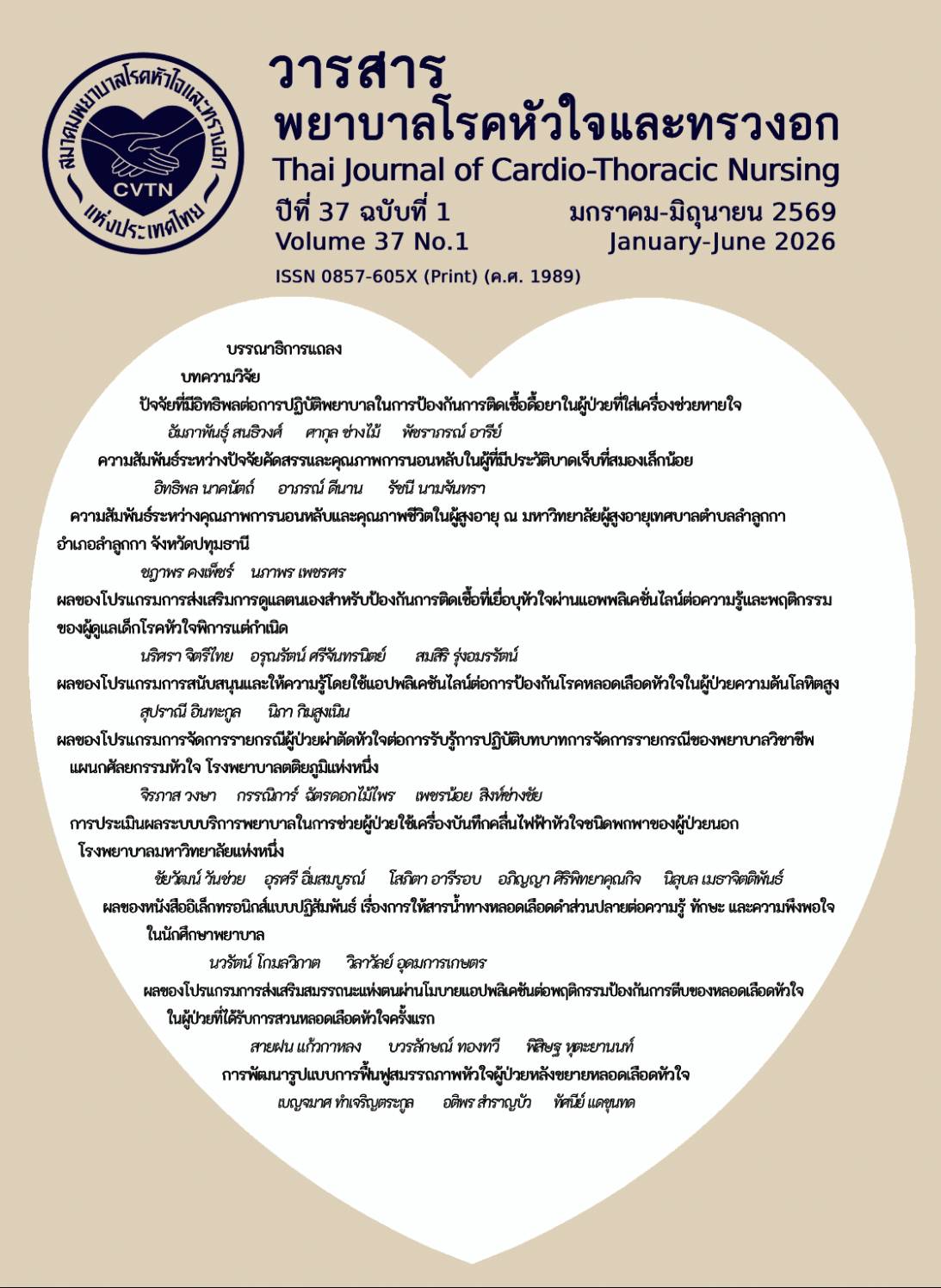
Influencing factors on nursing care to prevent antimicrobial resistant infection in patients with ventilator
Keywords:
knowledge, organizational support, nursing practices, preventing antimicrobial resistance infection, patients with ventilatorAbstract
This predictive descriptive research aimed to examine factors influencing nursing practices in preventing antimicrobial-resistant infections in ventilated patients. The study applied the Knowledge, Attitude, and Practice (KAP) model (Bloom, 1956) combined with organizational support factors. The sample included 100 registered nurses working in medical, surgical, and intensive care units of public hospitals in Samut Sakhon Province, selected through simple random sampling. Data were collected from October to December 2024 using questionnaires covering general information, knowledge, attitudes, organizational support, and nursing practices related to infection prevention. Data analysis involved frequency, percentage, and multiple regression analysis.
The results revealed that nurses' knowledge was at a very good level (M = 14.01, SD = 3.10), with 44% of nurses classified in this category. Attitudes were very positive (M = 30.85, SD = 2.87), with 75% demonstrating highly positive attitudes. Organizational support was high (M = 32.99, SD = 3.37), with 75% reporting strong support. The nursing practices were at a very good level (M = 52.92, SD = 3.80), with 90% exhibiting excellent practices. Attitude had the strongest influence on nursing practices (b = 0.29, p = 0.00), followed by knowledge (b = 0.23, p = 0.04), and organizational support (b = 0.20, p = 0.03). Together, these three factors significantly predicted nursing practices, accounting for 31.90% of the variance (Adjusted R²= 0.31, p < 0.05).
These findings can serve as guidelines for improving the quality of care for ventilated patients to reduce the incidence of antimicrobial-resistant infections by promoting nurses' knowledge, positive attitudes, and organizational support, thereby enhancing the effectiveness of nursing practices in preventing such infections.
References
Centers for Disease Control and Prevention. Antibiotic resistance threats in the United States, 2019 [Internet]. Atlanta (GA): US Department of Health and Human Services, Centers for Disease Control and Prevention; 2019 [cited 2024 Apr]. Available from: https://www.cdc.gov/antimicrobial-resistance/media/pdfs/2019-ar-threats-report-508.pdf
Meedet Y. Development of a nursing management system to prevent antibiotic-resistant infections in the medical intensive care unit. Nurs Health Public Health J. 2025;4(1):11–27. Available from:https://he03.tci-thaijo.org/index.php/nhphj/article/view/3176/2965 (in Thai).
Chomjan T, Singto P. Multiple-Antimicrobial Resistance (AMR) of Patients in Internal Medicine Department. APHEIT J Nurs Health. 2022;4(3):116. Available from: https://rsujournals.rsu.ac.th/index.php/ajnh/article/view/2827/2239 (in Thai).
Sirikit P. Nursing care of the patient with ventilator-associated pneumonia with multiple drugs resistant: case study 2 cases. Mahasarakham Hosp J. 2022;19(1):89–106. Available from: https://he02.tci-thaijo.org/index.php/MKHJ/article/view/256566/175433 (in Thai).
Sakhon Hospital. Report of infection prevention and control unit, October 2022–September 2023. Samut Sakhon: Sakhon Hospital; 2023.
Krathumbaen Hospital. Infection prevention and control unit annual report 2022. Samut Sakhon: Krathumbaen Hospital; 2022.
Krathumbaen Hospital. Infection prevention and control unit annual report 2023. Samut Sakhon: Krathumbaen Hospital; 2023.
Sornchai N, Yodnil W, Inchan T, Wongwichawatana J, Weerakieatikul P, Jancham S, et al. The effectiveness of the clinical nursing practice guidelines for preventing pneumonia caused by multidrug-resistant Acinetobacter baumannii on the incidence rate of ventilator-associated pneumonia in hospital. J Faculty of Nursing Burapha Univ. 2023;31(4):107-123. Available from: https://he02.tci-thaijo.org/index.php/Nubuu/article/view/265318/182099 (in Thai).
Sripanom S, Saensom D. Effects of the WHAPO-CRE clinical nursing practice guideline among intubated patients. J Nurs Health Care. 2020;38(4):181-90. Available from: https://he01.tci-thaijo.org/index.php/jnat-ned/article/view/245871/167767 (in Thai).
Bloom BS, Engelhart MD, Furst EJ, Hill WH, Krathwohl DR. Handbook I: cognitive domain. New York: David McKay; 1956.
Napradit A. Knowledge, attitudes, and practices of standard precaution among personnel.J Prapokklao Hosp Clin Med Educat Center. 2016;33(1):6-19. Available from: https://he02.tci-thaijo.org/index.php/ppkjournal/article/view/79671/63585 (in Thai).
Min S, Zhou Y, Sun Y, Ye J, Dong Y, Wang X, Li H. Knowledge, attitude, and practice associated with antimicrobial resistance among medical students between 2017 and 2022: a survey in East China. Front Public Health. 2022;10:1010582. doi:10.3389/fpubh.2022.1010582
Sarani H, Balouchi A, Masinaeinezhad N, Ebrahimitabs E. Knowledge, attitude, and practice of nurses about standard precautions for hospital-acquired infection in teaching hospitals affiliated to Zabol University of Medical Sciences (2014). Glob J Health Sci. 2016;8(3):193. doi: 10.5539/gjhs.v8n3p193
Dumbre DU. A study to assess the knowledge and compliance of critical care nurses regarding ventilator care bundle in prevention of ventilator-associated pneumonia. Medico Legal Update. 2019;19(1):176-178. doi:10.5958/0974-1283.2019.00035.5
Bunruam C, Unahalekhaka A, Lertwatthanawilat W. Factors predicting practices in prevention of drug-resistant organism transmission among registered nurses in regional hospitals. Nursing Journal. 2020;47(2):133-142. Available from: https://he02.tci-thaijo.org/index.php/cmunursing/article/view/241801/164590 (in Thai).
Thongsan W. Development of a model for promoting practices to prevent drug-resistant organisms infections among nursing personnel, Phonpisai District, Nongkhai Province. Nursing, Health, and Education Journal. 2021;4(1):19-28. Available from: https://he02.tci-thaijo.org/index.php/NHEJ/article/view/249285/170487 (in Thai).
Chaiyabutra S, Sawasrak K, Sunato P, Chamchumrat S. Transforming care at the bedside: enhancing nurses compliance for preventing the transmission of multidrug-resistant organisms. Chaiyaphum Med J. 2022;42(2):18-30. Available from: https://thaidj.org/index.php/CMJ/article/view/12749/10783 (in Thai).
Lacotte Y, Årdal C, Ploy MC, European Union Joint Action on Antimicrobial Resistance and Healthcare-Associated Infections (EU-JAMRAI). Infection prevention and control research priorities: what do we need to combat healthcare-associated infections and antimicrobial resistance? Results of a narrative literature review and survey analysis. Antimicrob Resist Infect Control. 2020;9:1-10. doi: 10.1186/s13756-020-00801-x
Vanichbuncha K, Vanichbuncha T. Using SPSS for Windows in Data Analysis. 34th ed. Bangkok: Chulalongkorn University Book Center; 2022.
Bamrasnaradura Institute, Department of Disease Control, Ministry of Public Health. Guidelines for infection prevention and control in hospitals [Internet]. Bangkok: Aksorn Graphic and Design; 2020. [cited 2024 Apr ]. Available from: https://tinyurl.com/472ej9ty
Wongratana C. Techniques of statistics for research. 12th ed. Bangkok: Tainetmitkit Interprogressive; 2010.
Khamdee C. Knowledge, attitudes, and practices for preventing the spread of drug-resistant pathogens among professional nurses at Si Prachan Hospital. J Boromarjonani Coll Nurs Suphanburi. 2024;7(1):113-130. Available from: https://he02.tci-thaijo.org/index.php/SNC/article/view/269611/183612 (in Thai).
Jaidee P, Tidchom P. Development and evaluation of practice guidelines for prevention of drug-resistant infections of nursing personnel in medical and surgery ward, Suwannaphum Hospital. J Res Health Innov Dev. 2020;1(3):53-61. Available from: https://he01.tci-thaijo.org/index.php/jrhi/article/view/253558/170933 (in Thai).
Schrader PG, Lawless KA. The knowledge, attitudes, & behaviors approach: how to evaluate performance and learning in complex environments. Perform Improv. 2004;43(9):8-15. doi: 10.1002/pfi.4140430905
Pornpatsiri P. Factors related to participation in hospital quality development in professional teams, Wang Wiset Hospital, Trang Province. J Health Environ Educ. 2020;5(3):140-147. Available from:https://so06.tcithaijo.org/index.php/hej/article/view/252864/170677(in Thai).
Yin Y, Sun M, Li Z, Bu J, Chen Y, Zhang K, Hu Z. Exploring the nursing factors related to ventilator-associated pneumonia in the intensive care unit. Front Public Health. 2022;10:715566. doi: 10.3389/fpubh.2022.715566
Downloads
Published
How to Cite
Issue
Section
License
Copyright (c) 2026 Thai Journal of Cardio-Thoracic Nursing

This work is licensed under a Creative Commons Attribution-NonCommercial-NoDerivatives 4.0 International License.
บทความนี้ยังไม่เคยตีพิมพ์หรืออยู่ในระหว่างส่งไปตีพิมพ์ในวารสารอื่น ๆ มาก่อน และกองบรรณาธิการขอสงวนสิทธิ์ในการตรวจทาน และแก้ไขต้นฉบับตามเกณฑ์ของวารสาร ในกรณีที่เรื่องของท่านได้ได้รับการตีพิมพ์ในวารสารฉบับนี้ถือว่าเป็น ลิขสิทธิ์ของวารสารพยาบาลโรคหัวใจและทรวงอก