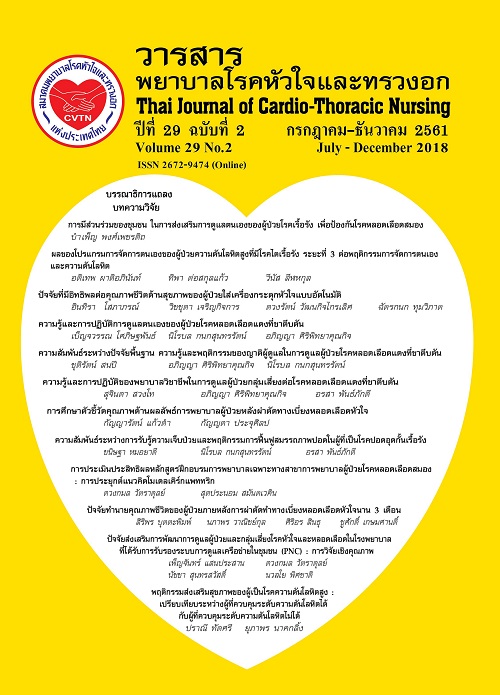
ความรู้และการปฏิบัติการดูแลตนเองของผู้ป่วยโรคหลอดเลือดแดงที่ขาตีบตัน
คำสำคัญ:
โรคหลอดเลือดแดงที่ขาตีบตัน, การปฏิบัติการดูแลตนเอง, ความรู้บทคัดย่อ
โรคหลอดเลือดแดงที่ขาตีบตันหากไม่สามารถควบคุมโรคและปัจจัยเสี่ยงได้อาจส่งผลให้ต้องสูญเสียอวัยวะ และเสียชีวิตก่อนวัยอันควร การวิจัยเชิงบรรยายนี้มีวัตถุประสงค์เพื่อศึกษาความรู้และพฤติกรรมการดูแลตนเองของผู้ที่มีโรคหลอดเลือดแดงที่ขาตีบตัน โดยใช้ทฤษฎีการดูแลตนเองของโอเร็มเป็นกรอบแนวคิดการวิจัย กลุ่มตัวอย่างเป็นผู้ป่วยโรคหลอดเลือดแดงที่ขาตีบตันที่มีคุณสมบัติตามกำหนด ณ โรงพยาบาลมหาวิทยาลัยแห่งหนึ่งในกรุงเทพมหานคร จำนวน 78 ราย เครื่องมือวิจัยประกอบด้วย 1) แบบสัมภาษณ์ข้อมูลส่วนบุคคล การรับรู้โรคและการรักษา 2) แบบสอบถามความรู้เกี่ยวกับโรคหลอดเลือดแดงที่ขาตีบตัน และ 3) แบบสอบถามพฤติกรรมการดูแลตนเอง วิเคราะห์ข้อมูลโดยใช้สถิติบรรยาย ความถี่ และร้อยละ
ผลการศึกษาพบว่ากลุ่มตัวอย่างส่วนใหญ่เป็นเพศชายอายุ 60 ปีขึ้นไป เป็นโรคหลอดเลือดแดงที่ขาตีบตันมานาน 1 – 5 ปี เคยสูบบุหรี่ มีโรคประจำตัวซึ่งเป็นปัจจัยเสี่ยงของโรคนี้ ทุกคนได้รับยาต้านเกล็ดเลือด ร้อยละ 50.0 ได้รับการทำทางเบี่ยงหลอดเลือดแดงที่ขา ร้อยละ 43.6 ได้รับการตัดนิ้วเท้า/เท้า ร้อยละ 51.3 มีผลตรวจติดตามทางห้องปฏิบัติการครบตามปัจจัยเสี่ยงของโรค ส่วนใหญ่ทราบโรคและปัจจัยเสี่ยงของตนเอง ทราบข้อมูลการรักษาที่ได้รับ แต่ไม่สามารถระบุชื่อยา ผลการตรวจทางห้องปฏิบัติการและเกณฑ์มาตรฐานในการควบคุมโรคและปัจจัยเสี่ยง มีคะแนนความรู้เกี่ยวกับโรคหลอดเลือดแดงที่ขาตีบตันโดยรวมระดับปานกลาง โดยมีคะแนนด้านการค้นหาสาเหตุและปัจจัยเสี่ยงในระดับน้อย มีคะแนนพฤติกรรมการดูแลตนเองโดยรวมระดับมาก แต่มีพฤติกรรมไม่เหมาะสมมากที่สุดด้านการเฝ้าระวังโรค
ผลการศึกษานี้สามารถใช้เป็นข้อมูลพื้นฐานในการสร้างแนวทางการให้ความรู้และปรับพฤติกรรมการดูแลตนเองของผู้ป่วยโรคหลอดเลือดส่วนปลายตีบตัน
เอกสารอ้างอิง
2. Anderson JL, Halperin JL, Albert NM, Bozkurt B, Brindis RG, Curtis LH, et al. Management of patients with peripheral artery disease (Compilation of 2005 and 2011 ACCF/AHA guideline recommendation): A report of the American college of cardiology foundation/American heart association task force on practice guidelines. Circulation. 2013; 127: 00-00.
3. The Sirens Society, Ministry of social development and human security. Survey of the older person in Thailand 2011 [Internet]. 2011 [cited 2015 March 15]. Available from: https://www.m-society.go.th/article attach/11400/15720.pdf. (in Thai).
4. National statistical office, Ministry of information and communication technology. The smoking and drinking behavior survey 2011. [Internet]. 2012 [cited 2015 March 15]. Available from: service.nso.go.th/nso/nsopublish/themes/files/smokeRep54.pdf. (in Thai).
5. Institute for population and social research, Mahidol university, Thai health promotion foundation, National health commission office. Thai health 2011: HIA Mechanism for developing public policy for life and health. Nakhon Pathom: Amarin Printing & Pulishing Pubic Company.
6. Jude EB, Oyibo SO, Chalmers N, Boulton AJ. Peripheral arterial disease in diabetic and nondiabetic patients: a comparison of severity and outcome. Diabetes Care. 2001; 24:1433-7.
7. Bunnag C, Noona R, Prasungsit C. Factors associated with quality of life for the patients with limb ischemia. J Nurs Sci 2011; 29(2 Suppl 1): 27-36. (in Thai).
8. Willigendael EM, Teilink JAW, Bartelink M, Kuiken BW, Boiten J, Moll FL, et al. Peripheral arterial disease: Public and patient awareness in the Netherlands. J Vas Surg. 2004; 27: 622-28.
9. Diniz JN, Pires RCCP. Perception of the peripheral arterial occlusive disease in Fontaine class I or II patients included in a Family Health Program. J Vasc Bras. [Internet]. 2010. [cited 2015 Jan 10]. Available from: https://www.scielo.br/pdf/jvb/v9n3/en_a05v9n3.pdf.
10. Sawangphong S. Factors related to first diagnosis time in patients with peripheral arterial occlusive disease. [Master Thesis of Nursing Science]. Bangkok: Mahidol University; 2009. (in Thai).
11. Thangrod R, Kimpee S, Thosingha O, Ruangsetakit C. Factors predicting health status in patients after infrainguinal bypass. J Nurs Sci. 2010; 28(4Suppl): 46-54.
12. Hanucharurnkul S , editor. Orem’s nursing theory in self-care: nursing science and arts. 1st ed. Bangkok: Visitsil Ltd; 1991. p. 1-45. (in Thai).
13. Srisatidnarakul B. The methodology in nursing research. 5th ed. Bangkok: You & I Intermedia; 2010.
14. Apiratanawong S. Self medication management in older adults. [Master Thesis of Nursing Science]. Bangkok: Mahidol University; 2008. (in Thai).
15. Bloom BS. Handbook on formative and summative evaluation of student learning. New York: McGraw-Hall; 1971
16. Leon LR, Labropoulos N, Lebda P, Kalman PG. The vascular surgeon’s role in risk factor modification: results of a survey. Perspect Vas Surg Endovasc Ther. 2005; 17(2):145-53.
17. Diabetes association of Thailand under the patronage of Her Royal Highness Princess Maha Chakri Sirithorn, The endocrine society of Thailand, Ministry of public health. Clinical practice guideline for diabetes 2011. Bangkok: Srimuang printing Co., Ltd; 2557.
18. Senachai N, Panpakdee O, Siripitayakunkit A. Relationship among nurses’ basic conditioning factors, knowledge and competency for providing care of patients at risks of peripheral arterial disease. Thai Journal of Cardio-Thoracic Nursing. 2014; 25(2): 1-16.
ดาวน์โหลด
เผยแพร่แล้ว
รูปแบบการอ้างอิง
ฉบับ
ประเภทบทความ
สัญญาอนุญาต
บทความนี้ยังไม่เคยตีพิมพ์หรืออยู่ในระหว่างส่งไปตีพิมพ์ในวารสารอื่น ๆ มาก่อน และกองบรรณาธิการขอสงวนสิทธิ์ในการตรวจทาน และแก้ไขต้นฉบับตามเกณฑ์ของวารสาร ในกรณีที่เรื่องของท่านได้ได้รับการตีพิมพ์ในวารสารฉบับนี้ถือว่าเป็น ลิขสิทธิ์ของวารสารพยาบาลโรคหัวใจและทรวงอก