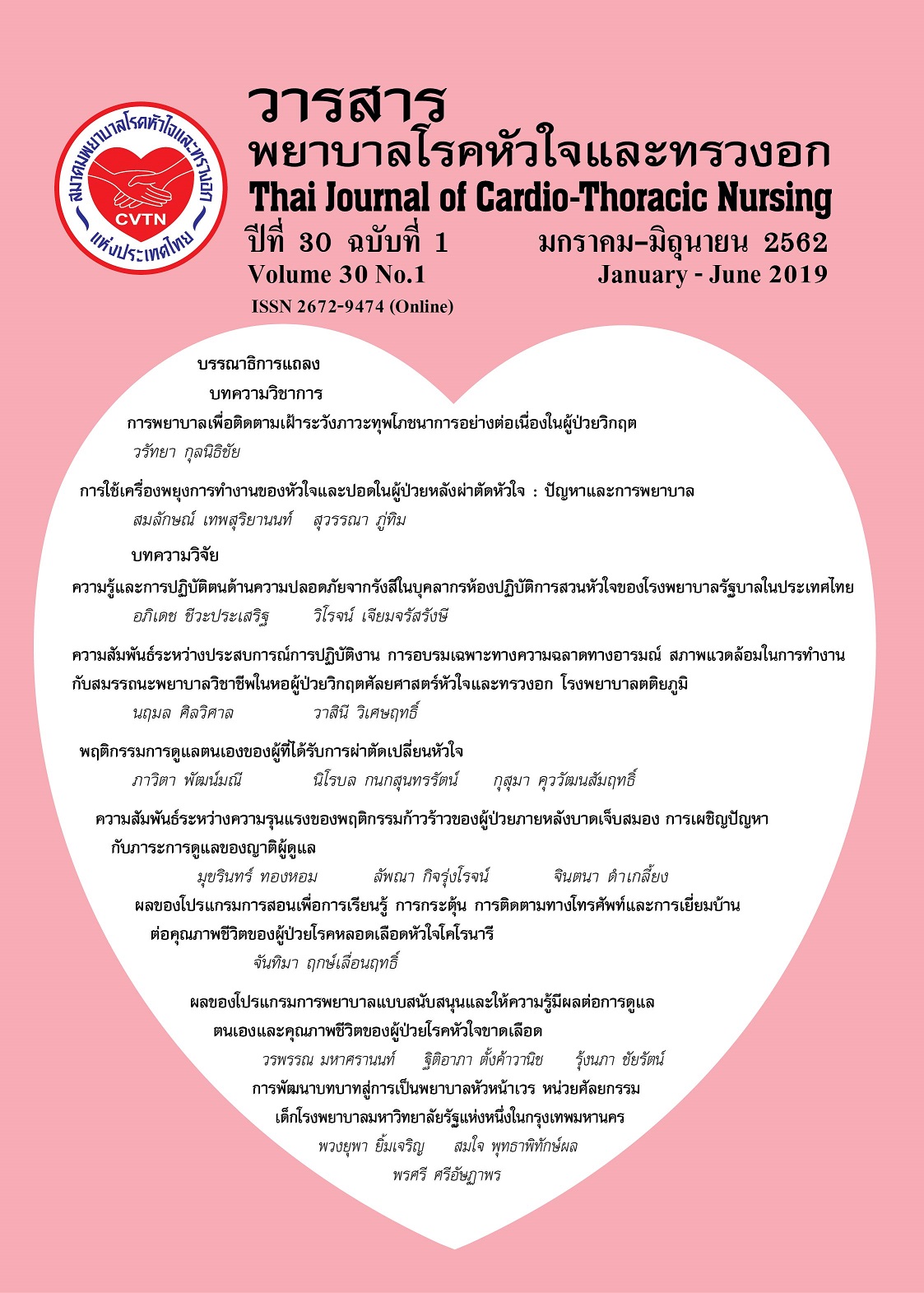
ผลของโปรแกรมการสอนเพื่อการเรียนรู้ การกระตุ้น การติดตามทางโทรศัพท์และการเยี่ยมบ้านต่อคุณภาพชีวิตของผู้ป่วยโรคหลอดเลือดหัวใจโคโรนารี
คำสำคัญ:
โปรแกรมการสอนเพื่อการเรียนรู้, การกระตุ้น, การติดตามทางโทรศัพท์และการเยี่ยมบ้าน, คุณภาพชีวิต, ผู้ป่วยโรคหลอดเลือดหัวใจโคโรนารีบทคัดย่อ
การวิจัยกึ่งทดลองแบบสองกลุ่มวัดก่อนและหลังการทดลองนี้มีวัตถุประสงค์เพื่อศึกษาผลของโปรแกรมการสอนเพื่อการเรียนรู้ การกระตุ้น การติดตามทางโทรศัพท์และการเยี่ยมบ้าน (Learning-Activated-Telephone-Home Visiting: LATH) ต่อคุณภาพชีวิตของผู้ป่วยโรคหลอดเลือดหัวใจโคโรนารี กลุ่มตัวอย่าง คือ ผู้ป่วยโรคหลอดเลือดหัวใจโคโรนารี จำนวน 100 คนคัดเลือกแบบเฉพาะเจาะจงตามเกณฑ์ที่กำหนด จากนั้นสุ่มจับฉลากเพื่อคัดเข้ากลุ่มทดลองและกลุ่มเปรียบเทียบ กลุ่มละ 50 คน โดยกลุ่มทดลองได้รับการดูแลตามมาตรฐานปกติร่วมกับกิจกรรมที่กำหนดในโปรแกรมฯ ได้แก่ การสอนเกี่ยวกับโรคประจำตัว การกระตุ้นให้เกิดการปฏิบัติตัวที่เหมาะสม การติดตามเยี่ยมทางโทรศัพท์ และการเยี่ยมบ้าน ในขณะที่กลุ่มเปรียบเทียบได้รับการดูแลและการให้คำแนะนำที่เป็นมาตรฐานตามปกติ การเก็บข้อมูลอยู่บนพื้นฐานการพิทักษ์สิทธิกลุ่มตัวอย่าง เก็บข้อมูลโดยใช้แบบสอบถามข้อมูลส่วนบุคคลและแบบสอบถาม Quality of life index-cardiac version IV ของ Ferrans and Powers โดยประกอบด้วยคำถาม 4 ด้าน ได้แก่ 1) ด้านภาวะสุขภาพและการทำหน้าที่ของร่างกาย 2) ด้านสังคมและเศรษฐกิจ 3) ด้านจิตวิญญาณ และ 4) ด้านครอบครัว การวิเคราะห์ข้อมูลโดยหาค่าร้อยละ ค่าเฉลี่ย ส่วนเบี่ยงเบนมาตรฐาน และ independent t-test
ผลการวิจัยพบว่า กลุ่มทดลองและกลุ่มเปรียบเทียบส่วนใหญ่เป็นเพศหญิง อายุเฉลี่ย 56.22 ± 9.39 และ 56.40 ± 9.79 ปีตามลำดับ ภายหลังใช้โปรแกรม LATH ผู้ป่วยในกลุ่มทดลองมีคะแนนเฉลี่ยคุณภาพชีวิตในภาพรวม (21.58 ± 1.66) และรายด้านอยู่ในระดับดี และสูงกว่าคะแนนเฉลี่ยคุณภาพชีวิตของกลุ่มเปรียบเทียบทั้งในภาพรวม (14.57 ± 3.19) และรายด้านอย่างมีนัยสำคัญทางสถิติที่ระดับ .001
จากผลการวิจัยที่พบว่าโปรแกรมการสอนเพื่อการเรียนรู้ การกระตุ้น การติดตามทางโทรศัพท์และการเยี่ยมบ้าน (LATH) มีประสิทธิภาพทำให้คุณภาพชีวิตของผู้ป่วยโรคหลอดเลือดหัวใจโคโรนารีเพิ่มสูงขึ้น จึงมีข้อเสนอแนะว่า หน่วยงานที่เกี่ยวข้องทั้งสถานศึกษาและโรงพยาบาลสามารถนำโปรแกรมนี้ไปใช้สอนและใช้ในการดูแลผู้ป่วยโรคหลอดเลือดโคโรนารีเพื่อยกระดับคุณภาพชีวิตของผู้ป่วยให้สูงขึ้น
เอกสารอ้างอิง
2. Martin CR. Scientific basis of healthcare: angina. Boca Raton, FL: CRC Press; 2011.
3. Cole JA, Smith SM, Hart N, Cupples ME. Systematic review of effect of diet and exercise lifestyle interventions in the secondary prevention of coronary heart disease. Cardiol Res Pract. 2011; 3: 1–25.
4. World Health Organization. The top 10 global causes of deaths 2016 [internet]. [Cited 2019, April 27]. Available from: https://www.who.int/news-room/fact-sheets/detail/the-top-10-causes-of-death
5. Strategy and Planning Division, Office of the Permanent Secretary. Annual report of illness statistics in year 2016. Bangkok: Strategy and Planning Division, Office of the Permanent Secretary, Ministry of Public Health; 2017. (in Thai).
6. Bureau of Epidemiology, Ministry of Public Health. Summaries of disease surveillance report 2015 [internet]. [Cited 2019, April 27]. Available from: https://www.boe.moph.go.th
7. Kiatchoosakun S, Sutra S, Thepsuthammarat K. Coronary artery disease in the Thai population: data from health situation analysis 2010. J Med Assoc Thai. 2012; 95 (Suppl 7): S149-55.
8. Saengsiri A, Wattradul D, Kangchanakul S, Natthumrongkul S, Nopplub S, Wonganunnont S. The factors influencing the self-care agency and quality of life of patients with coronary artery disease. Thai Journal of Cardio-Thoracic Nursing. 2015; 26(1): 104-18. (in Thai)
9. Le J, Dorstyn DS, Mpfou E, Prior E, Tully PJ. Health-related quality of life in coronary heart disease: a systematic review and meta-analysis mapped against the international classification of functioning, disability and health. Qual Life Res. 2018; 27(10): 2491-2503. doi: 10.1007/s11136-018-1885-5.
10. Valiee S, azavi NS, Aghajani M, Bashiri Z. Effectiveness of a psychoeducation program on the quality of life in patients with coronary heart disease: a clinical trial. Appl Nurs Res. 2016; 33: 36-41.
11. Wichitthongchai C. The factors associated with food consumption behaviors of cardiac and arterial diseases patients, Queen Sirikit Heart Center of the Northeastern Region, Khon Kaen University. Srinagarind Medical Journal. 2012; 27(4): 340-46. (in Thai).
12. Sukhee Ahn, Rhayun Song, Si Wan Choi. Effects of self-care health behaviors on quality of life mediated by cardiovascular risk factors among individuals with coronary artery disease: a structural equation modeling approach. Asian Nurs Res. 2016;10: 158-63.
13. Saengsiri A. The effects of a self-care promotion program on quality of life and reduction of risk factors of coronary heart disease patients. [Master Thesis of Nursing Science]. Bangkok: Mahidol University; 2003. (in Thai).
14. Ahn S, Song R, Choi SW. Effects of self-care health behaviors on quality of life mediated by cardiovascular risk factors among individuals with coronary artery disease: A structural equation modeling approach. Asian Nurs Res. 2016; 10(2):158-63. doi: 10.1016/j.anr.2016.03.004. Epub 2016 Apr 29.
15. Ritpetch N, Jitpanya C, Chimluang J. Relationships among symptom clusters, self –management, health value, sense of coherence, and health - related quality of life in patients with percutaneous coronary intervention. Princess of Narathiwas 2013; 5(1): 16-34. (in Thai).
16. Wenru Wang, Ying Lau, Aloysius Chow. Thompson DR, Hong-Gu He. Health-related quality of life and social support among Chinese patients with coronary heart disease in mainland China. Eur J Cardiovasc Nurs. 2014; 13(1): 48-54.
17. Laura Bacelar de Araujo Lourenç, Roberta Cunha Matheus Rodrigues, Thaís Moreira São-João. Maria Cecilia Gallani, Marilia Estevam Cornélio, Quality of life of coronary artery disease patients after the implementation of planning strategies for medication adherence. Rev. Latino-Am. Enfermagem. 2015; 23(1):11-9
18. Salavati M, Falahinia G, Vardanjani AE, Rafiei H, Moosavi S, Torkaman M. Comparison between effects of home based cardiac rehabilitation programs versus usual care on the patients’ health related quality of life after coronary artery bypass graft. Glob J Health Sci. 2016; 8(4): 196-202.
19. Farazmand J, Nasiripour A, Raeissi P. The effect of telephone follow-up programs after hospital discharge on hope and the quality of life in patients admitted to the coronary care unit (CCU). J Babol Univ Med Sci. 2017; 19(2); 41-6.
20. Rerkluenrit J, Wannapong S. Development of a self-care programme for heart failure patients in Nakhonnayok province: a participatory action research project. Thai Journal of Nursing Council. 2014; 29(4): 64-78. (in Thai).
21. Ferrans CE, Powers MJ. Psychometric assessment of the quality of life index. Res Nurs Health. 1992; 15: 29-38.
22. Pilot DF, Beck TB. Nursing research: principle and methods. 7th ed. Philadelphia. Lippincott William & Wilkins; 2004.
23. Ferrans CE, Powers MJ. Quality of life index cardiac version-IV 1998 [internet]. [Cited 2016, Jan 10]. Available from: https://www.uic.edu/orgs/qli/questionaires/pdf/ cardiac version IV/cardiac4english.pdf
24. De Smedt D, De Bacquer D, De Sutter J, Dallongeville J, Gevaert S, De Backer G, et al. The gender gap in risk factor control: effects of age and education on the control of cardiovascular risk factors in male and female coronary patients. Int J Cardiol. 2016; 15: 284-90.
25. Shojaei A, Tahrir B, Naderi N, Zare'ian A. The effect of patient education and telephone follow-up by nurse on the re-admission of patients with heart failure. J Nurs Edu. 2013; 6(1):16-26.
ดาวน์โหลด
เผยแพร่แล้ว
รูปแบบการอ้างอิง
ฉบับ
ประเภทบทความ
สัญญาอนุญาต
บทความนี้ยังไม่เคยตีพิมพ์หรืออยู่ในระหว่างส่งไปตีพิมพ์ในวารสารอื่น ๆ มาก่อน และกองบรรณาธิการขอสงวนสิทธิ์ในการตรวจทาน และแก้ไขต้นฉบับตามเกณฑ์ของวารสาร ในกรณีที่เรื่องของท่านได้ได้รับการตีพิมพ์ในวารสารฉบับนี้ถือว่าเป็น ลิขสิทธิ์ของวารสารพยาบาลโรคหัวใจและทรวงอก