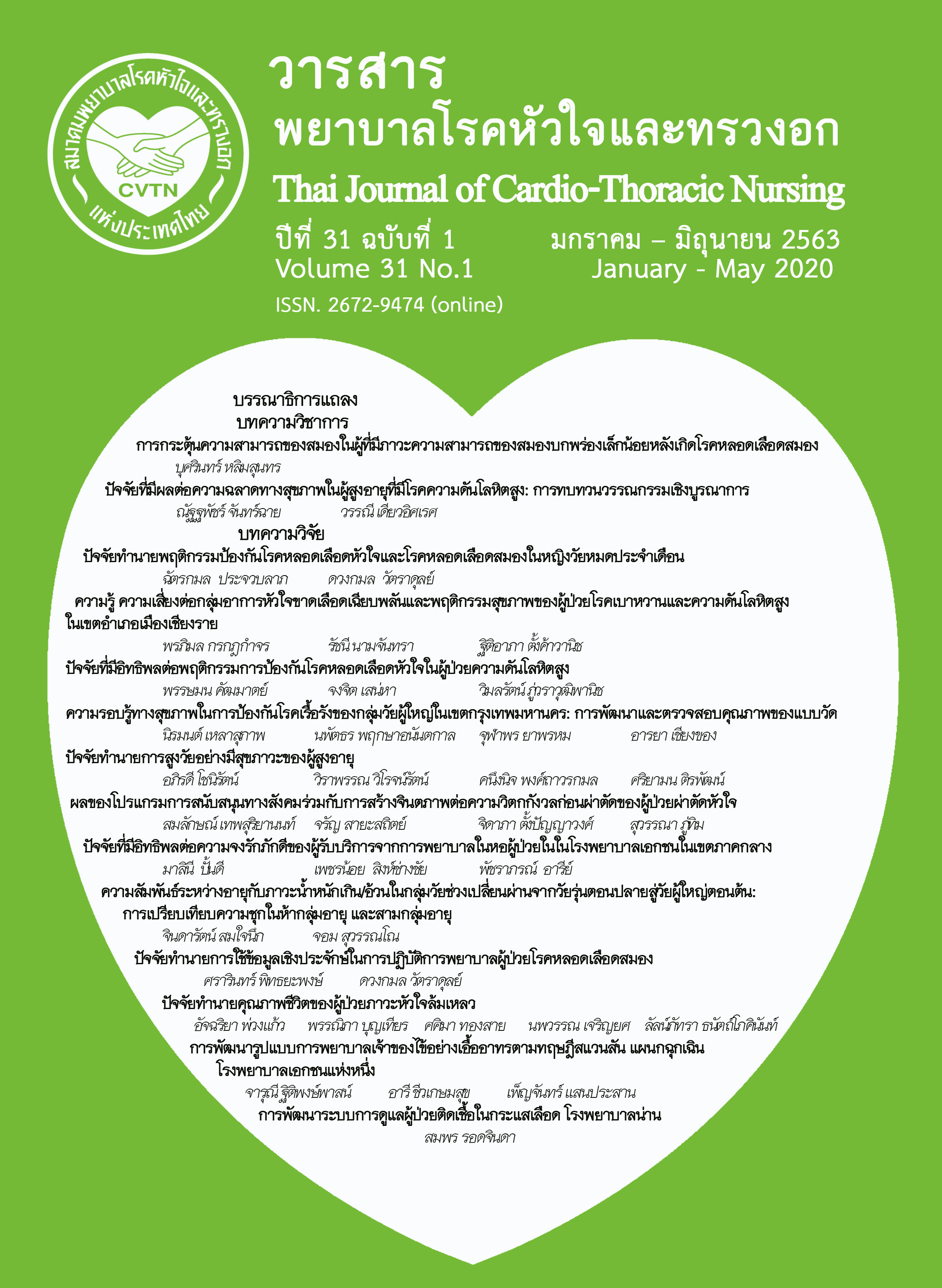
ปัจจัยที่มีอิทธิพลต่อพฤติกรรมการป้องกันโรคหลอดเลือดหัวใจในผู้ป่วยความดันโลหิตสูง
คำสำคัญ:
ผู้ป่วยความดันโลหิตสูง, พฤติกรรมการป้องกันโรคหลอดเลือดหัวใจ, การรับรู้ภาวะสุขภาพ, ความรู้, การสื่อสารระหว่างผู้ป่วยกับเจ้าหน้าที่สุขภาพบทคัดย่อ
การศึกษาครั้งนี้เป็นการวิจัยหาความสัมพันธ์เชิงทำนาย เพื่อศึกษาอิทธิพลของการรับรู้โอกาสเสี่ยงต่อการเป็นโรคหลอดเลือดหัวใจ การรับรู้ภาวะสุขภาพ ความรู้เกี่ยวกับโรคหลอดเลือดหัวใจและการสื่อสารระหว่างผู้ป่วยกับเจ้าหน้าที่สุขภาพต่อพฤติกรรมการป้องกันโรคหลอดเลือดหัวใจในผู้ป่วยความดันโลหิตสูงที่มารับการรักษาในโรงพยาบาลของรัฐแห่งหนึ่งในกรุงเทพมหานคร จำนวน 126 ราย เครื่องมือที่ใช้ในการเก็บข้อมูลได้แก่ แบบสอบถามข้อมูลทั่วไป แบบสอบถามการรับรู้โอกาสเสี่ยงต่อการเป็นโรคหลอดเลือดหัวใจ แบบสอบถามการรับรู้ภาวะสุขภาพ แบบทดสอบความรู้เกี่ยวกับโรคหลอดเลือดหัวใจ และแบบสอบถามการสื่อสารระหว่างผู้ป่วยกับเจ้าหน้าที่สุขภาพและพฤติกรรมการป้องกันโรคหลอดเลือดหัวใจในผู้ป่วยความดันโลหิตสูง วิเคราะห์ข้อมูลโดยใช้สถิติเชิงพรรณนาและวิเคราะห์ถดถอยพหุคูณ
ผลการวิจัยพบว่า กลุ่มตัวอย่างมีคะแนนเฉลี่ยพฤติกรรมการป้องกันโรคหลอดเลือดหัวใจอยู่ในระดับสูง ตัวแปรต้นทั้งหมดสามารถร่วมอธิบายความผันแปรของพฤติกรรมการป้องกันโรคหลอดเลือดหัวใจของกลุ่มตัวอย่างได้อย่างมีนัยสำคัญทางสถิติ ร้อยละ 11 (Adjusted R2 = .11, P < .01) โดยพบว่าเฉพาะ การรับรู้ภาวะสุขภาพ (β = .23, p = .01) ความรู้เกี่ยวกับโรคหลอดเลือดหัวใจ (β = .17, p = .04) และการสื่อสารระหว่างผู้ป่วยกับเจ้าหน้าที่สุขภาพ (β = .17, p = .04) เป็นปัจจัยที่สามารถทำนายพฤติกรรมการป้องกันโรคหลอดเลือดหัวใจในผู้ป่วยความดันโลหิตสูงได้อย่างมีนัยสำคัญทางสถิติ
ข้อเสนอแนะ บุคลากรสุขภาพควรประเมินและติดตามการรับรู้ภาวะสุขภาพของผู้ป่วย ให้ความรู้เกี่ยวกับโรคหลอดเลือดหัวใจ และพัฒนาการสื่อสารระหว่างผู้ป่วยกับเจ้าหน้าที่สุขภาพให้มีประสิทธิภาพเพื่อช่วยส่งเสริมพฤติกรรมการป้องกันโรคหลอดเลือดหัวใจในผู้ป่วยความดันโลหิตสูง
เอกสารอ้างอิง
2. Forouzanfar MH, Liu P, Roth GA, Ng M, Biryukov S, Marczak L, et al. Global burden of hypertension and systolic blood pressure of at least 110 to 115 mmHg 1990-2015. JAMA. 2017; 317: 165-82.
3. Ekpalakorn W, Puckcharern H, Thaikla K, Satheannoppakao W. Report of the Thai public health examination by the 5th physical examination 2014. 1st edition. Nonthaburi: Health Systems Research Institute; 2016. (in Thai).
4. Information and Communication Technology Centre, Office of the Permanent Secretary, Ministry of Public Health. Standard report group important non communicable disease [Internet]. 2018. [cited 2018 Sep 12]. Available from: https://hdcservice.moph.go.th/hdc/main/index_k.php (in Thai).
5. Bureau of Policy and Strategy, Office of the Permanent Secretary Ministry of Public Health. Public health statistics 2015. Bangkok: Samcharoen Panich; 2015. (in Thai).
6. William B, Mancia G, Spiering W, Rosei EA, Azizi M, Burnier M, et al. ESC/ESH guideline for the management of arterial hypertension. Eur Heart J. 2018; 39: 3021-104.
7. Thai Hypertension Society. Thai guidelines on the treatment of hypertension [Internet]. 2015. [cited 2018 JUN 13]. Available from: www.thai hypertension.org/ iles/GL%20HT%202015.pdf (in Thai).
8. Sutthipatthanangkoon C, Thato R. Factors predicting preventive behaviors for coronary artery disease among autonomous university staff in Bangkok University. Thai Journal of Cardio-Thoracic Nursing. 2017; 28: 111-25. (in Thai).
9. Sirikangwankun W, Thato R, Polsook R. Factors predicting preventive behaviors for coronary artery disease among the royal thai army personnel. Journal of Nursing Science Chulalongkorn University. 2017; 29: 99-111. (in Thai).
10. Khotchakhote J, Jirapongsuwan A, Kerdmongkol P, Amnatsatsue K, Kaewboonchoo O. Atherosclerosis prevention behaviors among Kasikorn bank employees in Bangkok. Kuakarun Journal of Nursing. 2012; 19: 71-86. (in Thai).
11. Zinat Motlagh SF, Chaman R, Sadeghi E, Eslami AA. Self-care behaviors and related factors in hypertensive patients. Iran Red Crescent Med J. 2016; 10;18(6):e35805. doi: 10.5812/ircmj.35805. PMID: 27621938; PMCID: PMC5004506.
12. Jandeekaewsakul P, Watthayu N, Suwonnaroop N. Factors predicting self-management behaviour among patients with uncontrolled essential hypertension. Journal of Nursing Science. 2018; 36: 31-43. (in Thai).
13. Jariyasakulwong P, Charoenkitkarn V, Pinyopasakul W, Sriprasong S, Roubsanthisuk W. Factors influencing on health promotion behaviors in young adults with hypertension. Princess of Naradhiwas University Journal. 2015; 7: 26-36. (in Thai).
14. The Heart Foundation of Thailand under The Royal Patronage. DASH Diet [Internet]. 2017 [cited 2019 Jul 14]. Available from: http://www. thaiheartfound.org/category/details/food/272
15. Stretcher VJ, Rosenstock IM. The health belief model. In Glanz K, Lewis FM, editors. Health behavior and health education theory research and practice. 2 nd edition. San Francisco: Jossey-bass; 1997.
16. Ammouri AA, Neuberger G. The perception of risk of heart disease scale: development and psychometric analysis. J Nurs Meas. 2008; 16(2):83-97. doi:10.1891/1061-3749.16.2.83
17. Ma C. An investigation of factors influencing self-care behaviors in young and middle-aged adults with hypertension based on a health belief model. Heart Lung. 2018;47(2):136-41. doi:10.1016/ j.hrtlng.2017.12.001
18. Chuenwattana W, Sonpakdee N. Self-care behaviours of diabetic patients at Bangmeanang Tambon Bang Yai Nonthaburi Province. Pathumthani University Academic Journal. 2014; 6: 163-70. (in Thai).
19. Lee GK, Wang HH, Liu KQ, Cheung Y, Morisky DE, Wong MC. Determinants of medication adherence to antihypertensive medications among a Chinese population using Morisky Medication Adherence Scale. PLoS One. 2013; 8(4):e62775. doi:10.1371/journal. pone.0062775
20. Kraisai P, Promla W. Factors influencing to self-care behaviours of patients diabetes mellitus at Pathumthani Province. Mahamakut Graduate School Journal. 2017; 15: 101-10. (in Thai).
21. Bureau of Non Communicable Disease, Ministry of Public Health. Guidelines for assessment of cardiovascular risk. Nonthaburi: The War Veterans Organization of Thailand under Royal Patronage of His Majesty the King; 2017. (in Thai).
22. Schillinger D, Bindman A, Wang F, Stewart A, Piette J. Functional health literacy and the quality of physician-patient communication among diabetes patients. Patient Educ Couns. 2004; 52(3): 315-23. doi:10.1016/S0738-3991(03) 00107-1
23. Schoenthaler A, Allegrante JP, Chaplin W, Ogedegbe G. The effect of patient-provider communication on medication adherence in hypertensive black patients: does race concordance matter?. Ann Behav Med. 2012; 43(3):372-82. doi:10.1007/s12160-011-9342-5
24. Phetarvut S, Watthayu N, Suwonnaroop N. Factors predicting diabetes self-management behavior among patients with diabetes mellitus type 2. Journal of Nursing Science. 2011; 29: 18-26. (in Thai).
25. Srihamartra W, Buatee S, Sittipakorn S. The relationship between health belief perception and health behaviors in patients with hypertension crisis. The journal of Boromarajonani College of nursing Nakhonratchasima. 2015; 21: 27-40. (in Thai).
26. Cohen J. A power primer. Psychol Bull. 1992; 112(1):155-59. doi:10.1037//0033-2909.112.1.155
27. Poomsrikaew O. Risk factors and perception of coronary heart disease risk among Thai patients with type 2 diabetes. The journal of Boromarajonani College of Nursing Nakhonratchasima. 2012; 18: 34-47. (in Thai).
28. Lawton MP, Moss M, Fulcomer M, Kleban MH. A research and service oriented multilevel assessment instrument. J Gerontol. 1982; 37(1):91-99. doi:10.1093/geronj/37.1.91
29. Sriyuktasuth A, Tosuksri W, Paitong P, Koolvisoot A. Utility of Pender’s model in describing health-promoting behaviors in rheumatoid arthritis patients. Journal Nursing Science. 2005;23(3):43-54. (in Thai).
30. Kanbuala W, Samartkit N, Keeratiyutawong P. Factors related to decision time for seeking treatment in patients with myocardial infarction. Nursing Journal of the Ministry of Public Health. 2014; 24: 21-36. (in Thai).
31. Polit DF, Beck CT. Nursing research: generating and assessing evidence for nursing practice. 10th edition. Philadelphia: Wolters Kluwer; 2017.
32. Luenam A, Ngamkham N, Sangsawang D, Pengpanich W, Rattanasuwannachai K, Sengla W, et al. Predictive factors of self-care behavior for prevention of hypertention among population group at risk. Huachiew Chalermprakiet University Journal of Health Science. 2019; 23: 93-106. (in Thai).
33. Urairat P, Puwarawuttipanit W, Sriyuktasuth A, Teerapornlertratt T. Factors influencing relapse behaviors in lupus nephitis patients. Journal of Nursing Science. 2012; 30: 55-63. (in Thai).
34. Saleema L, Panpakdee O, Arpanantikul M, Chai-Aroon T. The influence of basic conditioning factors and self-care agency on self-care behaviors in Thais with hypertension.PRIJNR 2016; 20(1):5-17.
ดาวน์โหลด
เผยแพร่แล้ว
รูปแบบการอ้างอิง
ฉบับ
ประเภทบทความ
สัญญาอนุญาต
บทความนี้ยังไม่เคยตีพิมพ์หรืออยู่ในระหว่างส่งไปตีพิมพ์ในวารสารอื่น ๆ มาก่อน และกองบรรณาธิการขอสงวนสิทธิ์ในการตรวจทาน และแก้ไขต้นฉบับตามเกณฑ์ของวารสาร ในกรณีที่เรื่องของท่านได้ได้รับการตีพิมพ์ในวารสารฉบับนี้ถือว่าเป็น ลิขสิทธิ์ของวารสารพยาบาลโรคหัวใจและทรวงอก