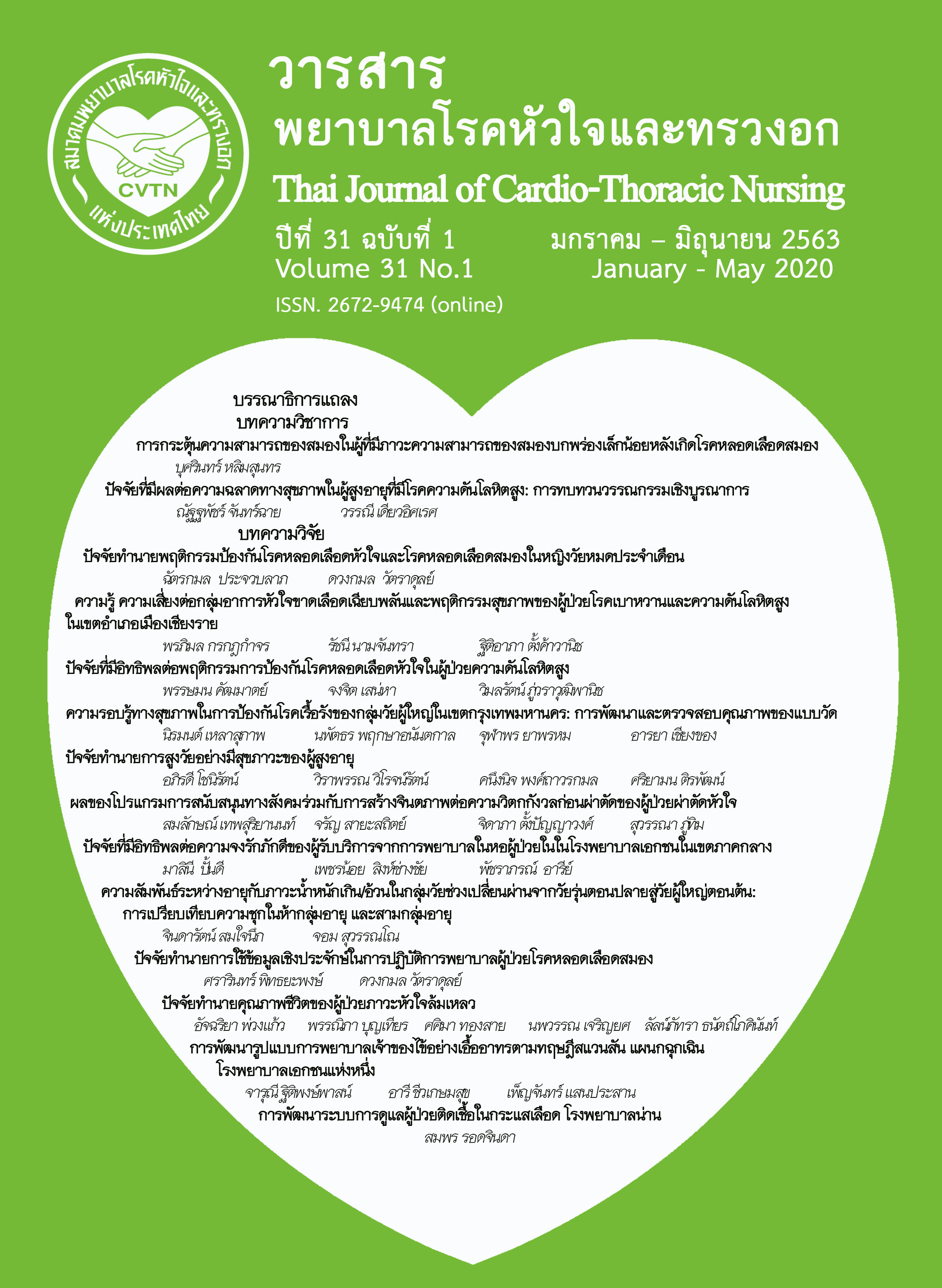
ปัจจัยทำนายการใช้ข้อมูลเชิงประจักษ์ในการปฏิบัติการพยาบาลผู้ป่วย โรคหลอดเลือดสมอง
คำสำคัญ:
ปัจจัยทำนาย, การพยาบาลโดยใช้ข้อมูลเชิงประจักษ์, พยาบาลผู้ดูแลผู้ป่วยโรคหลอดเลือดสมองบทคัดย่อ
การวิจัยเชิงทำนายครั้งนี้มีวัตถุประสงค์เพื่อ 1) ศึกษาความสัมพันธ์ระหว่างข้อมูลส่วนบุคคล การค้นหาและใช้แหล่งข้อมูลเชิงประจักษ์ และอุปสรรคในการปฏิบัติการพยาบาลโดยใช้ข้อมูลเชิงประจักษ์ ต่อพฤติกรรมการใช้ข้อมูลเชิงประจักษ์ในการปฏิบัติการพยาบาลโรคหลอดเลือดสมอง 2) ศึกษาปัจจัยทำนายการปฏิบัติการพยาบาลโดยใช้ข้อมูลเชิงประจักษ์ กลุ่มตัวอย่างเป็นพยาบาลวิชาชีพที่ดูแลผู้ป่วยโรคหลอดเลือดสมองในโรงพยาบาลระดับทุติยภูมิและตติยภูมิ จำนวน 104 คน คัดเลือกกลุ่มตัวอย่างโดยการสุ่มแบบง่ายด้วยโปรแกรมคอมพิวเตอร์ เครื่องมือในการวิจัยประกอบด้วย 1) แบบสอบถามข้อมูลทั่วไป 2) แบบสอบถามการค้นหาและใช้แหล่งข้อมูลเชิงประจักษ์ 3) แบบสอบถามอุปสรรคในการปฏิบัติการพยาบาลโดยใช้ข้อมูลเชิงประจักษ์ และ 4) แบบสอบถามพฤติกรรมการใช้ข้อมูลเชิงประจักษ์ในการปฏิบัติการพยาบาลผู้ป่วยโรคหลอดเลือดสมอง วิเคราะห์ข้อมูลด้วยสถิติสัมประสิทธิ์สหสัมพันธ์ของเพียร์สัน และการถดถอยพหุคูณแบบขั้นตอน
ผลการวิจัยพบว่า พฤติกรรมการใช้ข้อมูลเชิงประจักษ์ในการปฏิบัติการพยาบาลผู้ป่วยโรคหลอดเลือดสมองมีความสัมพันธ์ทางบวกกับหน่วยงานที่ปฏิบัติงาน และการค้นหาและใช้แหล่งของข้อมูลเชิงประจักษ์ระดับ D อย่างมีนัยสำคัญทางสถิติ (p<0.01, r = 0.30 และ r = 0.32) นอกจากนี้การใช้แหล่งข้อมูลเชิงประจักษ์ระดับ D และการปฏิบัติงานในหน่วยโรคหลอดเลือดสมอง (Stroke unit) สามารถทำนายการปฏิบัติการพยาบาลตามหลักฐานเชิงประจักษ์ได้ร้อยละ 16 (R2 = 0.16, p<0.01, β = 0.27 และ 0.23)
ข้อเสนอแนะจากการศึกษา พยาบาลควรได้รับการส่งเสริมให้มีความรู้และความสามารถในการค้นหาข้อมูลเชิงประจักษ์จากแหล่งข้อมูลที่มีคุณภาพและน่าเชื่อถือ รวมทั้งควรได้รับการสนับสนุนและแรงจูงใจในการนำข้อมูลเชิงประจักษ์ไปพัฒนาการปฏิบัติการพยาบาลในกลุ่มผู้ป่วยโรคหลอดเลือดสมอง
เอกสารอ้างอิง
2. Lehane E, Leahy-Warren P, O’Riordan C, Savage E, Drennan J, O’Tuathaigh C, et al. Evidence-based practice education for healthcare professions: an expert view. BMJ Evid Based Med. 2019;24(3):103-8.
3. Pasukunthapuk N, Viparksongkoh S. Development of specialty competency for stroke nurses. Journal of Nursing Division. 2014;41(1):74-87. (in Thai).
4. Baird LM, Miller T. Factors influencing evidence-based practice for community nurses. Br J Community Nurs. 2015;20(5):233-42.
5. Picheansathian W. Searching for evidence: essential skills of nurses in Thailand 4.0. Thai Journal of Nursing and Midwifery Practice. 2018;5(1):136-48. (in Thai)
6. Porter LW, Lawler EE, Hackman JR. Behavior in Organizations. New York: McGraw-Hill Book Company; 1975.
7. Gerrish K, Ashworth P, Lacey A, Bailey J, Cooke J, Kendall S, McNeilly E. Factors influencing the development of evidence-based practice: a research tool. J Adv Nurs. 2007;57(3):328-38.
8. Adib-Hajbaghery M. Factors facilitating and inhibiting evidence-based nursing in Iran. J Adv Nurs. 2007;58(6): 566-75.
9. Dalheim A, Harthug S, Nilsen RM, Nortvedt MW. Factors influencing the development of evidence-based practice among nurses: a self-report survey. BMC Health Serv Res. 2012;12:367. Published 2012 Oct 24. doi:10.1186/1472-6963-12-367
10. Siriruck S, Prasopkittikun T, Nookong A. Factors predicting evidence-based practice of pediatric nurses. Journal of Nursing Science. 2016;34(1):5-15. (in Thai).
11. González-Torrente S, Pericas-Beltrán J, Bennasar-Veny M, Adrover-Barceló R, Morales-Asencio JM, De Pedro-Gómez J. Perception of evidence-based practice and the professional environment of primary health care nurses in the Spanish context: a cross-sectional study. BMC Health Serv Res. 2012;12:227.
12. The Royal College of Physicians of Thailand. Evidence-based medicine & clinical practice guidelines (Clinical practice guidelines). College Bulletin. 2001;18(6):36-47. (in Thai)
13. Numpanon J, Picheansathian W, Jintrawet U. Factors Related to Evidence-based Practice among Pediatric Nurses in Northern Region. Nursing Journal. 2015;42:49-60. (in Thai)
14. McKenna HP, Ashton S, Keeney S. Barriers to evidence-based practice in primary care. J Adv Nurs. 2004;45(2):178–89.
15. Khammarnia M, Haj Mohammadi M, Amani Z, Rezaeian S, Setoodehzadeh F. Barriers to implementation of evidence based practice in zahedan teaching hospitals, iran, 2014. Nurs Res Pract. 2015;2015:357140.
16. Egerod I, Hansen GM. Evidence-based practice among Danish cardiac nurses: a national survey. J Adv Nurs. 2005;33(2):465-73.
17. Faul F. G*Power version 3.1.9.2 [Internet]. 2019 [cited 2019 Jun 9]. Available from: https://www. poycho.uni-uessldorf.de/abteilungen/aap/gpower3/
18. Yoshinaga N, Nakamura Y, Tanoue H, MacLiam F, Aoishi K, Shiraishi Y. Is modified brief assertiveness training for nurses effective? A single-group study with long-term follow-up. J Nurs Manag. 2018;26(1):59‐65.
19. Wattradul D. State of the art care for critical stroke: excellent nursing. Thai journal of critical care medicine. 2017;25(1):441-6. (in Thai).
20. Baessler CA, Blumberg M, Cunningham JS, Curran JA, Fennessey AG, Jacobs AM, et al. Medical-surgical nurses’ utilization of research methods and products. Medsurg Nurs. 1994;3(2):113-41.
21. Middleton S, McElduff P, Ward J, Grimshaw JM, Dale S, D'Este C, et al. Implementation of evidence-based treatment protocols to manage fever, hyperglycaemia, and swallowing dysfunction in acute stroke (QASC): a cluster randomised controlled trial. Lancet. 2011;378(9804):1699-706.
22. Melnyk BM, Ford LG, Long LE, Overholt EF. The establishment of evidence-based practice competencies for practicing registered nurses and advanced practice nurses in real-world clinical settings: proficiencies to improve healthcare quality, reliability, patient outcomes, and costs. Worldviews Evid Based Nurs. 2014;11(1):5-15.
23. Jongruk B, Lertsakornsiri M, Cinnoros S. Factors associated with competency of professional nurses in caring stroke patients. Princess of Naradhiwas University Journal. 2019;11(1):38-49. (in Thai).
24. Thorsteinsson HS. Icelandic nurses’ beliefs, skills, and resources associated with evidence-based practice and related factors: a national survey. Worldviews Evid Based Nurs. 2013;10(2):116-26.
25. Farokhzadian J, Khajouei R, Ahmadian L. Information seeking and retrieval skills of nurses: nurses readiness for evidence based practice in hospitals of a medical university in Iran. Int J Med Inform. 2015;84(8):570-7.
26. Buajeam S, Srisatidnarakul. Nurses’ competencies in stroke unit. Journal of Nursing Science Chulalongkon University. 2014;26 (3):121-33. (in Thai).
27. Namphet T, Wattradul D. Survey behavior of evidence based nursing practice in intensive care unit (ICU). The Journal of Thai Red Cross College of Nursing. 2005;30(3):404-19. (in Thai).
28. Patel PC, Panzera A, Denigris J, Dunn R, Chabot J, Conners S. Evidence-based practice and a nursing journal club: an equation for positive patient outcomes and nursing empowerment. J Nurses Staff Dev. 2011;27 (5):227-30. doi:10.1097/NND. 0b013e31822 d6dbc
29. Retsas A. Barriers to using research evidence in nursing practice. J Adv Nurs. 2000;31(3):599-606.
30. Leasure AR, Stirlen J, Thompson C. Barriers and facilitators to the use of evidence based best practice. Dimens Crit Care Nurs. 2008;27(2):74-82.
31. Saunders H, Vehviläinen-Julkunen K. The state of readiness for evidence-based practice among nurses: an integrative review. Int J Nurs Stud. 2016;56:128-40.
ดาวน์โหลด
เผยแพร่แล้ว
รูปแบบการอ้างอิง
ฉบับ
ประเภทบทความ
สัญญาอนุญาต
บทความนี้ยังไม่เคยตีพิมพ์หรืออยู่ในระหว่างส่งไปตีพิมพ์ในวารสารอื่น ๆ มาก่อน และกองบรรณาธิการขอสงวนสิทธิ์ในการตรวจทาน และแก้ไขต้นฉบับตามเกณฑ์ของวารสาร ในกรณีที่เรื่องของท่านได้ได้รับการตีพิมพ์ในวารสารฉบับนี้ถือว่าเป็น ลิขสิทธิ์ของวารสารพยาบาลโรคหัวใจและทรวงอก