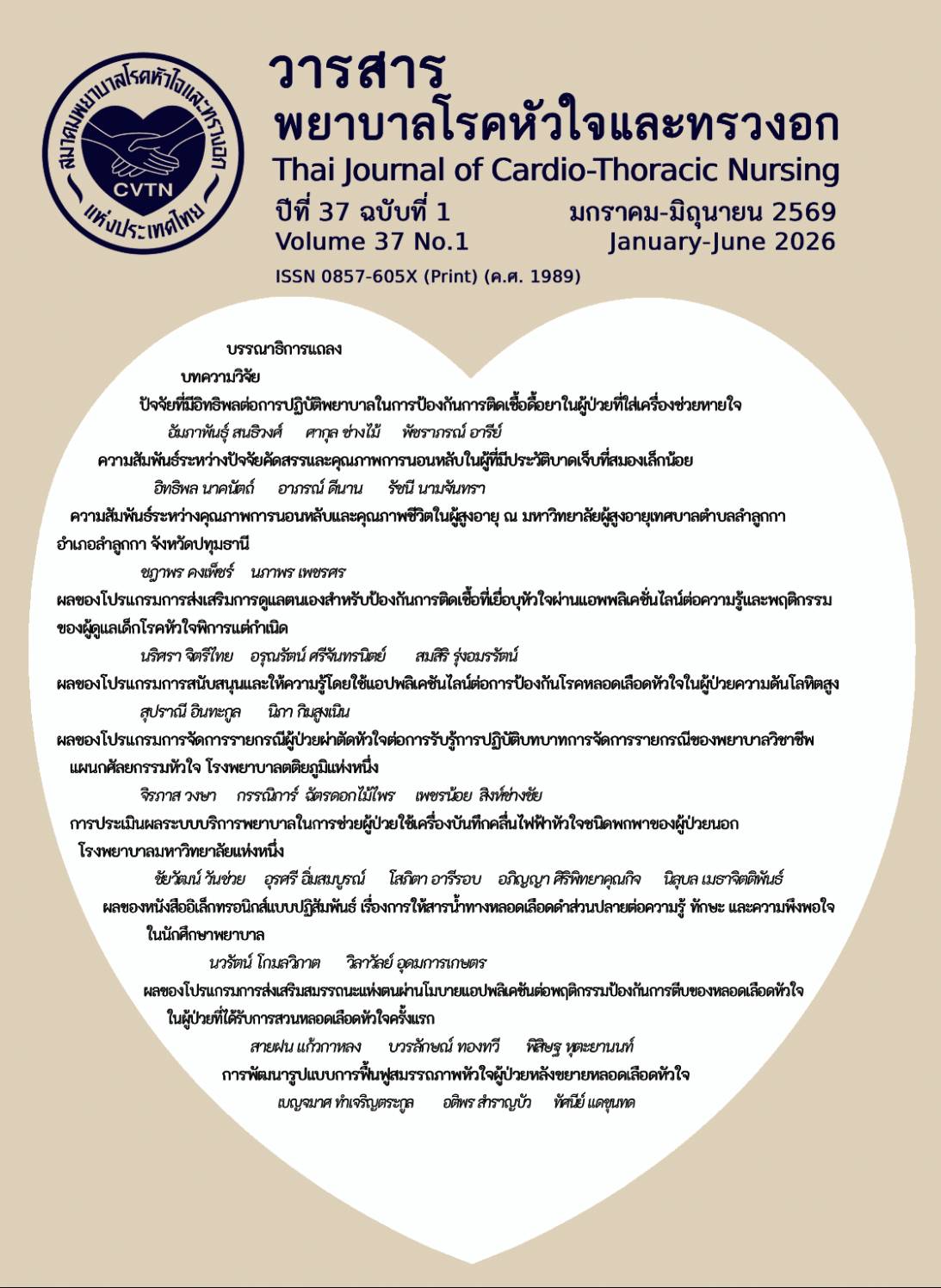
ผลของโปรแกรมการส่งเสริมสมรรถนะแห่งตนผ่านโมบายแอปพลิเคชัน ต่อพฤติกรรมป้องกันการตีบของหลอดเลือดหัวใจ ในผู้ป่วยที่ได้รับการสวนหลอดเลือดหัวใจครั้งแรก
คำสำคัญ:
การรับรู้สมรรถนะแห่งตน, ผู้ป่วยโรคหลอดเลือดหัวใจ, การสวนหลอดเลือดหัวใจบทคัดย่อ
การวิจัยกึ่งทดลองนี้มีวัตถุประสงค์เพื่อศึกษาผลของโปรแกรมการส่งเสริมสมรรถนะแห่งตนผ่านโมบายแอปพลิเคชันต่อพฤติกรรมป้องกันการตีบของหลอดเลือดหัวใจในผู้ป่วยโรคหลอดเลือดหัวใจที่ได้รับการสวนหลอดเลือดหัวใจครั้งแรก จำนวน 59 คน ที่เข้ารับการรักษาเป็นผู้ป่วยในของโรงพยาบาลตติยภูมิแห่งหนึ่งในจังหวัดปทุมธานี คัดเลือกกลุ่มตัวอย่างแบบเฉพาะเจาะจงตามคุณสมบัติที่กำหนด สุ่มเข้ากลุ่มทดลองที่ได้รับการพยาบาลปกติร่วมกับโปรแกรมการส่งเสริมสมรรถนะแห่งตนผ่านโมบายแอปพลิเคชัน (n = 30) และกลุ่มควบคุมที่ได้รับการพยาบาลปกติ (n = 29) เครื่องมือที่ใช้ในการเก็บรวบรวมข้อมูลประกอบด้วย 1) แบบสอบถามข้อมูลทั่วไปและข้อมูลการเจ็บป่วย และ 2) แบบประเมินพฤติกรรมป้องกันการตีบของหลอดเลือดหัวใจ เครื่องมือที่ใช้ในการทดลอง ประกอบด้วย 1) โปรแกรมการส่งเสริมสมรรถนะแห่งตนผ่านโมบายแอปพลิเคชัน 12 สัปดาห์ เครื่องมือที่ใช้กำกับการทดลองประกอบด้วย 1) แบบประเมินการรับรู้สมรรถนะแห่งตนของผู้ป่วยโรคหลอดเลือดหัวใจ วิเคราะห์ข้อมูลโดยใช้สถิติเชิงพรรณนา และวิเคราะห์ความแตกต่างของค่าเฉลี่ยคะแนนพฤติกรรมป้องกันการตีบของหลอดเลือดหัวใจโดยใช้สถิติวิเคราะห์ความแปรปรวนแบบวัดซ้ำสองทาง
ผลการศึกษาพบว่า หลังเข้าร่วมโปรแกรมสัปดาห์ที่ 4 และหลังสิ้นสุดโปรแกรมสัปดาห์ที่ 12 กลุ่มทดลองมีการเพิ่มขึ้นของค่าเฉลี่ยคะแนนพฤติกรรมป้องกันการตีบของหลอดเลือดหัวใจจากก่อนเข้าร่วมโปรแกรมอย่างมีนัยสำคัญทางสถิติ (F(1.55,88.25) = 135.33, p < .001) และหลังเข้าร่วมโปรแกรมสัปดาห์ที่ 4 และหลังสิ้นสุดโปรแกรมสัปดาห์ที่ 12 กลุ่มทดลองมีค่าเฉลี่ยคะแนนพฤติกรรมป้องกันการตีบของหลอดเลือดหัวใจสูงกว่ากลุ่มควบคุมอย่างมีนัยสำคัญทางสถิติ (p < .001, p < .001)
ผลการศึกษาครั้งนี้แสดงให้เห็นว่า การใช้โมบายแอปพลิเคชันในการส่งเสริมสมรรถนะแห่งตนในผู้ป่วยที่ได้รับการสวนหลอดเลือดหัวใจครั้งแรก สามารถเพิ่มความมั่นใจในการดูแลตนเอง และส่งผลทำให้ผู้ป่วยมีพฤติกรรมป้องกันการตีบของหลอดเลือดหัวใจดีขึ้นได้ บุคลากรทางการแพทย์สามารถนำไปพัฒนารูปแบบการดูแลผู้ป่วยโรคหลอดเลือดหัวใจที่ต้องได้รับการกระตุ้นการปฏิบัติพฤติกรรมและติดตามอย่างต่อเนื่อง เพื่อให้เกิดการปฏิบัติพฤติกรรมดูแลสุขภาพอย่างยั่งยืนต่อไป
เอกสารอ้างอิง
Organization WHO. Cardiovascular-diseases (CVDs) [serial online] 2022. 2022 [cited 2025 January 15]. Available from: https://www.who.int/news-room/fact-sheets/detail/cardiovascular-diseases-(cvds)
Ministry of Public Health. The situation of coronary heart disease. [Internet]. Nonthaburi; The Institute; 2023 [cited 2025 January 15]. Available from: https://spd.moph.go.th/public-health-statistics/ (in Thai).
Severino P, D'Amato A, Pucci M, Infusino F, Adamo F, Birtolo LI, et al. Ischemic heart disease pathophysiology paradigms overview: from plaque activation to microvascular dysfunction. Int J Mol Sci. 2020; 21(21). doi.org/10.3390/ijms21218118
Chacko L, P. Howard J, Rajkumar C, Nowbar AN, Kane C, Mahdi D, et al. Effects of percutaneous coronary intervention on death and myocardial infarction stratified by stable and unstable coronary artery disease. Circ Cardiovasc Qual Outcomes. 2020; 13(2):e006363. doi.org/ 10.1161/ circoutcomes. 119.006363
Nordenskjold AM, Lagerqvist B, Baron T, Jernberg T, Hadziosmanovic N, Reynolds HR, et al. Reinfarction in patients with myocardial infarction with nonobstructive coronary arteries (MINOCA): Coronary findings and prognosis. Am J Med. 2019;132(3):335-346. doi.10.1016/j.amjmed.2018.10.007.
Zhang D-M, Chen S. In-Stent Restenosis and a Drug-coated balloon: insights from a clinical therapeutic strategy on coronary artery diseases. Cardiol Res Pract. 2020; 2020(1): 8104939. doi.org/10.1155/2020/8104939
Balghith MA, Alghamdi AM, Ayoub KM, Saleh AA, Aziz MS, Algahtany M, et al. Stent thrombosis is a major concern in clinical practice: a single Saudi center experience. J Saudi Heart Assoc. 2013; 25(4):233-8. doi.org/10.1016/j.jsha.2013.07.001
Koltowski L, Filipiak KJ, Kochman J, Pietrasik A, Huczek Z, Balsam P, et al. Cost-effectiveness of radial vs. femoral approach in primary percutaneous coronary intervention in STEMI - randomized, control trial. Hellenic J Cardiol. 2016; 57(3):198-202. doi.org/10.1016/j.hjc.2016.06.005
Thomas RJ, Beatty AL, Beckie TM, Brewer LC, Brown TM, Forman DE, et al. Home-Based Cardiac Rehabilitation. J Am Coll Cardiol. 2019; 74(1):133-53. doi.org/10.1016/j.jacc.2019.03.008
Rattanaprom A, Srisuk N, Koson N. Self-care behaviors among patients with coronary heart disease after percutaneous coronary intervention. Nurs Sci J Thail. 2023; 41(4):56-72. Available from: https://he02.tci-thaijo.org/index.php/ns/article/view/260610/181046 (in Thai).
Detkaew A, Samartkit N, Masingboon K. Relationships of perceived self-efficacy, lifestyle stress, and social support to health behaviors in adults with acute coronary syndrome post percutaneous coronary intervention. J Fac Nurs Burapha Univ. 2021; 29(2):71-80. Available from: https://he02.tci-thaijo.org/index.php/Nubuu/article/view/251862/171136 (in Thai).
Rasrikrid P, Choowattanapakorn T. The effect of self-efficacy promotion combined with family support program on physical activity in older persons with coronary artery disease receiving percutaneous coronary intervention. Royal Thai Navy Med J. 2019; 46(3):653-68. Available from: https://he01.tci-thaijo.org/index.php/nmdjournal/ article/view/231403 (in Thai).
Lapkern W, Thongthawee B, Piyayotai D. The effect of self-efficacy promotion program in applying qigong with phase 1 cardiac rehabilitation on anxiety among acute coronary syndrome patients undergoing percutaneous coronary intervention. J Thai Cardio-Thorac Nurs. 2024;35(1):66-82. Available from: https://he02.tci-thaijo.org/index.php/ journalthaicvtnurse/ article/view/263565 (in Thai).
Polsook R, Aungsuroch Y, Thongvichean T. The effect of self-efficacy enhancement program on medication adherence among post-acute myocardial infarction. Appl Nurs Res. 2016; 32:67-72. doi.org/10.1016/j.apnr.2016.05.002
Bandura A. self-efficacy: the exercise of control. New York: W. H. Freeman and Company; 1997.
Mulsrisuk S, Yotha J, Chirakorn A, Jaiborisuttigul N, Thammakul C, Ruangpiyasakul P. Effects of a self-efficacy enhancement program on heart failure care behaviors and revisit rates in patients with heart failure. J Thai Nurs Midwifery Counc. 2024; 39(3):439-54. Available from: https://he02.tci-thaijo.org/index.php/TJONC/ article/ view/268078 (in Thai)
Thongsantia N, Tachaudomdach C, Rattanakanlaya K. Effect of a self-efficacy enhancing program on dietary and exercise behaviors in patients with coronary artery disease after receiving percutaneous coronary intervention treatment. J Boromarjonani Coll Nurs Suphanburi. 2026; 9(1):95-111. Available from: https://he02.tci-thaijo.org/index.php/SNC/ article/view/278449 (in Thai).
Sansanayudh N, Chandavimol M, Srimahachota S, Limpijankit T, Hutayanon P, Kiatchoosakun S, et al. Patient characteristics, procedural details, and outcomes of contemporary percutaneous coronary intervention in real-world practice: insights from nationwide Thai PCI Registry. J Interv Cardiol. 2022; 2022(1): 5839834. doi.org/10.1155/2022/5839834
Ministry of Public Health. Policy of the Ministry of Public Health 2025. [Internet]. Nonthaburi; The Institute; 2025 [cited 2026 Apr 19]. Available from: https://spd.moph.go.th/wp-content/uploads/2025/10/1.1-Slide-Policy-_ver10.pdf
Brors G, Pettersen TR, Hansen TB, Fridlund B, Holvold LB, Lund H, Norekval TM. Modes of e-health delivery in secondary prevention programmes for patients with coronary artery disease: a systematic review. BMC Health Serv Res. 2019; 19(1):364. doi.org/10.1186/s12913-019-4106-1
Iribarren SJ, Akande TO, Kamp KJ, Barry D, Kader YG, Suelzer E. Effectiveness of Mobile Apps to Promote Health and Manage Disease: Systematic Review and Meta-analysis of Randomized Controlled Trials. JMIR Mhealth Uhealth. 2021; 9(1):e21563. doi.org/ 10.2196/21563
Boroumand S, Moeini M. The effect of a text message and telephone follow-up program on cardiac self-efficacy of patients with coronary artery disease: a randomized controlled trial. Iran J Nurs Midwifery Res. 2016; 21(2):171–176. Available from: https://journals. lww.com/jnmr/fulltext/2016/21020/the_effect_of_a_text_message_and_telephone.10.aspx
Boonchom V, Khamdam K, Kreutong R. The Development of Android Application for Disseminating Thai Cultural Heritage of the Lower Southern Provinces of Thailand. Thaksin Univ J. 2020; 23(3):31-40. Available from: https://ph02.tci-thaijo.org/index.php/ tsujournal/article /download/ 240094/ 164669/842802 (in Thai).
Kuljitchueawong S. LINE-communicating format on the creativity of smartphone: benefits and limits of application. Executive Journal. 2013; 33(4):42-54. Available from: https://so01.tci-thaijo.org/ index.php/executivejournal/ article/view/80877 (in Thai).
The Heart Association of Thailand under the Royal Patronage of H.M. the King. Cardiac rehabilitation guideline [Internet]. 2010 [cited 2025 January 15]. Available from: https://www. slideshare. net/slideshow/2553-78162432/78162432 (in Thai).
Shim JL, Hwang SY. Long-term effects of nurse-led individualized education on middle-aged patients with acute coronary syndrome: a quasi-experimental study. BMC Nurs. 2017; 16(1):59. doi.org/10.1186/s12912-017-0254-y
Srisatidnarakul B. Effect size, power analysis, and sample size calculation using G*Power. 1st ed. Bangkok: Chulalongkorn University Press; 2020. (in Thai).
Borson S, Scanlan JM, Chen P, Ganguli M. The Mini-Cog as a screen for dementia: validation in a population-based sample. J Am Geriatr Soc. 2003; 51(10):1451-4. doi.org/10.1046/j.1532-5415.2003.51465.x
Trongsakul S. The prevalence of undiagnosed cognitive impairment and prevalence of undiagnosed depressive mood in over 60s with type 2 diabetes in a Thai community: a cross-sectional study. [Doctoral Thesis]. Norwich: University of East Anglia; 2013. Available from: https://ueaeprints.uea.ac.uk/id/eprint/43121
Potjamanpong P, Kritpracha C, Chinnawong T. Effect of self-efficacy integration with family support program on behaviors to prevent heart attack recurrence in patients with acute myocardial infarction after revascularization. Songklanagarind J Nurs. 2015; 35(1):49-66. Available from: https://he02.tci-thaijo. org/ index. php/nur-psu/article/view/33092/28140 (in Thai).
Sullivan, Mark D, LaCroix, Andrea Z., Russo, Joan, et al. Self-efficacy and self-reported functional status in coronary heart disease: a six-month prospective study. Psychosom Med. 1998; 60(4):473-78. doi.org/10.1097/00006842-199807000-00014
Saengsiri A, Thanasilp S, Preechawong S. A psychometric evaluation of the thai version of the cardiac self-efficacy questionnaire for patients with coronary artery disease. J Health Res. 2017; 27(6):383-9. Aavailable from: https://he01.tci-thaijo.org/index.php/ jhealthres/article/view/88724/69763
Panyakom S, Chensirimongkol J. The effects of a digital media-based self-efficacy promotion program post-discharge on the self-care behaviors of colorectal cancer patients with ostomies. Thai Red Cross Nurs J. 2024; 17(3):105-120. Available from: https://he02.tci-thaijo.org/index.php/trcnj/article/view/269571 (in Thai).
Praditkitku C, Wattanakitkrileart D, Phligbua W, Srimahachota S. The effect of a self-care program via LINE application on self-care in patients undergoing percutaneous coronary intervention. J R Thai Army Nurses. 2024; 25(1):423-31. Available from: https://he01.tci-thaijo.org/index.php/JRTAN/article/view/263423 (in Thai).
ดาวน์โหลด
เผยแพร่แล้ว
รูปแบบการอ้างอิง
ฉบับ
ประเภทบทความ
สัญญาอนุญาต
ลิขสิทธิ์ (c) 2026 วารสารพยาบาลโรคหัวใจและทรวงอก

อนุญาตภายใต้เงื่อนไข Creative Commons Attribution-NonCommercial-NoDerivatives 4.0 International License.
บทความนี้ยังไม่เคยตีพิมพ์หรืออยู่ในระหว่างส่งไปตีพิมพ์ในวารสารอื่น ๆ มาก่อน และกองบรรณาธิการขอสงวนสิทธิ์ในการตรวจทาน และแก้ไขต้นฉบับตามเกณฑ์ของวารสาร ในกรณีที่เรื่องของท่านได้ได้รับการตีพิมพ์ในวารสารฉบับนี้ถือว่าเป็น ลิขสิทธิ์ของวารสารพยาบาลโรคหัวใจและทรวงอก