
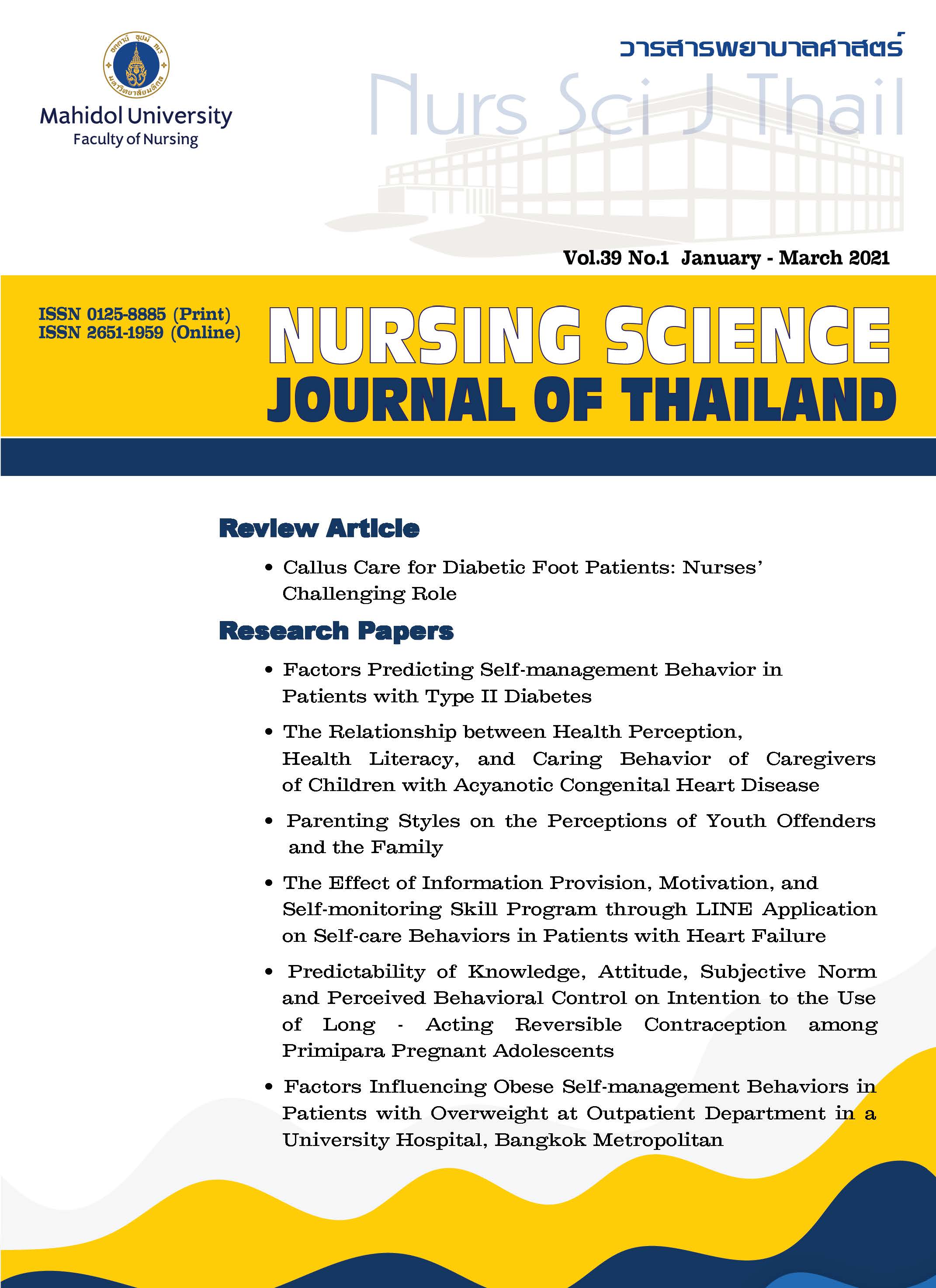
ผลของโปรแกรมการให้ข้อมูล แรงจูงใจ และทักษะการเฝ้าระวังตนเองผ่านแอปพลิเคชันไลน์ต่อพฤติกรรมการดูแลตนเองในผู้ป่วยภาวะหัวใจล้มเหลว
Article Sidebar
Main Article Content
บทคัดย่อ
วัตถุประสงค์: เพื่อศึกษาผลของโปรแกรมการให้ข้อมูล แรงจูงใจ และทักษะการเฝ้าระวังตนเองผ่านแอปพลิเคชันไลน์ต่อพฤติกรรมการดูแลตนเองในผู้ป่วยภาวะหัวใจล้มเหลว
รูปแบบการวิจัย: การวิจัยเชิงทดลองแบบสุ่มและมีกลุ่มควบคุม
วิธีดำเนินการวิจัย: กลุ่มตัวอย่างเป็นผู้ป่วยภาวะหัวใจล้มเหลวอายุ 18 ปีขึ้นไป จำนวน 64 ราย ที่เข้ารับการรักษาที่แผนกผู้ป่วยนอก โรงพยาบาลตติยภูมิแห่งหนึ่งในกรุงเทพมหานคร มีระดับความรุนแรงของภาวะหัวใจล้มเหลว NYHA Functional class I-III มีโทรศัพท์สมาร์ทโฟนและสามารถใช้งานแอปพลิเคชันไลน์ได้ โดยทำการสุ่มอย่างง่ายเข้ากลุ่มทดลองและกลุ่มควบคุม กลุ่มละ 32 ราย ระหว่างการทดลอง กลุ่มตัวอย่างถอนตัวออกจากการวิจัยกลุ่มละ 1 ราย กลุ่มควบคุมได้รับการพยาบาลตามปกติ กลุ่มทดลองได้รับโปรแกรมการให้ข้อมูล แรงจูงใจ และทักษะการเฝ้าระวังตนเองผ่านแอปพลิเคชันไลน์ ตั้งแต่เดือนกุมภาพันธ์ถึงเดือนมิถุนายน 2563 ประเมินผลพฤติกรรมการดูแลตนเองโดยใช้แบบสอบถามพฤติกรรมการดูแลตนเองผู้ป่วยภาวะหัวใจล้มเหลวยูโรเปี้ยน วิเคราะห์เปรียบเทียบผลพฤติกรรมการดูแลตนเองโดยใช้สถิติการทดสอบทีแบบสองกลุ่มอิสระ และแบบสองกลุ่มที่สัมพันธ์กัน
ผลการวิจัย: หลังการทดลองพบว่า กลุ่มทดลองที่ได้รับโปรแกรมการให้ข้อมูล แรงจูงใจ และทักษะการเฝ้าระวังตนเองผ่านแอปพลิเคชันไลน์มีพฤติกรรมการดูแลตนเองดีกว่าก่อนได้รับโปรแกรม (t = 9.67, p < .01) และพบว่ากลุ่มทดลองมีคะแนนเฉลี่ยพฤติกรรมการดูแลตนเองมากกว่ากลุ่มควบคุม อย่างมีนัยสำคัญทางสถิติ (t = -7.13 , p < .01)
สรุปและข้อเสนอแนะ: โปรแกรมการให้ข้อมูล แรงจูงใจ และทักษะการเฝ้าระวังตนเองผ่านแอปพลิเคชันไลน์ช่วยส่งเสริมให้ผู้ป่วยภาวะหัวใจล้มเหลวมีพฤติกรรมการดูแลตนเองมากขึ้นได้ ดังนั้น พยาบาลควรนำโปรแกรมนี้ไปประยุกต์ใช้ในผู้ป่วยภาวะหัวใจล้มเหลว เพื่อส่งเสริมให้ผู้ป่วยมีพฤติกรรมการดูแลตนเองที่ดีขึ้นต่อไป
Article Details
ลิขสิทธิ์: วารสารพยาบาลศาสตร์เป็นเจ้าของลิขสิทธิ์ในการเผยแพร่ผลงานที่ตีพิมพ์ ห้ามผู้ใดนำบทความที่ได้รับการตีพิมพ์ในวารสารพยาบาลศาสตร์ไปเผยแพร่ในลักษณะต่างๆ ดังต่อไปนี้ การส่งบทความไปตีพิมพ์เผยแพร่ที่อื่น การนำบทความเผยแพร่ออนไลน์ การถ่ายเอกสารบทความเพื่อกิจกรรมที่ไม่ใช่การเรียนการสอน ยกเว้นเสียแต่ได้รับอนุญาตจากวารสารพยาบาลศาสตร์
Disclaimer: เนื้อหาบทความหรือข้อคิดเห็นใดๆ ในวารสารพยาบาลศาสตร์ ถือเป็นความรับผิดชอบของผู้เขียน กองบรรณาธิการไม่จำเป็นต้องเห็นด้วยและไม่มีส่วนรับผิดชอบแต่อย่างใด
เอกสารอ้างอิง
Groenewegen A, Rutten FH, Mosterd A, Hoes AW. Epidemiology of heart failure. Eur J Heart Fail. 2020. doi: 10.1002/ejhf.1858.
Bureau of Policy and Strategy, Office of the Permanent Secretary, Ministry of Public Health. Public health statistics A.D. 2015 [internet]. Nonthaburi: Bureau of Policy and Strategy; 2015 [cite 2019 Aug 22]. Available from: http://bps.moph.go.th/new_bps/sites/default/files/health_statistic2558.pdf. (in Thai).
Gardner RS, McDonagh TA, Walker NL. Heart failure. 2nd ed. Oxford: Oxford University Press; 2014. 512 p.
Heart Failure Council of Thailand, The Heart Association of Thailand under the Royal Patronage. Heart Failure Council of Thailand (HFCT) 2019 heart failure guideline. Samut Prakan: Nextstep D-sign; 2019. 61 p. (in Thai).
Ponikowski P, Voors AA, Anker SD, Bueno H, Cleland JGF, Coats AJS, et al. 2016 ESC guidelines for the diagnosis and treatment of acute and chronic heart failure: the task force for the diagnosis and treatment of acute and chronic heart failure of the European Society of Cardiology (ESC) developed with the special contribution of the Heart Failure Association (HFA) of the ESC. Eur J Heart Fail. 2016;37(27):2129-200. doi: 10.1093/eurheartj/ehw128.
Riegel B, Moser DK, Buck HG, Dickson VV, Dunbar SB, Lee CS, et al. Self-care for the prevention and management of cardiovascular disease and stroke: a scientific statement for healthcare professionals from the American Heart Association. J Am Heart Assoc. 2017;6(9):e006997. doi: 10.1161/JAHA.117.006997.
Jaarsma T, Árestedt KF, Måtensson J, Dracup K, Strömberg A. The European Heart Failure Self-care Behaviour scale revised into a nine-item scale (EHFScB-9): a reliable and valid international instrument. Eur J Heart Fail. 2009;11(1):99-105. doi: 10.1093/eurjhf/hfn007.
Vellone E, Jaarsma T, Strömberg A, Fida R, Årestedt K, Rocco G, et al. The European heart failure self-care behaviour scale: new insights into factorial structure, reliability, precision and scoring procedure. Patient Educ Couns. 2014;94(1):97-102. doi: 10.1016/j.pec.2013.09.014.
Poungkaew A, Sindhu S, Pinyopasakul W, Tresukosol D, Viwatwongkasem C. Evaluation of a health service system for heart failure management in Thailand. Suranaree Journal of Science and Technology. 2018;25(3):295-306.
Fisher JD, Fisher WA. Changing AIDS-risk behavior. Psychol Bull. 1992;111(3):455-74. doi: 10.1037/0033-2909.111.3.455.
Toukhsati SR, Driscoll A, Hare DL. Patient self-management in chronic heart failure - establishing concordance between guidelines and practice. Card Fail Rev. 2015;1(2):128-31. doi: 10.15420/cfr.2015.1.2.128.
Brahmbhatt DH, Cowie MR. Remote management of heart failure: an overview of telemonitoring technologies. Card Fail Rev. 2019;5(2):86-92. doi: 10.15420/cfr.2019.5.3.
Athilingam P, Jenkins B, Johansson M, Labrador M. A mobile health intervention to improve self-care in patients with heart failure: pilot randomized control trial. JMIR Cardio. 2017;1(2):e3. doi: 10.2196/cardio.7848.
Grustam AS, Severens JL, De Massari D, Buyukkaramikli N, Koymans R, Vrijhoef HJM. Cost-effectiveness analysis in telehealth: a comparison between home telemonitoring, nurse telephone support, and usual care in chronic heart failure management. Value Health. 2018;21(7):772-82. doi: 10.1016/j.jval.2017.11.011.
Chimkaew J, Juntarawijit Y, Tansuphaswasdikhul S. Effects of supportive educative nursing system on self-care behaviors among patients with heart failure who readmit in hospital. Journal of Nursing and Health Sciences. 2018;12(Special Issue):86-96. (in Thai).
Terdsudthironapoom P. The effects of self-care promoting program on self-care behaviors and quality of life among patients with heart failure in Prachuapkhirikhan hospital. Thai Journal of Cardio-Thoracic Nursing. 2015;26(1):2-14. (in Thai).
Khitka P, Sittisombu S, Chaiard J. Interventions for promoting self-care behaviors among persons with heart failure: a systematic review. Nursing Journal. 2017;44(4):71-80. (in Thai).
Al-Sutari M, Ahmad M. The effect of educational program on self-care behaviors and health outcome among patients with heart failure: an experimental study. Int J Evid Based Healthc. 2017;15:1-8. doi: 10.1097/XEB.0000000000000108.
Wagenaar KP, Broekhuizen BD, Rutten FH, Strömberg A, van Stel HF, Hoes AW, et al. Interpretability of the European heart failure self-care behaviour scale. Patient Prefer Adherence. 2017;11:1841-9. doi: 10.2147/PPA.S144915.
Reid KRY, Reid K, Esquivel JH, Thomas SC, Rovnyak V, Hinton I, et al. Using video education to improve outcomes in heart failure. Heart Lung. 2019;48(5):386-94. doi: 10.1016/j.hrtlng.2019.05.004.
Jeon E, Park H-A. Experiences of patients with a diabetes self-care app developed based on the information-motivation-behavioral skills model: before-and-after study. JMIR Diabetes. 2019;4(2):e11590. doi: 10.2196/11590.
Aamodt IT, Lycholip E, Celutkiene J, von Lueder T, Atar D, Falk RS, et al. Self-care monitoring of heart failure symptoms and lung impedance at home following hospital discharge: longitudinal study. J Med Internet Res. 2020;22(1):e15445. doi: 10.2196/15445.
Jintana P, Sriyuktasuth A, Pongthavornkamol K, Nata N. Information-motivation-behavioral skills program improved phosphate binder adherence in patients with chronic hemodialysis. Journal of Nursing Science. 2016;34(2):92-101. (in Thai).
Polhan B, Wattanakitkrileart D, Pongthavornkamol K. The effects of education and inhaler skills program through line application on symptom control among asthmatic patient. Journal of The Royal Thai Army Nurses. 2019;20(3):93-103. (in Thai).
Wang X-H, Qiu J-B, Ju Y, Chen G-C, Yang J-H, Pang J-H, et al. Reduction of heart failure rehospitalization using a weight management education intervention. J Cardiovasc Nurs. 2014;29(6):528-34. doi: 10.1097/JCN.0000000000000092.
