
Evaluating a Modified Sputum Preparation Method for Improved qRT-PCR Detection of COVID-19
DOI:
https://doi.org/10.33165/rmj.48.03.e270736Keywords:
qRT-PCR, Sputum sample, Modified sample preparation method, COVID-19Abstract
Background: An appropriate specimen is the crucial for quantitative reverse transcriptase–polymerase chain reaction (qRT-PCR) detection of COVID-19. Sputum is suitable specimen due to its noninvasive and simple collection process. For reference method, sputum samples were prepared by adding normal saline in a 1:2 ratio, followed by mixing and vortexing until fully dissolved. However, its sticky and vicious nature can hinder the preparation process and delay results. Therefore, a modified sample preparation was required during the COVID-19 pandemic.
Objective: To compare a modified sample preparation method with reference method for sputum specimens in the detection of COVID-19 by qRT-PCR.
Methods: Leftover sputum specimens were included and prepared in parallel using both the modified sample preparation and reference methods. qRT-PCR for COVID-19 was performed using the Seegene Allplex SAR-CoV2 master assay. Sensitivity, specificity, and other performance parameters were statistically analyzed. Cycle threshold (Ct) values of target genes (E, RdRp/S, N, and S variants) from both methods were compared.
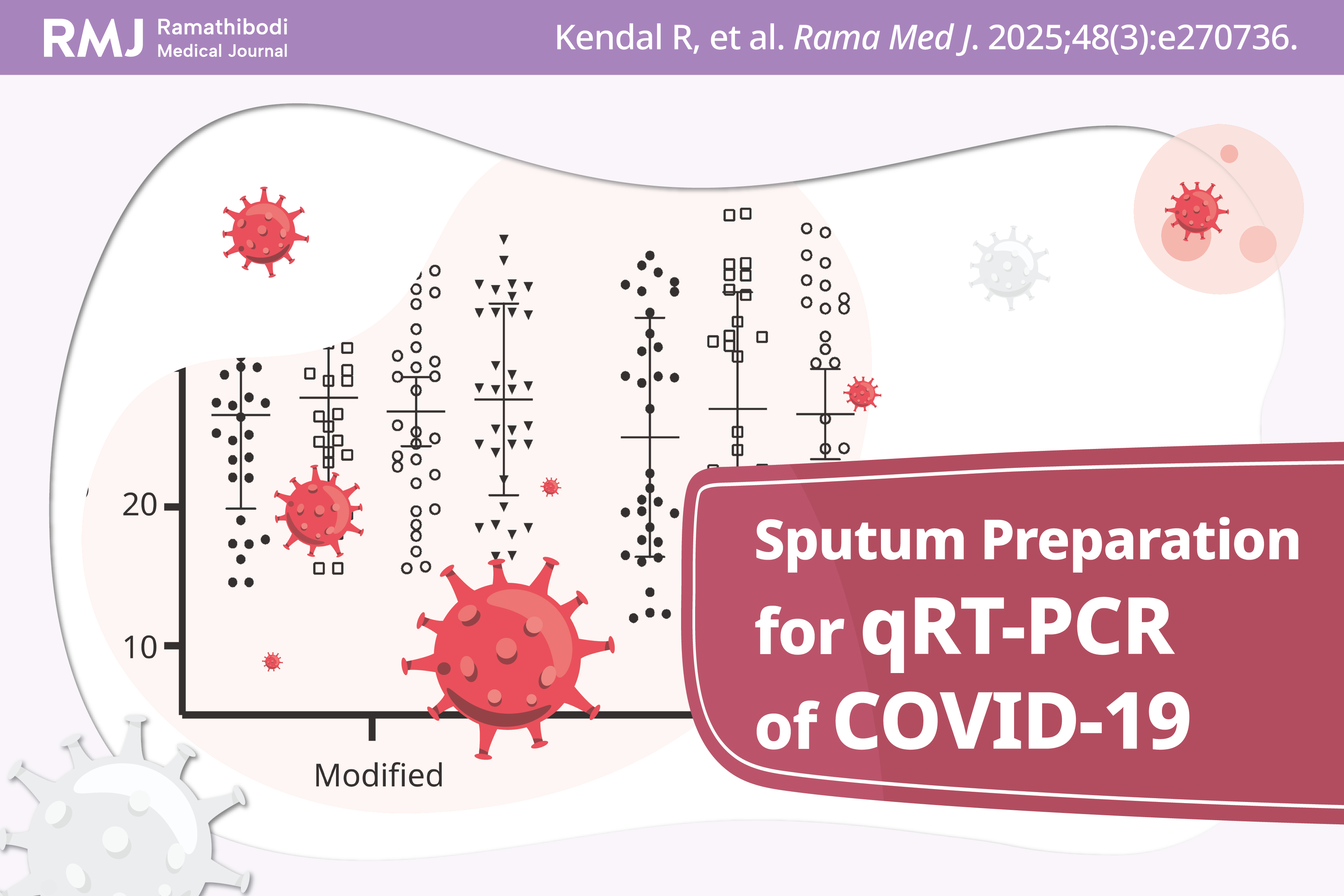
Result: A total of 202 samples were examined. The modified sample preparation and reference methods yield positive results of 32 (15.8%) and 31 (15.3%), inconclusive results of 1 (0.5%) and 5 (2.5%), invalid results of 4 (2.0%) and 27 (13.4%), and negative results of 165 (81.7%) and 139 (68.8%), respectively. The sensitivity and specificity were 86.7% and 100%, respectively, with positive predictive value of 100% and negative predictive value of 97.1%. There were no statistically significant differences in Ct values for the E, RdRp/S, N, and S variants between the 2 methods with P values of .169, .421, .513, and .172, respectively.
Conclusions: The modified sample preparation method can be used during a COVID-19 pandemic while maintaining the reliable accuracy and reducing turnaround time.
References
Naqvi AAT, Fatima K, Mohammad T, et al. Insights into SARS-CoV-2 genome, structure, evolution, pathogenesis and therapies: structural genomics approach. Biochim Biophys Acta Mol Basis Dis. 2020;1866(10):165878. doi:10.1016/j.bbadis.2020.165878
Sawicki SG, Sawicki DL, Siddell SG. A contemporary view of coronavirus transcription. J Virol. 2007;81(1):20-29. doi:10.1128/jvi.01358-06
Caliendo AM, Hanson KE. COVID-19: Diagnosis. UpToDate. 18 December 2024. Accessed 24 December 2024. https://www.uptodate.com/contents/covid-19-diagnosis
Zhou P, Yang XL, Wang XG, et al. A pneumonia outbreak associated with a new coronavirus of probable bat origin. Nature. 2020;579(7798):270-273. doi:10.1038/s41586-020-2012-7
Coronaviridae Study Group of the International Committee on Taxonomy of Viruses. The species Severe acute respiratory syndrome-related coronavirus: classifying 2019-nCoV and naming it SARS-CoV-2. Nat Microbiol. 2020;5(4):536-544. doi:10.1038/s41564-020-0695-z
US Food and Drug Administration. FAQs on Testing for SARS-CoV-2. 11 August 2023. Accessed 24 December 2024. https://www.fda.gov/medical-devices/coronavirus-covid-19-and-medical-devices/faqs-testing-sars-cov-2
Vandenberg O, Martiny D, Rochas O, van Belkum A, Kozlakidis Z. Considerations for diagnostic COVID-19 tests. Nat Rev Microbiol. 2021;19(3):171-183. doi:10.1038/s41579-020-00461-z
Lin C, Xiang J, Yan M, Li H, Huang S, Shen C. Comparison of throat swabs and sputum specimens for viral nucleic acid detection in 52 cases of novel coronavirus (SARS-Cov-2)-infected pneumonia (COVID-19). Clin Chem Lab Med. 2020;58(7):1089-1094. doi:10.1515/cclm-2020-0187
Akowuah E, Acheampong G, Ayisi-Boateng NK, et al. Comparable detection of SARS-CoV-2 in sputum and oropharyngeal swab samples of suspected COVID-19 patients. COVID. 2022;2(7):858-866. doi:10.3390/covid2070062
Uddin MKM, Shirin T, Hossain ME, et al. Diagnostic performance of self-collected saliva versus nasopharyngeal swab for the molecular detection of SARS-CoV-2 in the clinical setting. Microbiol Spectr. 2021;9(3):e0046821. doi:10.1128/spectrum.00468-21
Tsujimoto Y, Terada J, Kimura M, et al. Diagnostic accuracy of nasopharyngeal swab, nasal swab and saliva swab samples for the detection of SARS-CoV-2 using RT-PCR. Infect Dis. 2021;53(8):581-589. doi:10.1080/23744235.2021.1903550
Fan G, Qin X, Streblow DN, Hoyos CM, Hansel DE. Comparison of SARS-CoV-2 PCR-based detection using saliva or nasopharyngeal swab specimens in asymptomatic populations. Microbiol Spectr. 2021;9(1):e0006221. doi:10.1128/spectrum.00062-21
Kiryanov SA, Levina TA, Kadochnikova VV, Konopleva MV, Suslov AP, Trofimov DY. Clinical evaluation of nasopharyngeal, oropharyngeal, nasal swabs, and saliva for the detection of SARS-CoV-2 by direct RT-PCR. Diagnostics. 2022;12(5):1091. doi:10.3390/diagnostics12051091
Thwe PM, Ren P. Analysis of sputum/tracheal aspirate and nasopharyngeal samples for SARS-CoV-2 detection by laboratory-developed test and panther fusion system. Diagn Microbiol Infect Dis. 2021;99(1):115228. doi:10.1016/j.diagmicrobio.2020.115228
Guzman NA, Guzman DE. A COVID-19 infection with positive sputum and negative nasopharyngeal/oropharyngeal rapid antigen-based testing: a case report and pilot study. Med Clin Case Rep J. 2023;1(2):77-84. doi:10.51219/mccrj/norberto-a-guzman/22
Department of Disease Control, Ministry of Public Health. Guidelines for Surveillance and Investigation of Coronavirus Disease 2019 (COVID-19). Published 1 December 2021. Updated 22 December 2021. Accessed 24 December 2024. https://ddc.moph.go.th/viralpneumonia/eng/file/guidelines/g_GSI_22Dec21.pdf
Sharma K, Aggarwala P, Gandhi D, et al. Comparative analysis of various clinical specimens in detection of SARS-CoV-2 using rRT-PCR in new and follow up cases of COVID-19 infection: quest for the best choice. PLoS One. 2021;16(4):e0249408. doi:10.1371/journal.pone.0249408
Mohammadi A, Esmaeilzadeh E, Li Y, Bosch RJ, Li JZ. SARS-CoV-2 detection in different respiratory sites: a systematic review and meta-analysis. EBioMedicine. 2020;59:102903. doi:10.1016/j.ebiom.2020.102903
Zhang H, Chen M, Zhang Y, et al. The yield and consistency of the detection of SARS-CoV-2 in multiple respiratory specimens. Open Forum Infect Dis. 2020;7(10):ofaa379. doi:10.1093/ofid/ofaa379
Wang W, Xu Y, Gao R, et al. Detection of SARS-CoV-2 in different types of clinical specimens. JAMA. 2020;323(18):1843-1844. doi:10.1001/jama.2020.3786
Chan JF, Yuan S, Kok KH, et al. A familial cluster of pneumonia associated with the 2019 novel coronavirus indicating person-to-person transmission: a study of a family cluster. Lancet. 2020;395(10223):514-523. doi:10.1016/S0140-6736(20)30154-9
Liu R, Han H, Liu F, et al. Positive rate of RT-PCR detection of SARS-CoV-2 infection in 4880 cases from one hospital in Wuhan, China, from Jan to Feb 2020. Clin Chim Acta. 2020;505:172-175. doi:10.1016/j.cca.2020.03.009
Downloads
Published
How to Cite
Issue
Section
License
Copyright (c) 2025 by the Author(s). Licensee RMJ.

This work is licensed under a Creative Commons Attribution 4.0 International License.