
Endogenous Endophthalmitis Caused by Group B Streptococcus Following Urinary Tract Infection
DOI:
https://doi.org/10.33165/rmj.48.02.e271521Keywords:
Group B Streptococcus, Endogenous endophthalmitis, Urinary tract infectionAbstract
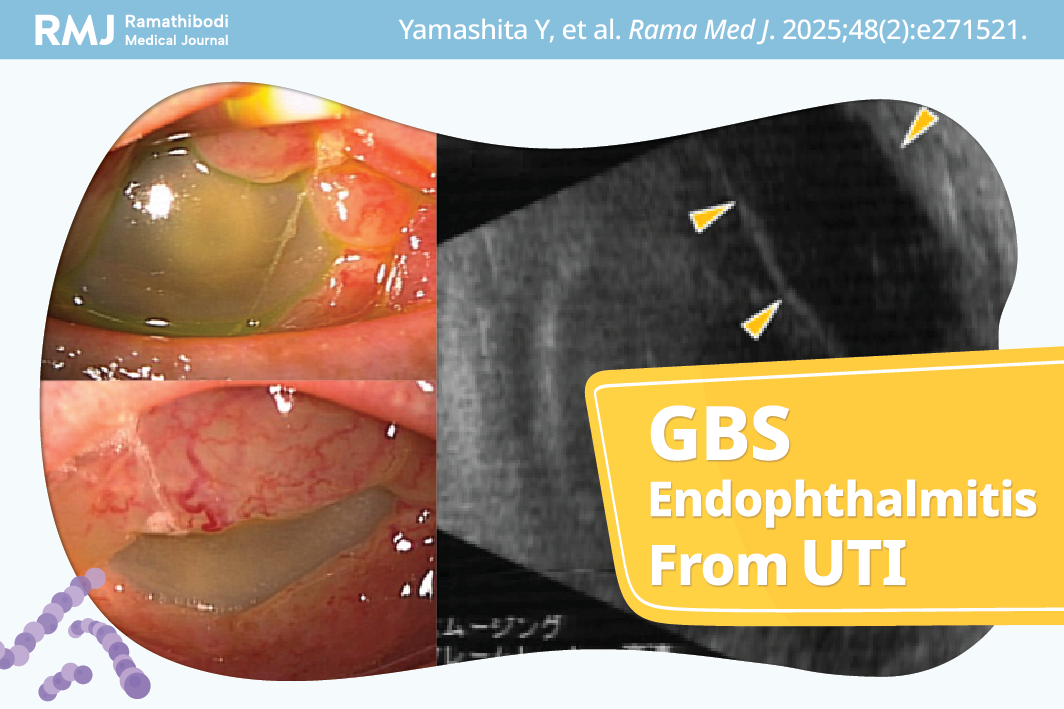
Background: Endogenous endophthalmitis is a condition where infection spreads hematogenously to the eye. Group B Streptococcus (GBS) is a rare causative microorganism of endogenous endophthalmitis. A case of endogenous endophthalmitis caused by GBS secondary to urinary tract infection (UTI) is reported.
Case Presentation: An 83-year-old male presented with decreased visual acuity, ocular pain, and headache in his right eye three days after experiencing lower back pain. Initial examination revealed light perception in visual acuity, intraocular pressure of 30 mmHg, hypopyon in the anterior chamber, and severe vitreous opacity in the right eye. There was no history of trauma or ophthalmic surgery. The patient had been self-catheterizing due to chronic ureteral obstruction. Aqueous and vitreous samples were collected and blood tests and a urine culture were performed for microbiological examination. On the same day as the initial visit, vitrectomy was performed. Intraoperatively, extensive retinal necrosis and total retinal detachment were observed. Gram-positive cocci were detected in the aqueous humor, and GBS was isolated from both vitreous and urine cultures. Blood tests showed elevated levels of inflammatory markers, with a C-reactive protein of 5.4 mg/dL, and undiagnosed diabetes mellitus was found. Intensive antibiotic therapy resolved the inflammation, although, visual acuity did not improve.
Conclusions: Endogenous endophthalmitis was caused by GBS occurred secondary to UTI. Systemic assessment is crucial for diagnosing endogenous endophthalmitis, and early and appropriate treatment is essential.
References
Jackson TL, Paraskevopoulos T, Georgalas I. Systematic review of 342 cases of endogenous bacterial endophthalmitis. Surv Ophthalmol. 2014;59(6):627-635. doi:10.1016/j.survophthal. 2014.06.002
Wu ZH, Chan RP, Luk FO, et al. Review of clinical features, microbiological spectrum, and treatment outcomes of endogenous endophthalmitis over an 8-year period. J Ophthalmol. 2012;2012:265078. doi:10.1155/2012/265078
Durand ML. Bacterial and fungal endophthalmitis. Clin Microbiol Rev. 2017;30(3):597-613. doi:10.1128/CMR.00113-16
Danielescu C, Anton N, Stanca HT, Munteanu M. Endogenous endophthalmitis: a review of case series published between 2011 and 2020. J Ophthalmol. 2020;2020:8869590. doi:10.1155/2020/8869590
Jackson TL, Eykyn SJ, Graham EM, Stanford MR. Endogenous bacterial endophthalmitis: a 17-year prospective series and review of 267 reported cases. Surv Ophthalmol. 2003;48(4):403-423. doi:10.1016/s0039-6257(03)00054-7
Wong JS, Chan TK, Lee HM, Chee SP. Endogenous bacterial endophthalmitis: an East Asian experience and a reappraisal of a severe ocular affliction. Ophthalmology. 2000;107(8):1483-1491. doi:10.1016/s0161-6420(00)00216-5
Lee SY, Chee SP. Group B Streptococcus endogenous endophthalmitis: case reports and review of the literature. Ophthalmology. 2002;109(10):1879-1886. doi:10.1016/s0161-6420(02)01225-3
Yoshida M, Yokokura S, Nishida T, et al. Endogenous endophthalmitis caused by group B streptococcus; case reports and review of 35 reported cases. BMC Ophthalmol. 2020;20(1):126. doi:10.1186/s12886-020-01378-0
Lu X, Ng DS, Zheng K, et al. Risk factors for endophthalmitis requiring evisceration or enucleation. Sci Rep. 2016;6:28100. doi:10.1038/srep28100
Bjerrum SS, la Cour M. 59 eyes with endogenous endophthalmitis- causes, outcomes and mortality in a Danish population between 2000 and 2016. Graefes Arch Clin Exp Ophthalmol. 2017;255(10):2023-2027. doi:10.1007/s00417-017-3760-4
Gajdzis M, Figuła K, Kamińska J, Kaczmarek R. Endogenous endophthalmitis-the clinical significance of the primary source of infection. J Clin Med. 2022;11(5):1183. doi:10.3390/jcm11051183
Yang Y, Wong Y, Li Y, et al. Clinical features, antibiotic susceptibilities, and outcomes of endophthalmitis caused by streptococcal infection: children vs. adults. Antibiotics (Basel). 2023;12(6):962. doi:10.3390/antibiotics12060962
Ren C, Li Z, Meng F, Du Y, Sun H, Guo B. Endogenous endophthalmitis caused by urinary tract infection: a case report. Medicine (Baltimore). 2023;102(46):e36139. doi:10.1097/MD.0000000000036139
Russell NJ, Seale AC, O’Driscoll M, et al. Maternal colonization with group B Streptococcus and serotype distribution worldwide: systematic review and meta-analyses. Clin Infect Dis. 2017;65(suppl_2):S100-S111. doi:10.1093/cid/cix658
Phares CR, Lynfield R, Farley MM, et al. Epidemiology of invasive group B streptococcal disease in the United States, 1999-2005. JAMA. 2008;299(17):2056-2065. doi:10.1001/jama.299.17.2056
Downloads
Published
How to Cite
Issue
Section
License
Copyright (c) 2025 by the Author(s). Licensee RMJ.

This work is licensed under a Creative Commons Attribution 4.0 International License.