
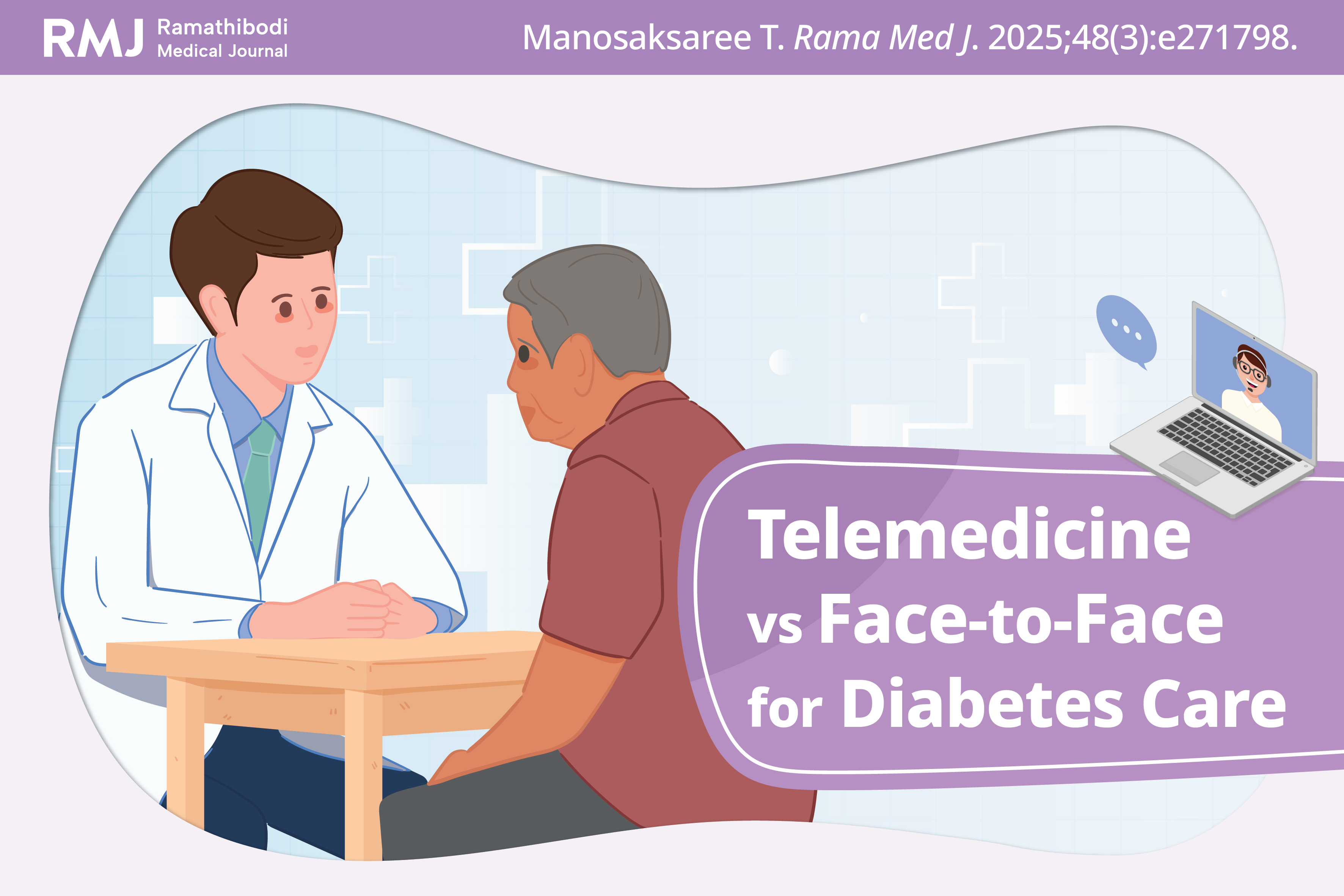
A Comparison of Treatment Outcomes for Diabetes Between Telemedicine and Face-to-Face Interaction Modality in Primary Care Setting
DOI:
https://doi.org/10.33165/rmj.48.03.e271798Keywords:
Telemedicine, Diabetes control, Face-to-face interaction modalitiesAbstract
Background: Diabetes is a chronic disease and a significant global health issue. Currently, there are various treatment methods available, and telemedicine has become one of the widely used approaches today. However, there is still a lack of studies on its effectiveness, and patients remain concerned about the outcomes of their treatments.
Objective: To compare treatment outcomes for diabetic patients between telemedicine and face-to-face interaction modalities.
Methods: This study was a quasi-experimental design to compare 2 service delivery models between telemedicine and face-to-face modalities. Participants in both groups were followed for 6 to 9 months. Descriptive statistics were used for demographic data analysis and inferential statistics were applied to compare treatment outcomes.
Results: Participants consisted of diabetic patients receiving treatment at 5 primary care unit, 77 participants were enrolled in the study, with 40 in the experimental group and 37 in the control group. The results showed that both groups demonstrated reductions in hemoglobin A1c (HbA1c), systolic and diastolic blood pressure , and low-density lipoprotein cholesterol (LDL-C) levels, with no significant differences between the groups (P > .05). Most participants reported similar levels of treatment satisfaction; however, those in the telemedicine group exhibited significantly lower confidence in the modality’s ability to prevent future diabetes-related complications (P < .05).
Conclusions: The treatment outcomes of diabetic patients using telemedicine were comparable to those achieved through face-to-face interaction, with no significant differences in overall patient satisfaction between the 2 modalities.
References
International Diabetes Federation. Facts & Figures. Accessed 25 February 2025. https://idf.org/about-diabetes/diabetes-facts-figures
The Royal College of Physicians of Thailand; Diabetes Association of Thailand under The Patronage of Her Royal Highness Princess Maha Chakri Sirindhorn; The Endocrine Society of Thailand; Department of Medical Services, Ministry of Public Health; National Health Security Office. Clinical Practice Guidelines for Diabetes 2023. Sreemueang Printing Co, Ltd; 2023. Accessed 25 February 2025. https://thaipedendo.org/wp-content/uploads/2023/08/Clinical-Practice-Guideline-for-Diabetes-2023.pdf
Wicaksana AL, Hertanti NS, Ferdiana A, Pramono RB. Diabetes management and specific considerations for patients with diabetes during coronavirus diseases pandemic: a scoping review. Diabetes Metab Syndr. 2020;14(5):1109-1120. doi:10.1016/j.dsx.2020.06.070
O’Brien T, Denham SA. Diabetes care and education in rural regions. Diabetes Educ. 2008;34(2):334-347. doi:10.1177/0145721708316318
Rasmussen OW, Lauszus FF, Loekke M. Telemedicine compared with standard care in type 2 diabetes mellitus: a randomized trial in an outpatient clinic. J Telemed Telecare. 2016;22(6):363-368. doi:10.1177/1357633X15608984
Matusitz J, Breen GM. E-health: a new kind of telemedicine. Soc Work Public Health. 2008;23(1):95-113. doi:10.1300/J523v23n01_06
Mullick AR, Rayhan N, Koly KN, et al. Telemedicine and telehealth: a virtual care platform with prospects & importance during COVID-19 outbreak. Eur J Pharm Med Res. 2020;7(8):39-45.
Lee SWH, Chan CKY, Chua SS, Chaiyakunapruk N. Comparative effectiveness of telemedicine strategies on type 2 diabetes management: a systematic review and network meta-analysis. Sci Rep. 2017;7(1):12680. doi:10.1038/s41598-017-12987-z
De Groot J, Wu D, Flynn D, Robertson D, Grant G, Sun J. Efficacy of telemedicine on glycaemic control in patients with type 2 diabetes: a meta-analysis. World J Diabetes. 2021;12(2):170-197. doi:10.4239/wjd.v12.i2.170
Zhai YK, Zhu WJ, Cai YL, Sun DX, Zhao J. Clinical- and cost-effectiveness of telemedicine in type 2 diabetes mellitus: a systematic review and meta-analysis. Medicine. 2014;93(28):e312. doi:10.1097/MD.0000000000000312
Flodgren G, Rachas A, Farmer AJ, Inzitari M, Shepperd S. Interactive telemedicine: effects on professional practice and health care outcomes. Cochrane Database Syst Rev. 2015;2015(9):CD002098. doi:10.1002/14651858.CD002098.pub2
Liu W, Saxon DR, McNair B, Sanagorski R, Rasouli N. Endocrinology telehealth consultation improved glycemic control similar to face-to-face visits in veterans. J Diabetes Sci Technol. 2016;10(5):1079-1086. doi:10.1177/1932296816648343
Su D, Zhou J, Kelley MS, et al. Does telemedicine improve treatment outcomes for diabetes? a meta-analysis of results from 55 randomized controlled trials. Diabetes Res Clin Pract. 2016;116:136-148. doi:10.1016/j.diabres.2016.04.019
Sood A, Watts SA, Johnson JK, Hirth S, Aron DC. Telemedicine consultation for patients with diabetes mellitus: a cluster randomised controlled trial. J Telemed Telecare. 2018;24(6):385-391. doi:10.1177/1357633X17704346
Ciemins E, Coon P, Peck R, Holloway B, Min SJ. Using telehealth to provide diabetes care to patients in rural Montana: findings from the promoting realistic individual self-management program. Telemed J E Health. 2011;17(8):596-602. doi:10.1089/tmj.2011.0028
Hamasaki H. Patient satisfaction with telemedicine in adults with diabetes: a systematic review. Healthcare. 2022;10(9):1677. doi:10.3390/healthcare10091677
Cho JH, Kim HS, Yoo SH, et al. An internet-based health gateway device for interactive communication and automatic data uploading: clinical efficacy for type 2 diabetes in a multi-centre trial. J Telemed Telecare. 2017;23(6):595-604. doi:10.1177/1357633X16657500
Ruiz de Adana MS, Alhambra-Expósito MR, Muñoz-Garach A, et al. Randomized study to evaluate the impact of telemedicine care in patients with type 1 diabetes with multiple doses of insulin and suboptimal HbA1c in Andalusia (Spain): PLATEDIAN Study. Diabetes Care. 2020;43(2):337-342. doi:10.2337/dc19-0739
Abanemai NA, Alyobi G, Aljabri A, Almaghyuli L, Kofi M. Patient satisfaction with virtual care compared to clinic visit among diabetic patients in primary care. J Family Med Prim Care. 2022;6(1):171. doi:10.29011/2688-7460.100071
AshaRani PV, Jue Hua L, Roystonn K, et al. Readiness and acceptance of eHealth services for diabetes care in the general population: cross-sectional study. J Med Internet Res. 2021;23(9):e26881. doi:10.2196/26881
Saisho Y. Use of diabetes treatment satisfaction questionnaire in diabetes care: importance of patient-reported outcomes. Int J Environ Res Public Health. 2018;15(5):947. doi:10.3390/ijerph15050947
Downloads
Published
How to Cite
Issue
Section
License
Copyright (c) 2025 by the Author(s). Licensee RMJ.

This work is licensed under a Creative Commons Attribution 4.0 International License.