
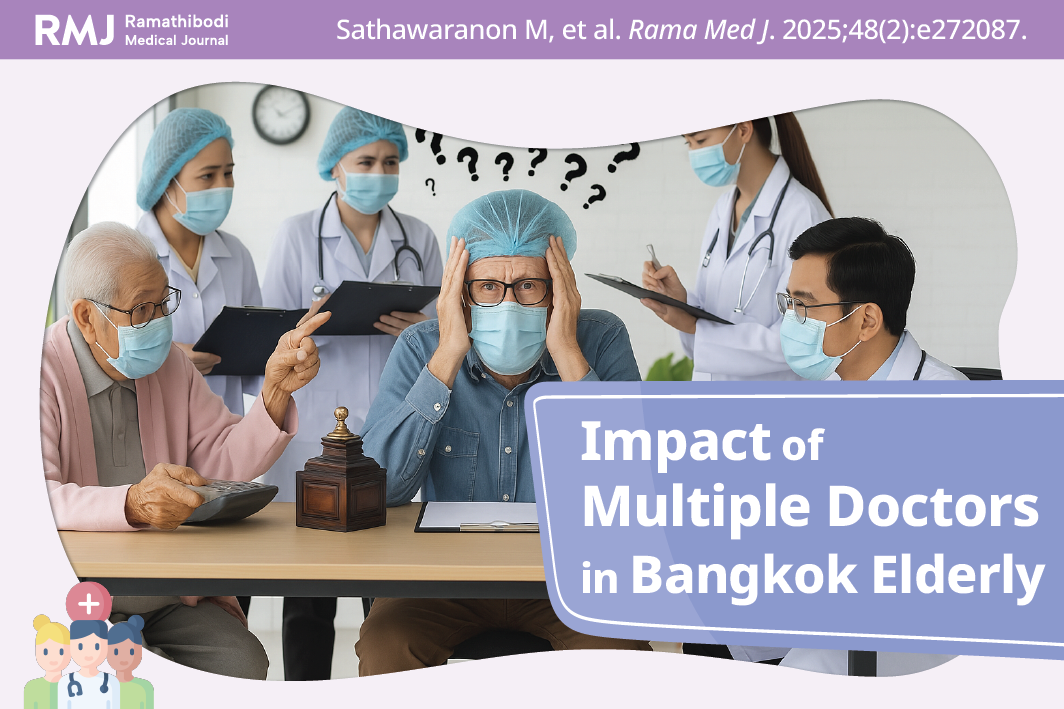
Impact of Following Up With Multiple Specialist Doctors for the Elderly in Bangkok and Surrounding Areas: A Mixed-Methods Study
DOI:
https://doi.org/10.33165/rmj.48.02.e272087Keywords:
Follow-up, Specialists, Effect, Quality of life, Elderly, Continuity of patient careAbstract
Background: The elderly often have complex illnesses, requiring specialized treatment and follow-up care from doctors in various fields. It has impacted their abilities to adapt to increasing health challenges, and there are few studies about this dimension.
Objectives: To study the prevalence and impact of follow-up with multiple doctors on the lives of the elderly in Bangkok and surrounding areas.
Methods: An exploratory sequential mixed-methods study based on Ramathibodi Hospital outpatient visits, data included from July 2022 to June 2023. We studied the prevalence of elders having multiple follow-ups in Bangkok and surrounding areas. Then, we used purposive sampling for face-to-face, semi-structured in-depth interview and chart review.
Results: The prevalence of elders having multiple follow-ups with specialist doctors was 36.4%. Of the 12 interviewed participants, the median age was 70 and the average number of visits was 39 times per year. Findings from the interviews showed that the impact of multiple diseases could lead to negative feelings such as limitations in activities, shattered dreams, despair, and hopelessness. Patients may have faced difficulties accessing the healthcare system. On the other hand, there were positive feelings such as finding a meaningful life, strengthening family relationships, feeling at home, and feeling valued as teachers by students. Patients may have encountered doctors with varied experiences and frequent changes, which could lead to a lack of trust. It was crucial for patients to learn to manage their conditions. Building a good relationship with their doctor could help patients trust them more.
Conclusions: Elders with multiple follow-ups were primarily found in Bangkok and surrounding areas. This issue arose from both disease-oriented care and discontinuity of care. With multiple diseases and doctors involved, it affected the lives of the elderly both positively and negatively.
References
World Health Organization. Ageing and health. 1 October 2024. Accessed 10 February 2025. https://www.who.int/news-room/fact-sheets/detail/ageing-and-health
Department of Older Persons. Statistics of elderly. 30 September 2024. Accessed 10 February 2025. https://www.dop.go.th/en/statistics_page?cat=1&id=2559
Department of Older Persons. Situation and trends of elder society in Thailand 2013-2030. 25 August 2016. Accessed 10 February 2025. https://www.dop.go.th/th/know/1/47
Kuo MC, Jeng C, Chen CM, Jian WS. Profile of elderly with multiple physician visits: advocacy for tailored comprehensive geriatric assessment use in clinics. Geriatr Gerontol Int. 2014;14(2):372-380. doi:10.1111/ggi.12111
Reynaldos-Grandón K, Nasabún-Flores V, Pedrero-Castillo V, Cortéz-Pinto E, Ureta-Achurra J, Pavlov-Sepúlveda T. Poly-consultant patients: concept variability. Rev Med Chil. 2020;148(1):128-129. doi:10.4067/S0034-98872020000100128
Vedsted P, Christensen MB. Frequent attenders in general practice care: a literature review with special reference to methodological considerations. Public Health. 2005;119(2):118-137. doi:10.1016/j.puhe.2004.03.007
Kivelä K, Elo S, Kääriäinen M. Frequent attenders in primary health care: a concept analysis. Int J Nurs Stud. 2018;86:115-124. doi:10.1016/j.ijnurstu.2018.06.003
Smucker DR, Zink T, Susman JL, Crabtree BF. A framework for understanding visits by frequent attenders in family practice. J Fam Pract. 2001;50(10):847-852.
Báez K, Aiarzaguena JM, Grandes G, Pedrero E, Aranguren J, Retolaza A. Understanding patient-initiated frequent attendance in primary care: a case-control study. Br J Gen Pract. 1998;48(437):1824-1827.
Perhoniemi R, Blomgren J. Frequent attenders of three outpatient health care schemes in Finland: characteristics and association with long-term sickness absences, 2016-2018. BMC Public Health. 2021;21(1):870. doi:10.1186/s12889-021-10866-x
Welzel FD, Stein J, Hajek A, König HH, Riedel-Heller SG. Frequent attenders in late life in primary care: a systematic review of European studies. BMC Fam Pract. 2017;18(1):104. doi:10.1186/s12875-017-0700-7
Hodgson P, Smith P, Brown T, Dowrick C. Stories from frequent attenders: a qualitative study in primary care. Ann Fam Med. 2005;3(4):318-323. doi:10.1370/afm.311
Bergh H, Baigi A, Fridlund B, Marklund B. Life events, social support and sense of coherence among frequent attenders in primary health care. Public Health. 2006;120(3):229-236. doi:10.1016/j.puhe.2005.08.020
Bergh H, Baigi A, Månsson J, Mattsson B, Marklund B. Predictive factors for long-term sick leave and disability pension among frequent and normal attenders in primary health care over 5 years. Public Health. 2007;121(1):25-33. doi:10.1016/j.puhe.2006.08.018
Downloads
Published
How to Cite
Issue
Section
License
Copyright (c) 2025 by the Author(s). Licensee RMJ.

This work is licensed under a Creative Commons Attribution 4.0 International License.