
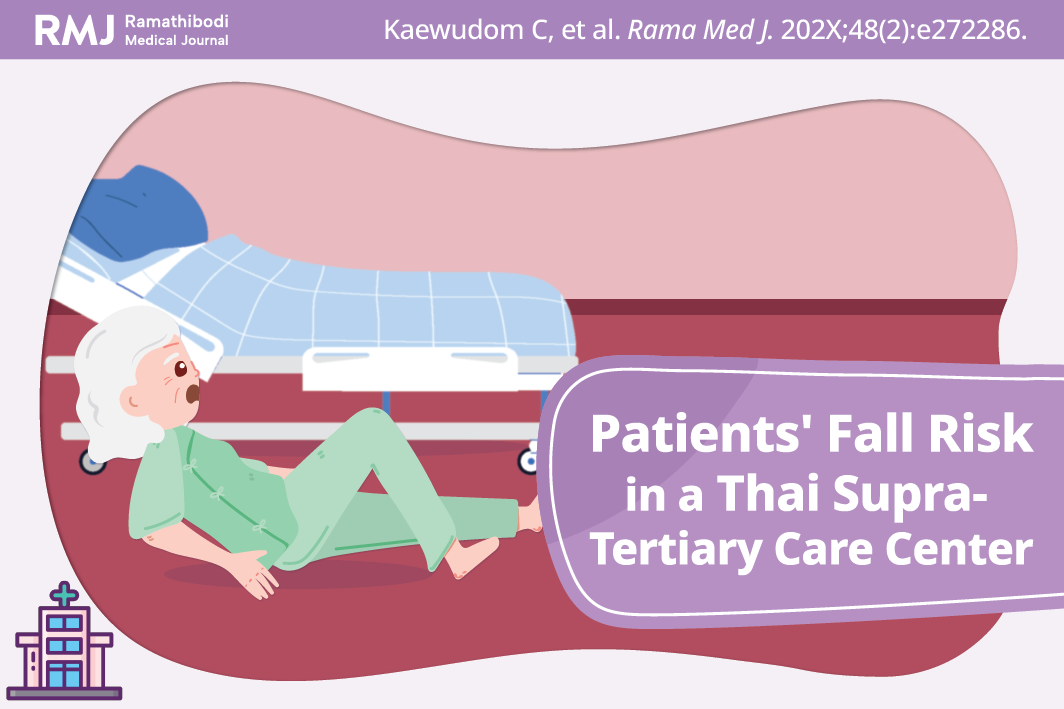
Risk of Falls Among Hospitalized Elderly Patients in a Supra-Tertiary Care Hospital, Thailand
DOI:
https://doi.org/10.33165/rmj.48.02.e272286Keywords:
Fall, Elderly patients, Supra-tertiary care hospitalAbstract
Background: Falls are an important issue among elderly patients. The chance of falling increases with age, which can affect daily activities, lead to readmission, and reduce quality of life.
Objectives: To investigate the risk of falls among elderly patients admitted to an inpatient ward at a supra-tertiary care hospital and to compare fall risk levels of fall risk at various stages of hospitalization.
Methods: This was a retrospective descriptive study. All data were obtained from the medical records of 212 older patients admitted between 1 January 2021 and 1 December 2022, at Sriragarind Hospital. The Friedman and Wilcoxon signed rank tests were used to analyze descriptive statistics and variances.
Results: The proportion of fall risk at level 1 was 45.75% on the first day of admission, 46.70% during hospitalization, and 58.96% before discharge. The risk of falls was significantly different across the time periods, particularly on the first day of admission compared to during hospitalization and before hospital discharge.
Conclusions: The risk of falling increases during hospitalization due to several factors, such as restricted vision and hearing, urinary incontinence, and complications arising during hospitalization. Therefore, a comprehensive fall risk assessment of elderly patients covering all aspects is necessary to prevent the problem from occurring and use the study findings to update the guidelines for preventing falls in older patients.
References
Limpawattana P. Fall. In: Limpawattana P, ed. Elderly Syndrome and Interesting Health Issues. 3rd ed. Klungnana Vitthaya Press; 2023:39-62.
World Health Organization. Falls. 26 April 2021. Accessed 13 March 2025. https://www.who.int/news-room/fact-sheets/detail/falls
Carpenter CR, Avidan MS, Wildes T, Stark S, Fowler SA, Lo AX. Predicting geriatric falls following an episode of emergency department care: a systematic review. Acad Emerg Med. 2014;21(10):1069-1082. doi:10.1111/acem.12488
Xu Q, Ou X, Li J. The risk of falls among the aging population: a systematic review and meta-analysis. Front Public Health. 2022;10:902599. doi:10.3389/fpubh.2022.902599
Limpawattana P. Fall. In: Limpawattana P, ed. Elderly Syndrome and Interesting Health Issues. 2nd ed. Klungnana Vitthaya Press; 2018:35-56.
Moon S, Chung HS, Kim YJ, et al. The impact of urinary incontinence on falls: a systematic review and meta-analysis. PLoS One. 2021;16(5):e0251711. doi:10.1371/journal.pone.0251711
Aroonsang P, Piyawattanapong S, Panpanit L, et al. Health profile of hospitalized older persons in Srinagarind Hospital. J Nurs Sci Health. 2017;40(2):74-84.
Yang YK, Kor CT, Sun YW, Wang HY, Yang YT, Liu SY. Associations between doses of fall-risk-increasing drugs (FRIDs) and falls of hospitalized patients. Sci Rep. 2023;13(1):14380. doi:10.1038/s41598-023-41568-6
Ghosh M, O'Connell B, Afrifa-Yamoah E, Kitchen S, Coventry L. A retrospective cohort study of factors associated with severity of falls in hospital patients. Sci Rep. 2022;12(1):12266. doi:10.1038/s41598-022-16403-z
Hirata R, Katsuki NE, Shimada H, et al. The administration of lemborexant at admission is not associated with inpatient falls: a multicenter retrospective observational study. Int J Gen Med. 2024;17:1139-1144. doi:10.2147/IJGM.S452278
Faculty of Medicine, Khon Kaen University. Patient statistics at Srinagarind Hospital, Faculty of Medicine, Khon Kaen University, Volume 42. Medical Records and Statistics Department, Srinagarind Hospital; 2021. Accessed 13 March 2025. https://drive.google.com/file/d/1X7PePc_9ARCN3W3DFUkI_ywf6HGrVoWz/view
Aroonsang P. Nursing Care of Important Problems of the Elderly: Application. 2nd ed. Klungnana Vitthaya Press; 2011.
Aroonsang P, Sritanyarat W, Lertrat P, et al. Health profile of older persons in health care institute and in community. J Nurs Sci Health. 2012;35(2):15-24.
Krejie RV, Morgan DW. Determining sample size for research activities. Educ Psychol Meas. 1970;30(3):607-610. doi:10.1177/001316447003000308
Kaewudom C, Leethong-In M, Ekwuttiwongsa R, et al. Health profile of hospitalized older people in special wards of Srinagarind Hospital. KKU Journal of Medicine. 2024;10(1):38-48.
Jehu DA, Davis JC, Falck RS, et al. Risk factors for recurrent falls in older adults: a systematic review with meta-analysis. Maturitas. 2021;144:23-28. doi:10.1016/j.maturitas.2020.10.021
Kwak MS, Cha JM, Yang HJ, et al. Safety and efficacy of low-volume preparation in the elderly: oral sulfate solution on the day before and split-dose regimens (SEE SAFE) study. Gut Liver. 2019;13(2):176-182. doi:10.5009/gnl18214
Dhar M, Kaeley N, Mahala P, Saxena V, Pathania M. The prevalence and associated risk factors of fear of fall in the elderly: a hospital-based, cross-sectional study. Cureus. 2022;14(3):e23479. doi:10.7759/cureus.23479
Rittenhouse KJ, To T, Rogers A, et al. Hyponatremia as a fall predictor in a geriatric trauma population. Injury. 2015;46(1):119-123. doi:10.1016/j.injury.2014.06.013
Boyer S, Gayot C, Bimou C, et al. Prevalence of mild hyponatremia and its association with falls in older adults admitted to an emergency geriatric medicine unit (the MUPA unit). BMC Geriatr. 2019;19(1):265. doi:10.1186/s12877-019-1282-0
Al-Tehewy MM, Amin GE, Nassar NW. A study of rate and predictors of fall among elderly patients in a university hospital. J Patient Saf. 2015;11(4):210-214. doi:10.1097/PTS.0000000000000117
Mazur K, Wilczyński K, Szewieczek J. Geriatric falls in the context of a hospital fall prevention program: delirium, low body mass index, and other risk factors. Clin Interv Aging. 2016;11:1253-1261. doi:10.2147/CIA.S115755
Moon S, Chung HS, Kim YJ, et al. The impact of urinary incontinence on falls: a systematic review and meta-analysis. PLoS One. 2021;16(5):e0251711. doi:10.1371/journal.pone.0251711
Walohtae F, Siriphan S. Guidelines for preventing falls of elderly patients in hospitals. Pnu Sci J. 2022;14(2):282-296.
Morris ME, Webster K, Jones C, et al. Interventions to reduce falls in hospitals: a systematic review and meta-analysis. Age Ageing. 2022;51(5):afac077. doi:10.1093/ageing/afac077
Cameron ID, Dyer SM, Panagoda CE, et al. Interventions for preventing falls in older people in care facilities and hospitals. Cochrane Database Syst Rev. 2018;9(9):CD005465. doi:10.1002/14651858.CD005465.pub4
Downloads
Published
How to Cite
Issue
Section
License
Copyright (c) 2025 by the Author(s). Licensee RMJ.

This work is licensed under a Creative Commons Attribution 4.0 International License.