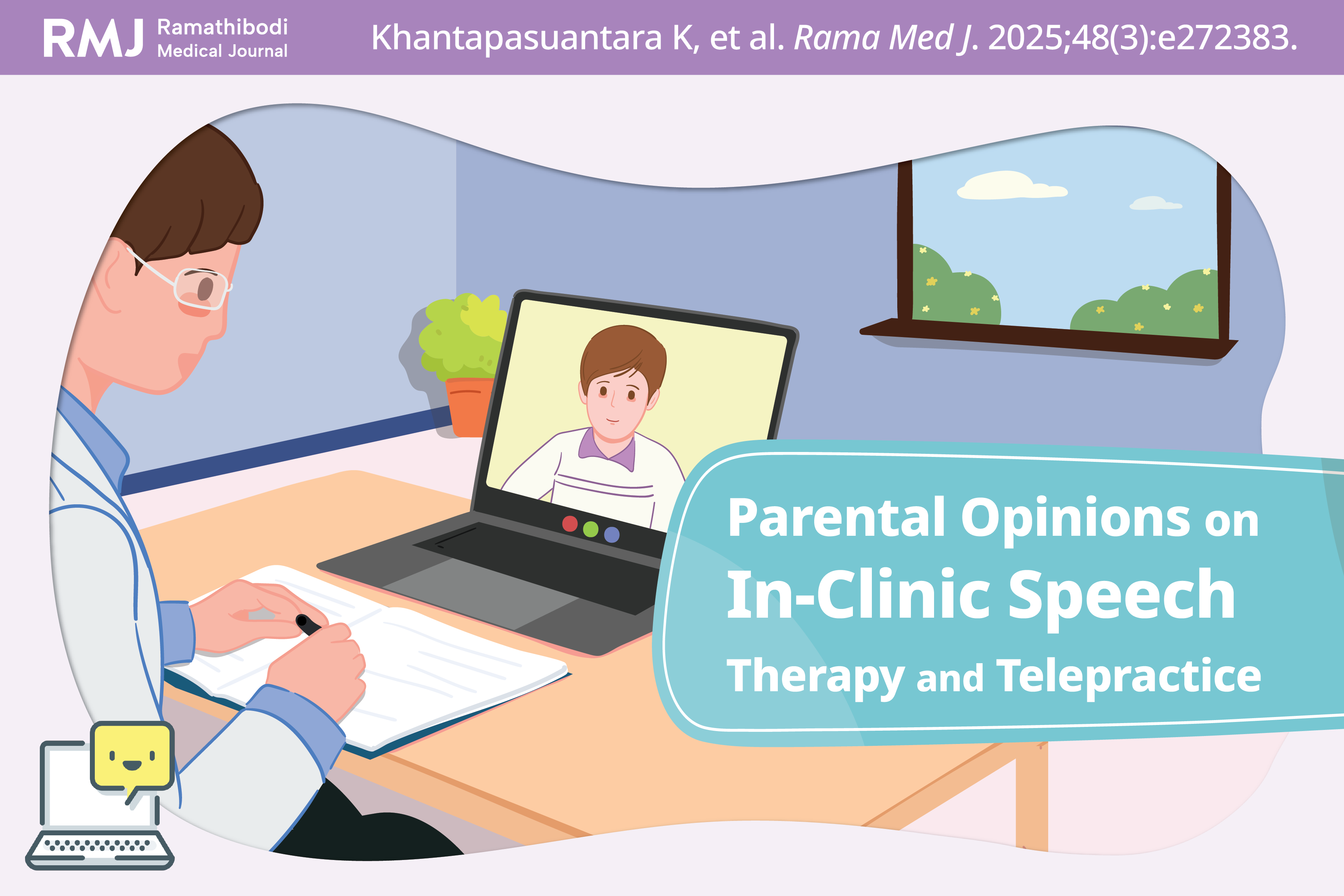
A Comparative Study of Parental Opinions on In-Clinic Speech Therapy and Telepractice
DOI:
https://doi.org/10.33165/rmj.48.03.e272383Keywords:
In-clinic speech therapy, Telepractice, Parental opinionAbstract
Background: The COVID-19 pandemic has impacted speech and language therapy practices in Thailand, preventing patients from receiving in-person therapy sessions at clinics. To address prolonged gaps between therapy sessions, speech therapists adopted telepractice as an alternative.
Objective: To compare parental opinions between in-clinic speech therapy and telepractice.
Methods: Researchers distributed an electronic questionnaire to 78 parents via online speech therapy platforms. The questionnaire comprised 3 sections: patient information (4 items), parent information (6 items), and parental opinions on in-clinic speech therapy versus telepractice (15 items). In the patient and parent information sections, parents selected options corresponding to their situation. In the section on parental opinions, parents rated their views using a Likert scale.
Results: Parents demonstrated significantly higher levels of satisfaction with in-clinic speech therapy compared to telepractice across 12 topics (P < .05), whereas no statistically significant differences were observed in 3 topics (P > .05). Topics where in-clinic therapy was rated more positively included pretherapy processes, therapy procedures, posttherapy processes, therapy outcomes, and factors related to location and therapy materials.
Conclusions: Parents provided more positive feedback for in-clinic speech therapy than telepractice. Despite the critical role telepractice played during the COVID-19 pandemic, parents still believe in-clinic therapy is more effective. As the severity of the COVID-19 pandemic decreases, it is likely that the use of telepractice will decline in favor of in-clinic therapy.
References
Houston KT. Telepractice in Speech-Language Pathology. Plural Publishing Inc; 2013.
American Speech-Language-Hearing Association. Telepractice. Accessed 14 March 2025. https://www.asha.org/practice-portal/professional-issues/telepractice
Aueworakhunanan T, Dejket P, Phakkachok S, Punkla W. Exploring the feasibility of implementing telepractice innovation for speech-language pathologists in Thailand. Rama Med J. 2024;47(1):32-46. doi:10.33165/rmj.2024.47.1.266036
Aueworakhunanan T, Dejket P, Opassereepadung T, et al. Effectiveness of speech telepractice system service. Rama Med J. 2023;46(1):23-31. doi:10.33165/rmj.2023.46.1.258134
Fong R, Tsai CF, Yiu OY. The implementation of telepractice in speech language pathology in Hong Kong during the COVID-19 pandemic. Telemed E-Health. 2021;27(1):30-38. doi:10.1089/tmj.2020.0223
Kim S, Roman AM, Moore A, Patient and caregiver satisfaction regarding telepractice versus in-person services at a university speech, language, and hearing clinic. Clin Arch Commun Disord. 2022;7(3):83-93. doi:10.21849/cacd.2021.00598
Sicotte C, Lehoux P, Fortier-Blanc J, Leblanc Y. Feasibility and outcome evaluation of a telemedicine application in speech-language pathology. J Telemed Telecare. 2003;9(5):253-258. doi:10.1258/135763303769211256
Macoir J, Sauvageau VM, Boissy P, Tousignant M, Tousignant M. In-home synchronous telespeech therapy to improve functional communication in chronic poststroke aphasia: results from a quasi-experimental study. Telemed E-Health. 2017;23(8):630-639. doi:10.1089/tmj.2016.0235
Grogan-Johnson S, Schmidt AM, Schenker J, Alvares R, Rowan LE, Taylor J. A comparison of speech sound intervention delivered by telepractice and side-by-side service delivery models. Commun Disord Q. 2013;34(4):210-220. doi:10.1177/1525740113484965
Wales D, Skinner L, Hayman M. The efficacy of telehealth-delivered speech and language intervention for primary school-age children: a systematic review. Int J Telerehabil. 2017;9(1):55-70. doi:10.5195/ijt.2017.6219
Christopoulou M, Drosos K, Petinou K. Recent advances of telepractice for autism spectrum disorders in speech and language pathology. Neuropsychiatr Dis Treat. 2022;18:2379-2389. doi:10.2147/NDT.S384300
Rende B, Ramsberger G. Telepractice experiences in a university training clinic. Perspect Neurophysiol Neurogenic Speech Lang Disord. 2011;21(3):120-129. doi:10.1044/nnsld21.3.120
Department of Communication Sciences and Disorders, Faculty of Medicine Ramathibodi Hospital, Mahidol University. The advantages and limitations of telepractice through speech-language-pathologists in a pandemic situation. Accessed 14 March 2025. https://www.rama.mahidol.ac.th/commdis/th/km/speech-online
Boey R, Lefevere S. An evaluation of telepractice use during the covid-19 pandemic for the treatment of speech and language disorders in Belgium. Int J Telerehabil. 2022;14(1):e6411. doi:10.5195/ijt.2022.6411
Grillo EU. Results of a survey offering clinical insights into speech-language pathology telepractice methods. Int J Telerehabil. 2017;9(2):25-30. doi:10.5195/ijt.2017.6230
Cheslock MA, Kahn SJ. Supporting families and caregivers in everyday routines. ASHA Lead. 2011;16(11):10-13. doi:10.1044/leader.FTR1.16112011.10
Garnett R, Davidson B, Eadie P. Parent perceptions of a group telepractice communication intervention for autism. Autism Dev Lang Impair. 2022;7:23969415211070127. doi:10.1177/23969415211070127
Crutchley S, Campbell M. Telespeech therapy pilot project: stakeholder satisfaction. Int J Telerehabil. 2010;2(1):23-30. doi:10.5195/ijt.2010.6049
Law J, Dornstauder M, Charlton J, Gréaux M. Tele-practice for children and young people with communication disabilities: employing the COM-B model to review the intervention literature and inform guidance for practitioners. Int J Lang Commun Disord. 2021;56(2):415-434. doi:10.1111/1460-6984.12592
Waite MC, Theodoros DG, Russell TG, Cahill LM. Internet-based telehealth assessment of language using the CELF-4. Lang Speech Hear Serv Sch. 2010;41(4):445-458. doi:10.1044/0161-1461(2009/08-0131)
Al Awaji NN, Almudaiheem AA, Mortada EM. Assessment of caregivers' perspectives regarding speech-language services in Saudi Arabia during COVID-19. PLoS One. 2021;16(6):e0253441. doi:10.1371/journal.pone.0253441
Lam JHY, Lee SMK, Tong X. Parents' and students' perceptions of telepractice services for speech-language therapy during the COVID-19 pandemic: survey study. JMIR Pediatr Parent. 2021;4(1):e25675. doi:10.2196/25675
Yamane T. Statistics: An Introductory Analysis. 3rd ed. New York University Press; 1973.
Pozniak K, Rosenbaum P, Kwok EYL. Tasks performed by parents to enable telepractice for children with communication disorders: an interview study with clinicians and parents. Disabil Rehabil. 2024;46(8):1547-1558. doi:10.1080/09638288.2023.2201509
Hussain F, Rashid A, Khan MA, et al. Opinion of speech language pathologist about teletherapy in treatment of autism spectrum disorder. Pak Biomed J. 2022;5(2):138-142. doi:10.54393/pbmj.v5i2.136
Kwok EYL, Pozniak K, Cunningham BJ, Rosenbaum P. Factors influencing the success of telepractice during the COVID-19 pandemic and preferences for post-pandemic services: an interview study with clinicians and parents. Int J Lang Commun Disord. 2022;57(6):1354-1367. doi:10.1111/1460-6984.12760
Furlong LM, Serry TA. An exploratory study of speech-language pathologists' clinical practice in the literacy domain: comparing onsite practices with telepractice services during COVID-19. Int J Speech Lang Pathol. 2023;25(2):206-218. doi:10.1080/17549507.2022.2030410
McAllister LL, Atherton M, Winkworth A, et al. A descriptive case report of telesupervision and online case-based learning for speech and language therapy students in Vietnam during the COVID-19 pandemic. S Afr J Commun Disord. 2022;69(2):e1-e6. doi:10.4102/sajcd.v69i2.897
Peh HP, Yee K, Mantaring EJN. Changes in telepractice use and perspectives among speech and language therapists in Singapore through the COVID-19 pandemic. Int J Lang Commun Disord. 2023;58(3):802-812. doi:10.1111/1460-6984.12823
Passalacqua NG, Perlmutter A. Parent satisfaction with pediatric speech-language pathology telepractice services during the COVID-19 pandemic: an early look. Perspect ASHA Spec Interest Groups. 2022;7(6):2110-2121. doi:10.1044/2022_PERSP-21-00286
Downloads
Published
How to Cite
Issue
Section
License
Copyright (c) 2025 by the Author(s). Licensee RMJ.

This work is licensed under a Creative Commons Attribution 4.0 International License.