
MicroRNA-Mediated Regulation of Granulosa Cell Apoptosis: A Review
DOI:
https://doi.org/10.33165/rmj.2026.e272774Keywords:
MicroRNA, Granulosa cell apoptosis, Ovarian follicular development, Reproductive disordersAbstract
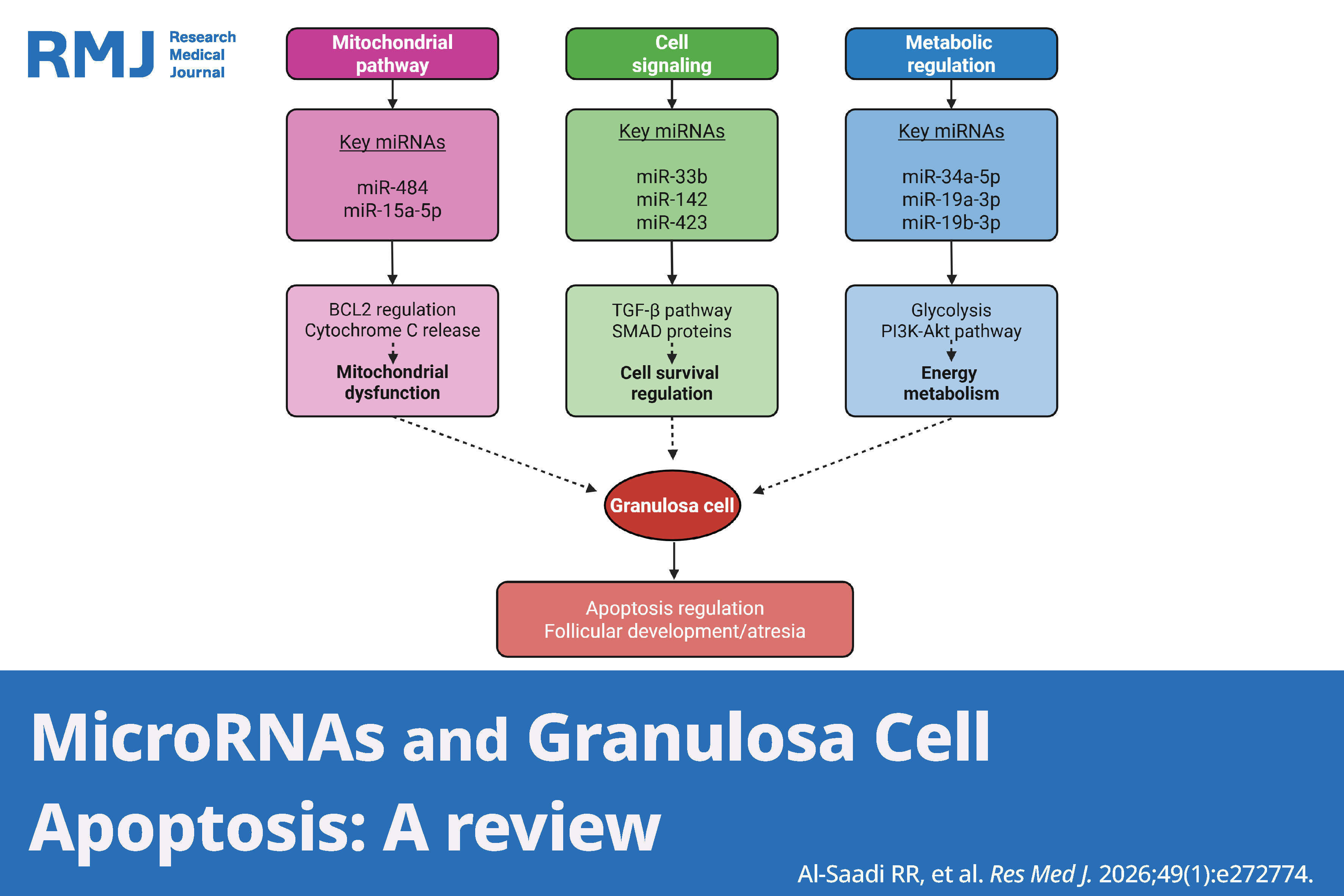
MicroRNAs (miRNAs) play a critical role in regulating granulosa cell apoptosis, a fundamental process in ovarian follicular development and atresia. This review synthesizes current evidence indicating that miRNAs coordinate granulosa cell fate through 3 primary mechanistic pathways. First, the mitochondrial pathway, where miRNAs such as miR-484, miR-15a-5p, and miR-26b modulate BCL2 family proteins and cytochrome C release. Second, cell signaling cascades, particularly through the transforming growth factor-β (TGF-β) pathway, where miR-33b, miR-142, miR-423, miR-383, and miR-320 regulate various signaling components including transforming growth factor beta receptor 1 (TGFBR1) and protecting mothers against decapentaplegic homolog (SMAD) proteins. Third, metabolic regulation, where miR-34a-5p, miR-19a-3p, and miR-19b-3p influence cellular metabolism and survival through pathways such as phosphoinositide 3-kinase-protein kinase B (PI3K-Akt) and glycolysis. Dysregulation of these miRNA-mediated processes has significant implications for reproductive disorders, particularly polycystic ovary syndrome (PCOS) and premature ovarian failure. Awareness about these complex regulatory networks not only advances the knowledge of follicular development but also indicates potential therapeutic targets for treating ovarian disorders characterized by abnormal granulosa cell apoptosis.
References
Yang L, Du X, Wang S, Lin C, Li Q, Li Q. A regulatory network controlling ovarian granulosa cell death. Cell Death Discov. 2023;9(1):70. doi:10.1038/s41420-023-01346-9
Shang R, Lee S, Senavirathne G, Lai EC. MicroRNAs in action: biogenesis, function and regulation. Nat Rev Genet. 2023;24(12):816-833. doi:10.1038/s41576-023-00611-y
Zhang J, Xu Y, Liu H, Pan Z. MicroRNAs in ovarian follicular atresia and granulosa cell apoptosis. Reprod Biol Endocrinol. 2019;17(1):9. doi:10.1186/s12958-018-0450-y
Matsuda-Minehata F, Inoue N, Goto Y, Manabe N. The regulation of ovarian granulosa cell death by pro- and anti-apoptotic molecules. J Reprod Dev. 2006;52(6):695-705. doi:10.1262/jrd.18069
Gebremedhn S, Salilew-Wondim D, Hoelker M, et al. MicroRNA-183-96-182 cluster regulates bovine granulosa cell proliferation and cell cycle transition by coordinately targeting FOXO1. Biol Reprod. 2016;94(6):127. doi:10.1095/biolreprod.115.137539
Nie M, Yu S, Peng S, Fang Y, Wang H, Yang X. miR-23a and miR-27a promote human granulosa cell apoptosis by targeting SMAD5. Biol Reprod. 2015;93(4):98. doi:10.1095/biolreprod.115.130690
Mendell JT. miRiad roles for the miR-17-92 cluster in development and disease. Cell. 2008;133(2):217-222. doi:10.1016/j.cell.2008.04.001
Cao R, Wu W, Zhou X, et al. Let-7g induces granulosa cell apoptosis by targeting MAP3K1 in the porcine ovary. Int J Biochem Cell Biol. 2015;68:148-157. doi:10.1016/j.biocel.2015.08.011
Du X, Pan Z, Li Q, Liu H, Li Q. SMAD4 feedback regulates the canonical TGF-β signaling pathway to control granulosa cell apoptosis. Cell Death Dis. 2018;9(2):151. doi:10.1038/s41419-017-0205-2
Liu J, Du X, Zhou J, Pan Z, Liu H, Li Q. MicroRNA-26b functions as a proapoptotic factor in porcine follicular granulosa cells by targeting Sma-and Mad-related protein 4. Biol Reprod. 2014;91(6):146. doi:10.1095/biolreprod.114.122788
Yao W, Pan Z, Du X, Zhang J, Li Q. miR-181b-induced SMAD7 downregulation controls granulosa cell apoptosis through TGF-β signaling by interacting with the TGFBR1 promoter. J Cell Physiol. 2018;233(9):6807-6821. doi:10.1002/jcp.26431
Farazi TA, Hoell JI, Morozov P, Tuschl T. MicroRNAs in Human Cancer. In: Schmitz U, Wolkenhauer O, Vera J, eds. MicroRNA Cancer Regulation. Advances in Experimental Medicine and Biology. Springer; 2013:1-20. doi:10.1007/978-94-007-5590-1_1
Gong Z, Yang J, Bai S, Wei S. MicroRNAs regulate granulosa cells apoptosis and follicular development - a review. Asian-Australas J Anim Sci. 2020;33(11):1714-1724. doi:10.5713/ajas.19.0707
Song Y, Yu G, Xiang Y, Li Y, Wan L, Tan L. Altered miR-186 and miR-135a contribute to granulosa cell dysfunction by targeting ESR2: a possible role in polycystic ovary syndrome. Mol Cell Endocrinol. 2019;494:110478. doi:10.1016/j.mce.2019.110478
Li Y, Xiang Y, Song Y, Wan L, Yu G, Tan L. Dysregulated miR-142, -33b and -423 in granulosa cells target TGFBR1 and SMAD7: a possible role in polycystic ovary syndrome. Mol Hum Reprod. 2019;25(10):638-646. doi:10.1093/molehr/gaz014
Yang X, Zhou Y, Peng S, et al. Differentially expressed plasma microRNAs in premature ovarian failure patients and the potential regulatory function of mir-23a in granulosa cell apoptosis. Reproduction. 2012;144(2):235-244. doi:10.1530/REP-11-0371
Faisal GF, Al-Kawaz UMR, Al-Anbari LA, Hussaini HAR. Evaluation of the level of stem cell factor in follicular fluid and its effect on oocyte maturity, embryo quality and pregnancy rate. Iraqi J Embryos Infertil Res. 2020;9(2):65-77. doi:10.28969/IJEIR.v9.i2.r5
Geng Y, Sui C, Xun Y, Lai Q, Jin L. MiRNA-99a can regulate proliferation and apoptosis of human granulosa cells via targeting IGF-1R in polycystic ovary syndrome. J Assist Reprod Genet. 2019;36(2):211-221. doi:10.1007/s10815-018-1335-x
Yin M, Wang X, Yao G, et al. Transactivation of micrornA-320 by microRNA-383 regulates granulosa cell functions by targeting E2F1 and SF-1 proteins. J Biol Chem. 2014;289(26):18239-18257. doi:10.1074/jbc.M113.546044
Xu S, Linher-Melville K, Yang BB, Wu D, Li J. Micro-RNA378 (miR-378) regulates ovarian estradiol production by targeting aromatase. Endocrinology. 2011;152(10):3941-3951. doi:10.1210/en.2011-1147
Zhang CL, Wang H, Yan CY, Gao XF, Ling XJ. Deregulation of RUNX2 by miR-320a deficiency impairs steroidogenesis in cumulus granulosa cells from polycystic ovary syndrome (PCOS) patients. Biochem Biophys Res Commun. 2017;482(4):1469-1476. doi:10.1016/j.bbrc.2016.12.059
Das M, Djahanbakhch O, Hacihanefioglu B, et al. Granulosa cell survival and proliferation are altered in polycystic ovary syndrome. J Clin Endocrinol Metab. 2008;93(3):881-887. doi:10.1210/jc.2007-1650
Almeida CP, Ferreira MCF, Silveira CO, et al. Clinical correlation of apoptosis in human granulosa cells - a review. Cell Biol Int. 2018;42(10):1276-1281. doi:10.1002/cbin.11036
Andrei D, Nagy RA, van Montfoort A, et al. Differential miRNA expression profiles in cumulus and mural granulosa cells from human pre-ovulatory follicles. Microrna. 2019;8(1):61-67. doi:10.2174/2211536607666180912152618
McGinnis LK, Luense LJ, Christenson LK. MicroRNA in ovarian biology and disease. Cold Spring Harb Perspect Med. 2015;5(9):a022962. doi:10.1101/cshperspect.a022962
Li H, Wang X, Mu H, et al. Mir-484 contributes to diminished ovarian reserve by regulating granulosa cell function via YAP1-mediated mitochondrial function and apoptosis. Int J Biol Sci. 2022;18(3):1008-1021. doi:10.7150/ijbs.68028
Zhang K, Zhong W, Li WP, Chen ZJ, Zhang C. miR-15a-5p levels correlate with poor ovarian response in human follicular fluid. Reproduction. 2017;154(4):483-496. doi:10.1530/REP-17-0157
Yin M, Lü M, Yao G, et al. Transactivation of microRNA-383 by steroidogenic factor-1 promotes estradiol release from mouse ovarian granulosa cells by targeting RBMS1. Mol Endocrinol. 2012;26(7):1129-1143. doi:10.1210/me.2011-1341
Schauer SN, Sontakke SD, Watson ED, Esteves CL, Donadeu FX. Involvement of miRNAs in equine follicle development. Reproduction. 2013;146(3):273-282. doi:10.1530/REP-13-0107
Tao H, Yang J, Xu M, Liu Z, Liu Y, Xiong Q. MicroRNA-27a-3p targeting Vangl1 and Vangl2 inhibits cell proliferation in mouse granulosa cells. Biochim Biophys Acta Gene Regul Mech. 2023;1866(1):194885. doi:10.1016/j.bbagrm.2022.194885
Lin F, Li R, Pan ZX, et al. miR-26b promotes granulosa cell apoptosis by targeting ATM during follicular atresia in porcine ovary. PLoS One. 2012;7(6):e38640. doi:10.1371/journal.pone.0038640
Li Y, Zhang Z, Wang S, Du X, Li Q. miR-423 sponged by lncRNA NORHA inhibits granulosa cell apoptosis. J Anim Sci Biotechnol. 2023;14(1):154. doi:10.1186/s40104-023-00960-y
Zhou J, Lei B, Li H, et al. MicroRNA-144 is regulated by CP2 and decreases COX-2 expression and PGE2 production in mouse ovarian granulosa cells. Cell Death Dis. 2017;8(2):e2597. doi:10.1038/cddis.2017.24
Chen Y, Guan F, Wang P, et al. Copper exposure induces ovarian granulosa cell apoptosis by activating the caspase-dependent apoptosis signaling pathway and corresponding changes in microRNA patterns. Ecotoxicol Environ Saf. 2023;264:115414. doi:10.1016/j.ecoenv.2023.115414
Khan HL, Bhatti S, Abbas S, et al. Melatonin levels and microRNA (miRNA) relative expression profile in the follicular ambient microenvironment in patients undergoing in vitro fertilization process. J Assist Reprod Genet. 2021;38(2):443-459. doi:10.1007/s10815-020-02010-2
Sontakke SD, Mohammed BT, McNeilly AS, Donadeu FX. Characterization of microRNAs differentially expressed during bovine follicle development. Reproduction. 2014;148(3):271-283. doi:10.1530/REP-14-0140
Cui X, Lei X, Huang T, et al. Follicular fluid-derived extracellular vesicles miR-34a-5p regulates granulosa cell glycolysis in polycystic ovary syndrome by targeting LDHA. J Ovarian Res. 2024;17(1):223. doi:10.1186/s13048-024-01542-w
Wang X, Yang J, Li H, et al. miR-484 mediates oxidative stress-induced ovarian dysfunction and promotes granulosa cell apoptosis via SESN2 downregulation. Redox Biol. 2023;62:102684. doi:10.1016/j.redox.2023.102684
Wang Y, Du X, Wang J. Transfer of miR-15a-5p by placental exosomes promotes pre-eclampsia progression by regulating PI3K/AKT signaling pathway via CDK1. Mol Immunol. 2020;128:277-286. doi:10.1016/j.molimm.2020.10.019
Naji M, Nekoonam S, Aleyasin A, et al. Expression of miR-15a, miR-145, and miR-182 in granulosa-lutein cells, follicular fluid, and serum of women with polycystic ovary syndrome (PCOS). Arch Gynecol Obstet. 2018;297(1):221-231. doi:10.1007/s00404-017-4570-y
Liu J, Tu F, Yao W, et al. Conserved miR-26b enhances ovarian granulosa cell apoptosis through HAS2-HA-CD44-Caspase-3 pathway by targeting HAS2. Sci Rep. 2016;6:21197. doi:10.1038/srep21197
Huo S, Qi H, Si Y, Li C, Du W. MicroRNA 26a targets Ezh2 to regulate apoptosis in mouse ovarian granulosa cells. Syst Biol Reprod Med. 2021;67(3):221-229. doi:10.1080/19396368.2021.1895362
Zhang X, Tao Q, Shang J, et al. MiR-26a promotes apoptosis of porcine granulosa cells by targeting the 3β-hydroxysteroid-Δ24-reductase gene. Asian-Australas J Anim Sci. 2020;33(4):547-555. doi:10.5713/ajas.19.0173
Yang Y, Jiang H, Xiao L, Yang X. MicroRNA-33b-5p is overexpressed and inhibits GLUT4 by targeting HMGA2 in polycystic ovarian syndrome: an in vivo and in vitro study. Oncol Rep. 2018;39(6):3073-3085. doi:10.3892/or.2018.6375
Kim K, Yang DK, Kim S, Kang H. miR-142-3p is a regulator of the TGFβ-mediated vascular smooth muscle cell phenotype. J Cell Biochem. 2015;116(10):2325-2333. doi:10.1002/jcb.25183
Lei Z, Xu G, Wang L, et al. MiR-142-3p represses TGF-β-induced growth inhibition through repression of TGFβR1 in non-small cell lung cancer. FASEB J. 2014;28(6):2696-2704. doi:10.1096/fj.13-247288
Yu Q, Xiang L, Yin L, Liu X, Yang D, Zhou J. Loss-of-function of miR-142 by hypermethylation promotes TGF-β-mediated tumour growth and metastasis in hepatocellular carcinoma. Cell Prolif. 2017;50(6):e12384. doi:10.1111/cpr.12384
Xu X, Guan R, Gong K, Xie H, Shi L. Circ_FURIN knockdown assuages testosterone-induced human ovarian granulosa-like tumor cell disorders by sponging miR-423-5p to reduce MTM1 expression in polycystic ovary syndrome. Reprod Biol Endocrinol. 2022;20(1):32. doi:10.1186/s12958-022-00891-9
Xie S, Zhang Q, Zhao J, Hao J, Fu J, Li Y. MiR-423-5p may regulate ovarian response to ovulation induction via CSF1. Reprod Biol Endocrinol. 2020;18(1):26. doi:10.1186/s12958-020-00585-0
Li Y, Wu X, Miao S, Cao Q. MiR-383-5p promotes apoptosis of ovarian granulosa cells by targeting CIRP through the PI3K/AKT signaling pathway. Arch Gynecol Obstet. 2022;306(2):501-512. doi:10.1007/s00404-022-06461-z
Liu Y, Mei Q, Yang J, et al. hsa-miR-320a-3p and hsa-miR-483-5p levels in human granulosa cells: promising bio-markers of live birth after IVF/ICSI. Reprod Biol Endocrinol. 2022;20(1):160. doi:10.1186/s12958-022-01037-7
Han S, Zhao X, Zhang Y, et al. MiR-34a-5p promotes autophagy and apoptosis of ovarian granulosa cells via the Hippo-YAP signaling pathway by targeting LEF1 in chicken. Poult Sci. 2023;102(2):102374. doi:10.1016/j.psj.2022.102374
Fabová Z, Loncová B, Bauer M, Sirotkin AV. Interrelationships between miR-34a and FSH in the control of porcine ovarian cell functions. Reprod Sci. 2023;30(6):1789-1807. doi:10.1007/s43032-022-01127-2
Cui C, Wang J, Han X, et al. Identification of small extracellular vesicle-linked miRNA specifically derived from intrafollicular cells in women with polycystic ovary syndrome. Reprod Biomed Online. 2021;42(5):870-880. doi:10.1016/j.rbmo.2021.02.002
Xie S, Batnasan E, Zhang Q, Li Y. MicroRNA expression is altered in granulosa cells of ovarian hyperresponders. Reprod Sci. 2016;23(8):1001-1010. doi:10.1177/1933719115625849
Ye T, Lin S, Ding S, Cao D, Luo L, Yeung WS. Role of exosomal microRNAs and lncRNAs in the follicular fluid of women with polycystic ovary syndrome. Res Sq. 2021:1-15. doi:10.21203/rs.3.rs-720055/v1
Nagata S, Inoue Y, Sato T, et al. Age-associated changes in miRNA profile of bovine follicular fluid. Reproduction. 2022;164(5):195-206. doi:10.1530/REP-22-0036
Downloads
Published
How to Cite
Issue
Section
License
Copyright (c) 2025 by the Author(s). Licensee RMJ.

This work is licensed under a Creative Commons Attribution 4.0 International License.