
Effect of Positive Psychological Capital and Self-Management Model Interventions on Pain and Functional Difficulty in Persons With Osteoarthritis
DOI:
https://doi.org/10.33165/rmj.2026.e272923Keywords:
Positive psychological capital, Self-management model, Osteoarthritis, Joint pain, Mobility limitations, Self-care behaviorAbstract
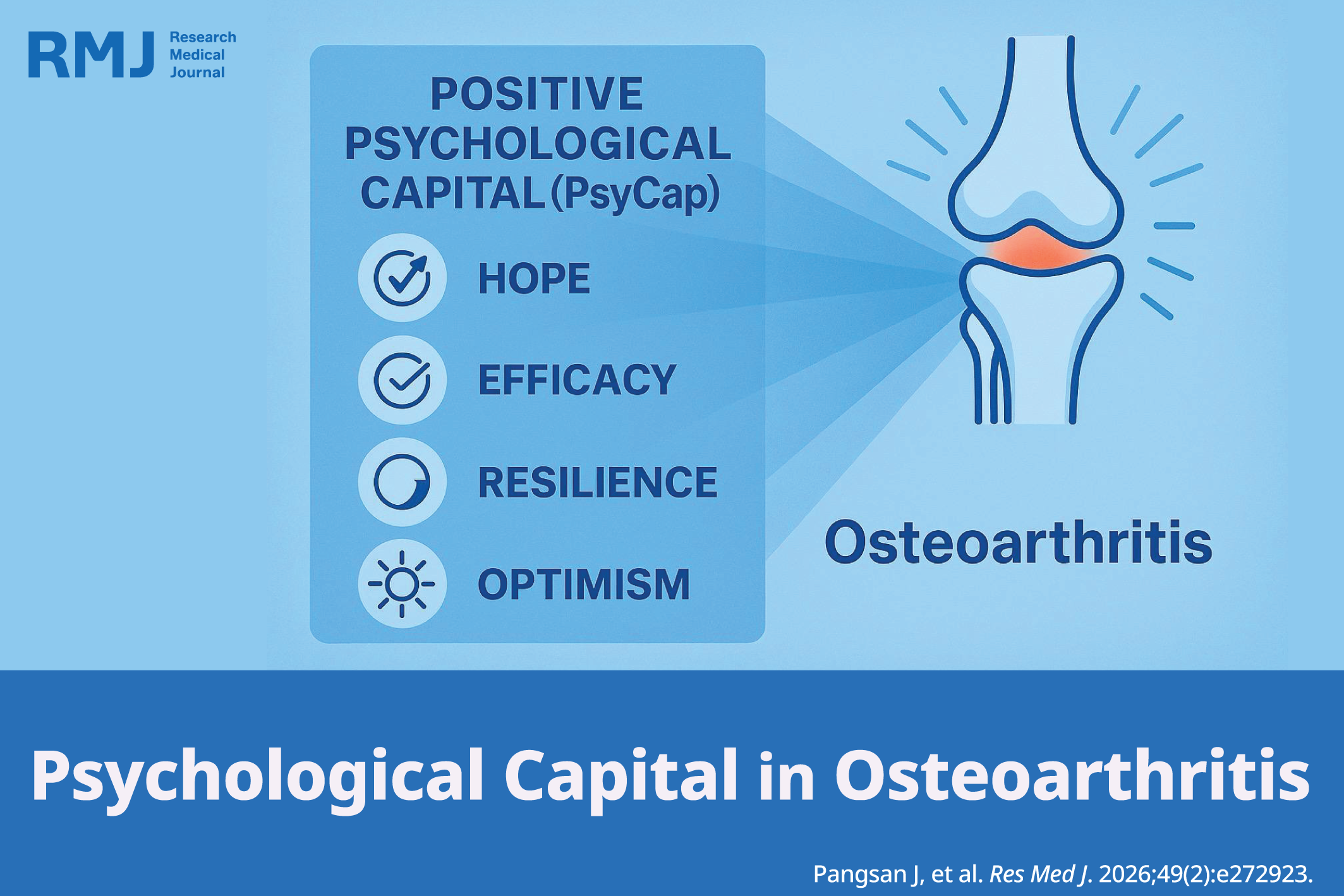
Background: Osteoarthritis is a prevalent global health challenge, particularly among the elderly, and leads to significant physical disability, emotional distress, and socioeconomic burden. Effective interventions addressing these multifaceted effects are limited, especially in patients with severe knee osteoarthritis awaiting a surgical intervention. This study was guided by 2 theoretical frameworks: the positive psychological capital (PsyCap) theory, which focuses on enhancing psychological resilience, motivation, and coping strategies; and the self-management model, which emphasizes goal setting, symptom tracking, and adherence to self-care behaviors.
Objectives: To evaluate the effectiveness of a novel intervention integrating PsyCap theory and self-management model strategies to enhance self-care behavior, alleviate pain, and reduce mobility difficulties among patients with severe knee osteoarthritis (Kellgren-Lawrence grades 3-4).
Methods: A quasi-experimental pretest-posttest design was used between May and July 2023 at the outpatient surgery department of a university hospital. A total of 34 patients with primary knee osteoarthritis were randomly assigned into experimental (n = 17) and control (n = 17) groups. The experimental group received a self-care behavior enhancement program integrating PsyCap and self-management principles. Outcomes were assessed at 3 time points: baseline, postintervention (4 weeks), and follow-up (12 weeks). Statistical analyses included descriptive statistics and 2-way repeated measures analysis of variance (ANOVA) to examine within- and between-group effects over time.
Results: Compared to the control group, the experimental group demonstrated significant improvements in self-care behaviors (F[1,32] = 24.982; P < .001; η² = 0.438), with significant time-group interaction effects (F[1.374,43.960] = 38.581; P < .001; η² = 0.547). Additionally, pain and mobility difficulties significantly decreased in the experimental group (F[1.640,52.473] = 42.261; P < .001; η² = 0.569), whereas no significant changes were observed in the control group.
Conclusions: Integrating PsyCap theory and the self-management model significantly improved self-care behavior and reduced pain and mobility difficulty in patients with severe knee osteoarthritis awaiting surgery. These benefits were sustained over 12 weeks.
References
World Health Organization. World Health statistics 2023: Monitoring Health for the SDGs, Sustainable Development Goals. World Health Organization; 2023. 19 May 2023. Accessed 16 March 2025. https://www.who.int/publications/i/item/9789240074323
World Health Organization. World Health statistics 2024: Monitoring Health for the SDGs, Sustainable Development Goals. World Health Organization; 2024. 21 May 2024. Accessed 16 March 2025. https://www.who.int/publications/i/item/9789240094703
Loeser RF, Collins JA, Diekman BO. Ageing and the pathogenesis of osteoarthritis. Nat Rev Rheumatol. 2016;12(7):412-420. doi:10.1038/nrrheum.2016.65
Hunter DJ, Bierma-Zeinstra S. Osteoarthritis. Lancet. 2019;393(10182):1745-1759. doi:10.1016/S0140-6736(19)30417-9
Giaretta S, Magni A, Migliore A, et al. A review of current approaches to pain management in knee osteoarthritis with a focus on Italian clinical landscape. J Clin Med. 2024;13(17):5176. doi:10.3390/jcm13175176
Areeue S. Orthopedic Nursing: From Evidence-Based Practice to Clinical Nursing Practice. Ramathibodi Textbook Project; 2021.
National Academies of Sciences, Engineering, and Medicine. The Role of Nonpharmacological Approaches to Pain Management: Proceedings of a Workshop. The National Academies Press; 2019. doi:10.17226/25406
Lee Y, Lee SH, Lim SM, Baek SH, Ha IH. Mental health and quality of life of patients with osteoarthritis pain: the sixth Korea national health and nutrition examination survey (2013-2015). PLoS One. 2020;15(11):e0242077. doi:10.1371/journal.pone.0242077
da Silva do Prado LD, Ramos MEK, Camargo JDC, Bertoncelo GL, Reginatto CC, de Oliveira Siqueira L. Relationship between pain, functional limitations, dependence, depression, and osteoarthritis in older adults. Fisioter Mov. 2023;36(10159):e36202. doi:10.1590/fm.2023.36202
Farinelli L, Riccio M, Gigante A, De Francesco F. Pain management strategies in osteoarthritis. Biomedicines. 2024;12(4):805. doi:10.3390/biomedicines12040805
Martinez-Calderon J, Cano-García FJ, García-Muñoz C, Rufo-Barbero C, Matias-Soto J, Infante-Cano M. How can clinicians enhance self-efficacy beliefs in osteoarthritis? an overview of systematic reviews with meta-analysis. Clin Rheumatol. 2024;43(5):1435-1446. doi:10.1007/s10067-024-06943-2
Loeser RF, Collins JA, Diekman BO. Ageing and the pathogenesis of osteoarthritis. Nat Rev Rheumatol. 2016;12(7):412-420. doi:10.1038/nrrheum.2016.65
American Academy of Orthopaedic Surgeons. Management of Osteoarthritis of the Knee (Non-Arthroplasty): Evidence-Based Clinical Practice Guideline. American Academy of Orthopaedic Surgeons (AAOS); 2021. 31 August 2021. Accessed 16 March 2025. https://www.aaos.org/oak3cpg
Luthans F, Youssef CM, Avolio BJ. Psychological Capital: Developing the Human Competitive Edge. Oxford University Press; 2007.
Creer TL. Self-management model of chronic illness. In: Kanfer FH, Goldstein AP, eds. Helping People Change: A Textbook of Methods. 3rd ed. Pergamon Press; 1986:63-90.
Abujaber S, Altubasi I, Hamdan M, Al-Zaben R. Impact of end-stage knee osteoarthritis on perceived physical function and quality of life: a descriptive study from Jordan. PLoS One. 2023;18(6):e0286962. doi:10.1371/journal.pone.0286962
Martinez-Calderon J, García-Muñoz C, Rufo-Barbero C, Matias-Soto J, Cano-García FJ. Acceptance and commitment therapy for chronic pain: an overview of systematic reviews with meta-analysis of randomized clinical trials. J Pain. 2024;25(3):595-617. doi:10.1016/j.jpain.2023.09.013
Bunsanong T, Chaimongkol N. A self-management support intervention on knee functional status and health-related quality of life among middle-age women: a randomized controlled trial. J Adv Nurs. 2021;77(1):376-386. doi:10.1111/jan.14600
Kennett L, Bei B, Jackson ML. A Randomized controlled trial to examine the feasibility and preliminary efficacy of a digital mindfulness-based therapy for improving insomnia symptoms. Mindfulness. 2021;12(10):2460-2472. doi:10.1007/s12671-021-01714-5
Ayre C, Scally AJ. Critical values for Lawshe’s content validity ratio: revisiting the original methods of calculation. Meas Eval Couns Dev. 2014;47(1):79-86. doi:10.1177/0748175613513808
Polit DF, Beck CT. Nursing Research: Generating and Assessing Evidence for Nursing Practice. 8th ed. Wolters Kluwer Health/Lippincott Williams & Wilkins; 2008.
DeVellis RF. Scale Development: Theory and Applications. 3rd ed. SAGE Publications, Inc; 2012.
Yi F, Li X, Song X, Zhu L. The underlying mechanisms of psychological resilience on emotional experience: attention-bias or emotion disengagement. Front Psychol. 2020;11:1993. doi:10.3389/fpsyg.2020.01993
Mease PJ, Karki C, Palmer JB, et al. Clinical characteristics, disease activity, and patient-reported outcomes in psoriatic arthritis patients with dactylitis or enthesitis: results from the Corrona Psoriatic Arthritis/Spondyloarthritis Registry. Arthritis Care Res. 2017;69(11):1692-1699. doi:10.1002/acr.23249
Wu Z, Zhou R, Zhu Y, et al. Self-management for knee osteoarthritis: a systematic review and meta-analysis of randomized controlled trials. Pain Res Manag. 2022;2022:2681240. doi:10.1155/2022/2681240
Zeng CY, Zhang ZR, Tang ZM, Hua FZ. Benefits and mechanisms of exercise training for knee osteoarthritis. Front Physiol. 2021;12:794062. doi:10.3389/fphys.2021.794062
Kong H, Wang XQ, Zhang XA. Exercise for osteoarthritis: a literature review of pathology and mechanism. Front Aging Neurosci. 2022;14:854026. doi:10.3389/fnagi.2022.854026
Lim J, Choi A, Kim B. The effects of resistance training on pain, strength, and function in osteoarthritis: systematic review and meta-analysis. J Pers Med. 2024;14(12):1130. doi:10.3390/jpm14121130
Downloads
Published
How to Cite
Issue
Section
License
Copyright (c) 2026 by the Author(s). Licensee RMJ.

This work is licensed under a Creative Commons Attribution 4.0 International License.