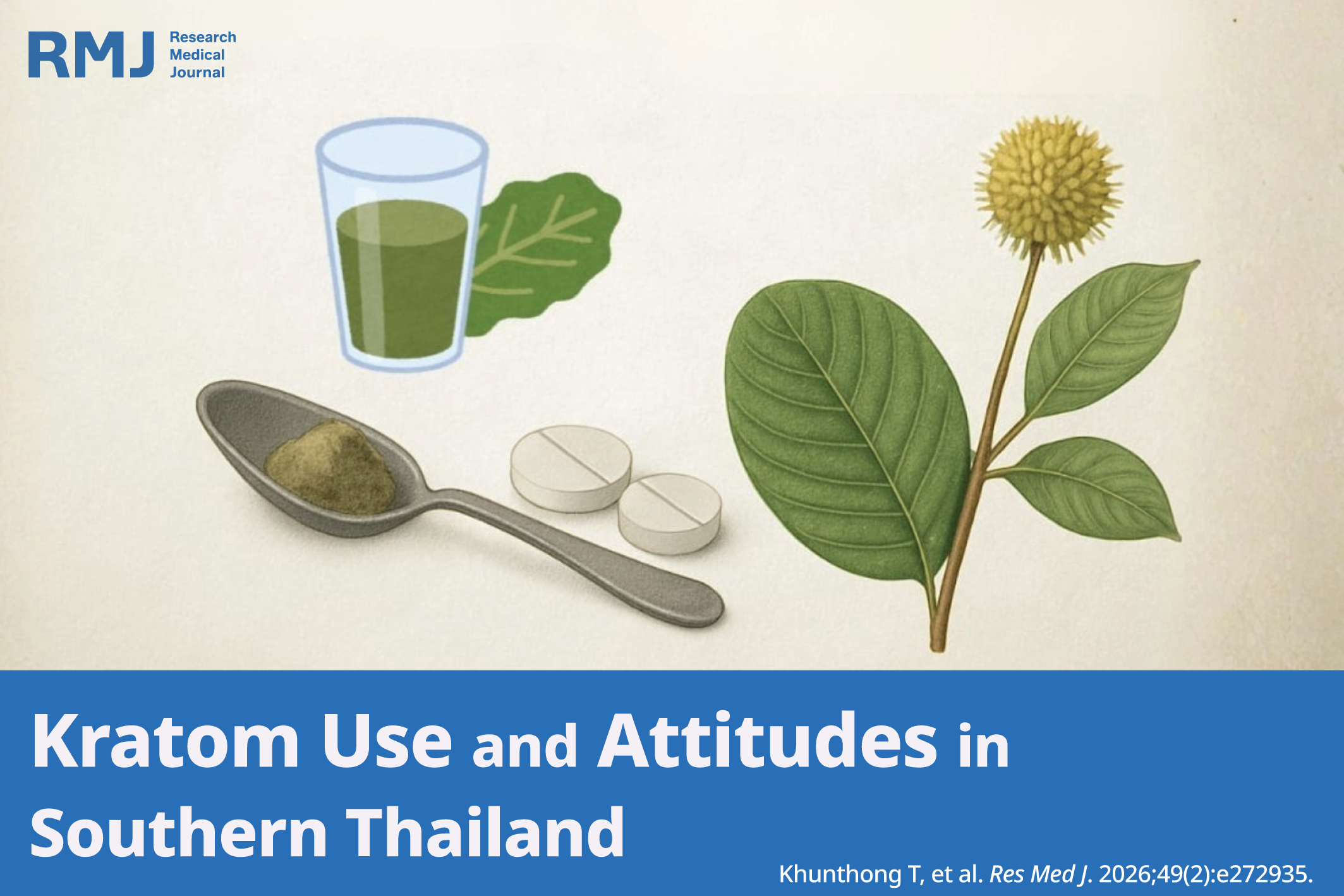
Exploring Kratom Use in High-Prevalence Areas of Southern Thailand: Attitudes, Knowledge, and Consumption Patterns – A Mixed-Methods Study
DOI:
https://doi.org/10.33165/rmj.2026.e272935Keywords:
Mitragyna speciosa, Kratom, Consumption patterns, Behavioral predictors, Southern ThailandAbstract
Background: Kratom (Mitragyna speciosa), a tropical tree native to Southeast Asia, has traditionally been used in Thailand for medicinal and recreational purposes. Although recently legalized for medicinal use, concerns remain regarding its safety and potential for abuse.
Objectives: To investigate kratom consumption patterns and identify demographic, behavioral, and cognitive predictors of current and harmful use in high-prevalence rural communities in southern Thailand.
Methods: A cross-sectional study was conducted among 169 participants from southern Thai communities with high kratom use. A structured questionnaire assessed demographics, attitudes, knowledge, and usage patterns. Harmful use was defined as consumption of more than 20 leaves per day. Multiple logistic regression analysis identified predictors of current and harmful use.
Results: Among participants, 45 (26.6%) were current users, and of those 22 (48.9%) met the criteria for harmful use. Predictors of current use included younger age (adjusted OR [AOR], 0.97; 95% CI, 0.94-0.99), tobacco use (AOR, 16.12; 95% CI, 5.01-51.86), poor mental health (AOR, 8.8; 95% CI, 2.2-35.16), and favorable attitudes toward kratom (AOR, 1.12 per point; 95% CI, 1.06-1.18). Harmful use was associated with long-term consumption (AOR, 10.54; 95% CI, 1.01-109.9), boiling as the method of use (AOR, 80.96; 95% CI, 4.98-1315.6), and lower knowledge scores (AOR, 17.8; 95% CI, 1.57-201.68).
Conclusions: Current and harmful kratom use are linked to specific demographic and behavioral factors. These findings support the need for targeted public health education and regulation in high-risk communities.
References
Davidson C, Cao D, King T, et al. A comparative analysis of kratom exposure cases in Thailand and the United States from 2010-2017. Am J Drug Alcohol Abuse. 2021;47(1):74-83. doi:10.1080/00952990.2020.1836185
Shah K, Tankersley W, Mekala H. Kratom: an emerging issue and need for regulations in the United States. Prim Care Companion CNS Disord. 2021;23(1):20r02770. doi:10.4088/PCC.20r02770
Henningfield JE, Wang DW, Huestis MA. Kratom abuse potential 2021: an updated eight factor analysis. Front Pharmacol. 2022;12:775073. doi:10.3389/fphar.2021.775073
Prozialeck WC, Avery BA, Boyer EW, et al. Kratom policy: the challenge of balancing therapeutic potential with public safety. Int J Drug Policy. 2019;70:70-77. doi:10.1016/j.drugpo.2019.05.003
Veltri C, Grundmann O. Current perspectives on the impact of Kratom use. Subst Abuse Rehabil. 2019;10:23-31. doi:10.2147/SAR.S164261
Charoenratana S, Anukul C, Aramrattana A. Attitudes towards kratom use, decriminalization and the development of a community-based kratom control mechanism in Southern Thailand. Int J Drug Policy. 2021;95:103197. doi:10.1016/j.drugpo.2021.103197
McCurdy CR, Sharma A, Smith KE, et al. An update on the clinical pharmacology of kratom: uses, abuse potential, and future considerations. Expert Rev Clin Pharmacol. 2024;17(2):131-142. doi:10.1080/17512433.2024.2305798
Singh D, Müller CP, Vicknasingam BK. Kratom (Mitragyna speciosa) dependence, withdrawal symptoms and craving in regular users. Drug Alcohol Depend. 2014;139:132-137. doi:10.1016/j.drugalcdep.2014.03.017
Singh D, Narayanan S, Müller CP, et al. Severity of kratom (Mitragyna speciosa Korth.) psychological withdrawal symptoms. J Psychoactive Drugs. 2018;50(5):445-450. doi:10.1080/02791072.2018.1511879
Eastlack SC, Cornett EM, Kaye AD. Kratom-pharmacology, clinical implications, and outlook: a comprehensive review. Pain Ther. 2020;9(1):55-69. doi:10.1007/s40122-020-00151-x
Trakulsrichai S, Sathirakul K, Auparakkitanon S, et al. Pharmacokinetics of mitragynine in man. Drug Des Devel Ther. 2015;9:2421-2429. doi:10.2147/DDDT.S79658
White CM. Pharmacologic and clinical assessment of kratom: an update. Am J Health Syst Pharm. 2019;76(23):1915-1925. doi:10.1093/ajhp/zxz221
Singh D, Narayanan S, Vicknasingam B. Traditional and non-traditional uses of mitragynine (kratom): a survey of the literature. Brain Res Bull. 2016;126(Pt 1):41-46. doi:10.1016/j.brainresbull.2016.05.004
Swogger MT, Walsh Z. Kratom use and mental health: a systematic review. Drug Alcohol Depend. 2018;183:134-140. doi:10.1016/j.drugalcdep.2017.10.012
Prozialeck WC, Jivan JK, Andurkar SV. Pharmacology of kratom: an emerging botanical agent with stimulant, analgesic and opioid-like effects. J Am Osteopath Assoc. 2012;112(12):792-799. doi:10.7556/jaoa.2012.112.12.792
Hosmer DW, Lemeshow S. Applied Logistic Regression. 2nd ed. John Wiley & Sons, Inc; 2000. doi:10.1002/0471722146
Signorell A, Aho K, Alfons A, et al. DescTools: Tools for Descriptive Statistics. R package version 0.99.60. 2019;28:17. doi:10.32614/CRAN.package.DescTools
Lele SR, Keim JL, Solymos P, Solymos MP, Imports M. Package ‘ResourceSelection’. Google Scholar; 2019.
Robin X, Turck N, Hainard A, et al. Package ‘pROC’. 2 September 2021. Accessed 12 June 2025. https://mirror.uned.ac.cr/cran/web/packages/pROC/pROC.pdf
von Elm E, Altman DG, Egger M, et al. Strengthening the reporting of observational studies in epidemiology (STROBE) statement: guidelines for reporting observational studies. BMJ. 2007;335(7624):806-808. doi:10.1136/bmj.39335.541782.AD
Saingam D, Singh D, Geater AF, Assanangkornchai S, Jitpiboon W, Latkin C. The health impact of long-term kratom (Mitragyna speciosa) use in Southern Thailand. Subst Use Misuse. 2023;58(10):1212-1225. doi:10.1080/10826084.2023.2215301
Smith KE, Panlilio LV, Feldman JD, et al. Ecological momentary assessment of self-reported kratom use, effects, and motivations among US adults. JAMA Netw Open. 2024;7(1):e2353401. doi:10.1001/jamanetworkopen.2023.53401
Smith KE, Dunn KE, Grundmann O, et al. Social, psychological, and substance use characteristics of U.S. adults who use kratom: initial findings from an online, crowdsourced study. Exp Clin Psychopharmacol. 2022;30(6):983-996. doi:10.1037/pha0000518
Grundmann O. Patterns of kratom use and health impact in the US-results from an online survey. Drug Alcohol Depend. 2017;176:63-70. doi:10.1016/j.drugalcdep.2017.03.007
Falise AM, Hoeflich CC, Nutley SK, Lopez-Quintero C, Striley CW. Polysubstance use profiles among US adults using kratom (Mitragyna speciosa): a latent class analysis using the National Survey on Drug Use and Health (NSDUH). Am J Addict. 2023;32(1):76-80. doi:10.1111/ajad.13345
Kalayasiri R, Boonthae S. Trends of cannabis use and related harms before and after legalization for recreational purpose in a developing country in Asia. BMC Public Health. 2023;23(1):911. doi:10.1186/s12889-023-15883-6
Bachu AK, Singal P, Griffin B, et al. Kratom use and mental health: a systematic literature review and case example. J Addict Dis. 2024;42(4):301-312. doi:10.1080/10550887.2023.2273192
Tokuda Y, Tubtimrattan A, Tansrisawad N, Meesilpavikkai K, Thirati P. Beyond mitragynine: composition survey and stability assessment of kratom tea ordered via food delivery platforms in Bangkok, Thailand. Chula Med J. 2024;68(2):113-123. doi:10.56808/2673-060X.5408
Downloads
Published
How to Cite
Issue
Section
License
Copyright (c) 2026 by the Author(s). Licensee RMJ.

This work is licensed under a Creative Commons Attribution 4.0 International License.