
Development of Enzyme-Linked Immunosorbent Assay and Lateral Flow Strip Assay for Trimeresurus albolabris Venom Detection
DOI:
https://doi.org/10.33165/rmj.2026.e273610Keywords:
Trimeresurus albolabris, Lateral flow strip assay, ELISA, Snake venomsAbstract
Background: Snakebite symptoms (eg, neurological signs, local swelling, nonclotting blood) can overlap among different snake types. Accurate venom identification is crucial for selecting the appropriate antivenom against hemotoxic, neurotoxic, or cytotoxic effects. In Thailand, the common snakes Daboia siamensis, Calloselasma rhodostoma, and Trimeresurus albolabris possess hemotoxic venoms, which can cause symptoms such as pain, swelling, bruising, and bleeding. Although enzyme-linked immunosorbent assay (ELISA) is widely employed for snake venom detection due to its high sensitivity, it is time-consuming. It requires a well-equipped laboratory and specialized skills, whereas the later flow strip assay (LFA) is easy to use and significantly reduces the time required; however, it is typically used for qualitative detection. However, both ELISA and LFA are valuable for snakebite diagnosis. Enhancing the sensitivity, accuracy, and reliability of these assays, particularly for low-abundance targets, remains a critical objective.
Objectives: To develop sandwich ELISA and LFA for detecting T. albolabris venom and to enhance the specificity of horse immunoglobulin G (HIgG) against T. albolabris venom for use in ELISA and LFA, thereby reducing the likelihood of cross-reactivity in detection.
Methods: Specific HIgG against T. albolabris venom was purified using an affinity column. The cross-reactivity of snake venoms was demonstrated through Western blotting. Snake venom detection was quantified by ELISA and visually assessed using LFA.
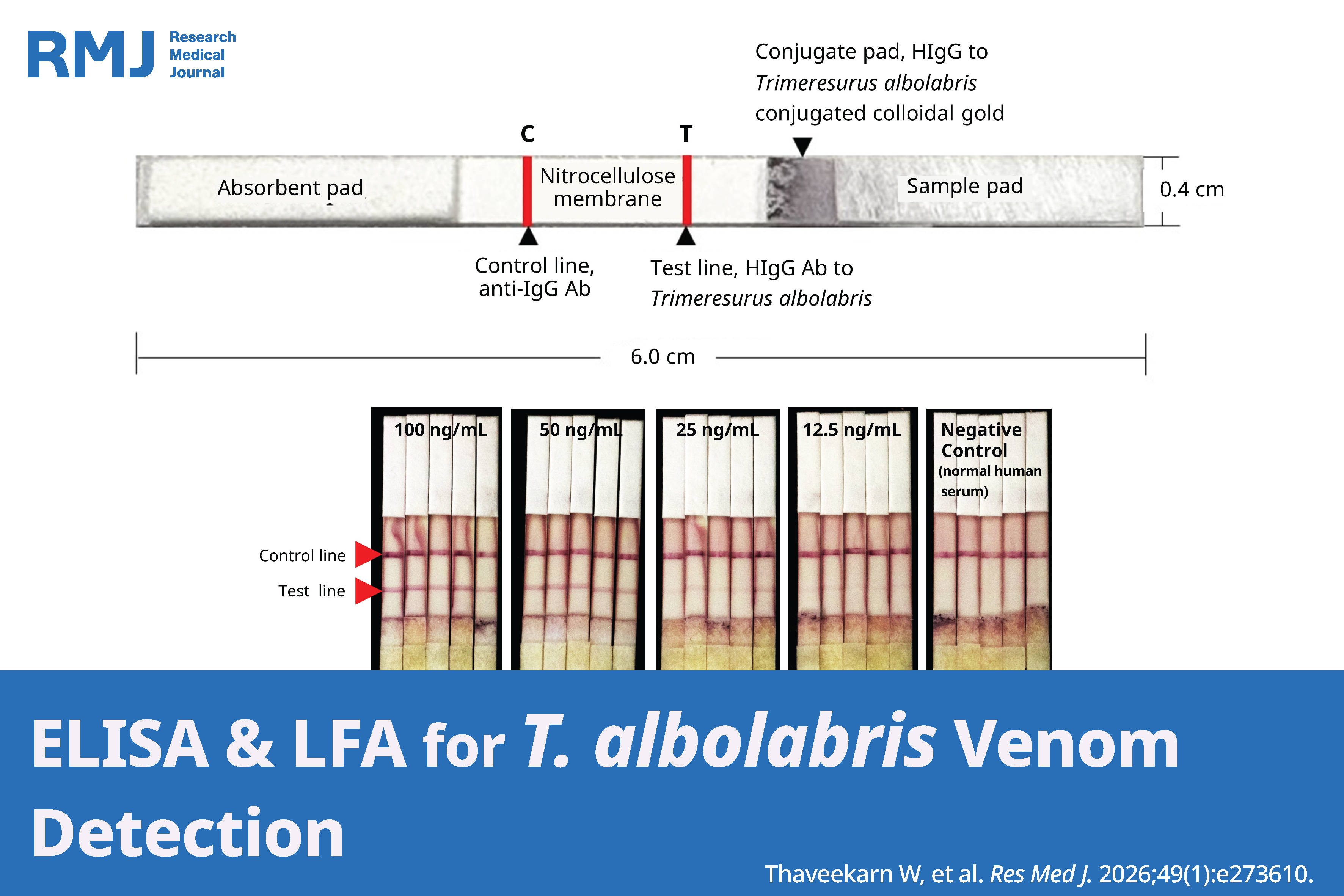
Results: The sandwich ELISA assay for T. albolabris venom detection yielded a coefficient of determination greater than 0.99, a limit of detection at 11.37 ng/mL, and a limit of quantification at 34.45 ng/mL, without any cross-reaction with the venom of C. rhodostoma and D. siamensis. The LFA can detect T. albolabris venom at 25 ng/mL, showing no cross-reaction and no positive test in the test line for either C. rhodostoma or D. siamensis venom.
Conclusions: The developed sandwich ELISA assay and the LFA could distinguish T. albolabris venom from C. rhodostoma and D. siamensis venom.
References
World Health Organization. Snakebite envenoming. 12 September 2023. Accessed 6 June 2025. https://www.who.int/news-room/fact-sheets/detail/snakebite-envenoming
World Health Organization. Guidelines for the Management of Snakebites. 2nd ed. World Health Organization; 2016. Accessed 6 June 2025. https://www.who.int/docs/default-source/searo/india/health-topic-pdf/who-guidance-on-management-of-snakebites.pdf?sfvrsn=552
Kasturiratne A, Wickremasinghe AR, de Silva N, et al. The global burden of snakebite: a literature analysis and modelling based on regional estimates of envenoming and deaths. PLoS Med. 2008;5(11):e218. doi:10.1371/journal.pmed.0050218
Ariaratnam CA, Sheriff MH, Arambepola C, Theakston RD, Warrell DA. Syndromic approach to treatment of snake bite in Sri Lanka based on results of a prospective national hospital-based survey of patients envenomed by identified snakes. Am J Trop Med Hyg. 2009;81(4):725-731. doi:10.4269/ajtmh.2009.09-0225
Isbister GK, Shahmy S, Mohamed F, Abeysinghe C, Karunathilake H, Ariaratnam A. A randomised controlled trial of two infusion rates to decrease reactions to antivenom. PLoS One. 2012;7(6):e38739. doi:10.1371/journal.pone.0038739
Greene S, Galdamez LA, Tomasheski R. White-lipped tree viper (Cryptelytrops albolabris) envenomation in an American viper keeper. J Emerg Med. 2017;53(6):e115-e118. doi:10.1016/j.jemermed.2017.09.003
Macêdo JKA, Joseph JK, Menon J, et al. Proteomic analysis of human blister fluids following envenomation by three snake species in India: differential markers for venom mechanisms of action. Toxins. 2019;11(5):246. doi:10.3390/toxins11050246
Mehta SR, Sashindran VK. Clinical features and management of snake bite. Med J Armed Forces India. 2002;58(3):247-249. doi:10.1016/S0377-1237(02)80140-X
Aydin S, Emre E, Ugur K, et al. An overview of ELISA: a review and update on best laboratory practices for quantifying peptides and proteins in biological fluids. J Int Med Res. 2025;53(2):3000605251315913. doi:10.1177/03000605251315913
Steuten J, Winkel K, Carroll T, et al. The molecular basis of cross-reactivity in the Australian Snake Venom Detection Kit (SVDK). Toxicon. 2007;50(8):1041-1052. doi:10.1016/j.toxicon.2007.07.023
Liu CC, Yu JS, Wang PJ, et al. Development of sandwich ELISA and lateral flow strip assays for diagnosing clinically significant snakebite in Taiwan. PLoS Negl Trop Dis. 2018;12(12):e0007014. doi:10.1371/journal.pntd.0007014
Kumar S, Aaron J, Sokolov K. Directional conjugation of antibodies to nanoparticles for synthesis of multiplexed optical contrast agents with both delivery and targeting moieties. Nat Protoc. 2008;3(2):314-320. doi:10.1038/nprot.2008.1
Wenzl T, Johannes H, Schaechtele A, Robouch P, Stroka J. Guidance Document on the Estimation of LOD and LOQ for Measurements in the Field of Contaminants in Food and Feed. Publications Office of the European Union; 2016. doi:10.2787/8931
iTeh Standards. ISO 5725-1:1994 (Main), Accuracy (trueness and precision) of measurement methods and results — Part 1: General principles and definitions. 22 December 1994. Accessed 6 June 2025. https://standards.iteh.ai/catalog/standards/sist/fd911a40-20f6-4c0b-ac29-30ba48191e7d/iso-5725-1-1994
Sánchez EE, Ramírez MS, Galán JA, López G, Rodríguez-Acosta A, Pérez JC. Cross reactivity of three antivenoms against North American snake venoms. Toxicon. 2003;41(3):315-320. doi:10.1016/s0041-0101(02)00293-3
Ledsgaard L, Jenkins TP, Davidsen K, et al. Antibody cross-reactivity in antivenom research. Toxins. 2018;10(10):393. doi:10.3390/toxins10100393
Mishra M, Tiwari S, Gunaseelan A, Li D, Hammock BD, Gomes AV. Improving the sensitivity of traditional Western blotting via Streptavidin containing Poly-horseradish peroxidase (PolyHRP). Electrophoresis. 2019;40(12-13):1731-1739. doi:10.1002/elps.201900059
Yang H, Zhang Q, Liu X, et al. Antibody-biotin-streptavidin-horseradish peroxidase (HRP) sensor for rapid and ultra-sensitive detection of fumonisins. Food Chem. 2020;316:126356. doi:10.1016/j.foodchem.2020.126356
Khlebtsov BN, Tumskiy RS, Burov AM, Pylaev TE, Khlebtsov NG. Quantifying the numbers of gold nanoparticles in the test zone of lateral flow immunoassay strips. ACS Appl Nano Mater. 2019;2(8):5020-5028. doi:10.1021/acsanm.9b00956
Rojnuckarin P, Banjongkit S, Chantawibun W, et al. Green pit viper (Trimeresurus albolabris and T. macrops) venom antigenaemia and kinetics in humans. Trop Doct. 2007;37(4):207-210. doi:10.1258/004947507782332838
Khin Ohn Lwin, Aye Aye Myint, Tun Pe, Theingie Nwe, Min Naing. Russell's viper venom levels in serum of snake bite victims in Burma. Trans R Soc Trop Med Hyg. 1984;78(2):165-168. doi:10.1016/0035-9203(84)90267-0
Knudsen C, Belfakir SB, Degnegaard P, et al. Multiplex lateral flow assay development for snake venom detection in biological matrices. Sci Rep. 2024;14(1):2567. doi:10.1038/s41598-024-51971-2
Downloads
Published
How to Cite
Issue
Section
License
Copyright (c) 2025 by the Author(s). Licensee RMJ.

This work is licensed under a Creative Commons Attribution 4.0 International License.