Nursing Students' Perceptions of Spiritual Care Competency: A Qualitative Study
DOI:
https://doi.org/10.33165/rmj.2026.e273630Keywords:
Nursing students, Spiritual care, Competency, Patients, Holistic nursingAbstract
Background: Spiritual care is a crucial component of holistic nursing practice, as it addresses patients' emotional, psychological, and existential well-being. Nursing students play a vital role in providing spiritual support, yet their competencies in this area remain underexplored.
Objective: To explore nursing students' perceptions of their competencies in providing spiritual care to patients.
Methods: A descriptive qualitative research design was employed in this study. Ten fourth-year nursing students from the Faculty of Nursing at Ubon Ratchathani Rajabhat University were selected using purposive sampling and snowball techniques. Data were collected through in-depth interviews conducted between December 2024 and January 2025. The research instruments included a semi-structured interview guide, field notes, observational tools, and the researcher’s reflective journal. Content analysis was used to analyze the data.
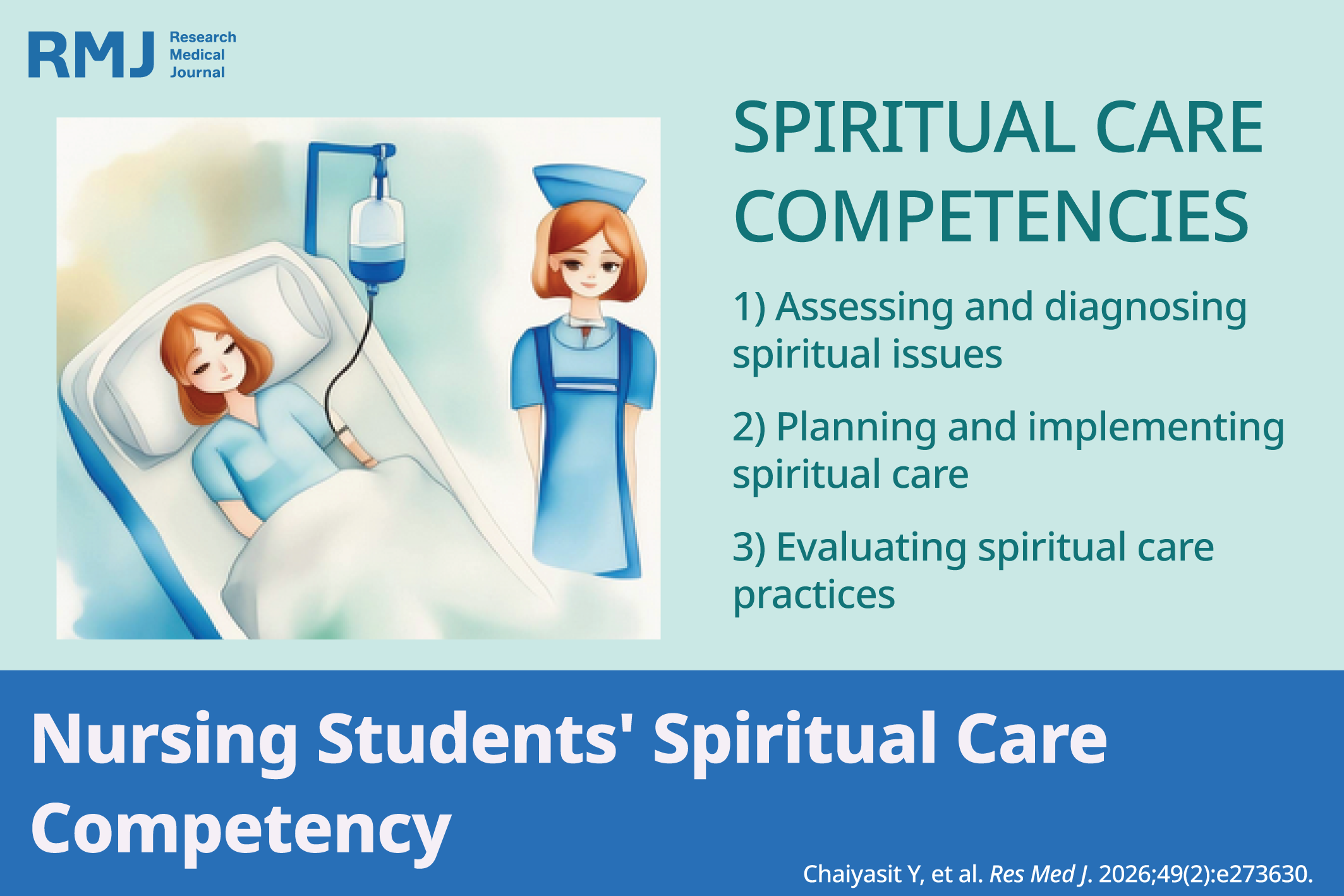
Results: The findings revealed that nursing students perceived their spiritual care competencies as encompassing 3 key areas: 1) assessing and diagnosing spiritual issues; 2) planning and implementing spiritual care, which included: maintaining a positive attitude and respecting patients’ spiritual beliefs, communication and counseling, empathy and compassion, encouraging patients to practice their faith and beliefs, and referring patients to spiritual care specialists; and 3) evaluating spiritual care practices.
Conclusions: While nursing students show confidence in certain aspects of spiritual care, the study highlights the need for enhanced training. Integrating comprehensive spiritual care education and practical experiences into the curriculum, along with support from spiritual care professionals, is essential for strengthening students' competencies.
References
Putri AS, Sunarya CE, Waluyo A. Nursing students’ spirituality and their perception of spirituality and spiritual care. Indonesion Nursing Journal of Education Clinic. 2023;8(1):3-11. doi:10.24990/injec.v8i1.484
Matos J, Querido A, Laranjeira C. Spiritual care through the lens of Portuguese palliative care professionals: a qualitative thematic analysis. Behav Sci. 2024;14(2):134. doi:10.3390/bs14020134
Sarrión-Bravo JA, González-Aguña A, Abengózar-Muela R, et al. Competence in spiritual and emotional care: learning outcomes for the evaluation of nursing students. Healthcare. 2022;10(10):2062. doi:10.3390/healthcare10102062
Ahmadi M, Estebsari F, Poormansouri S, Jahani S, Sedighie L. Perceived professional competence in spiritual care and predictive role of spiritual intelligence in Iranian nursing students. Nurse Educ Pract. 2021;57:103227. doi:10.1016/j.nepr.2021.103227
Guo Z, Zhang Y, Li P, Zhang Q, Shi C. Student nurses' spiritual care competence and attitude: an online survey. Nurs Open. 2023;10(3):1811-1820. doi:10.1002/nop2.1441
Poiynok S, Luangon D, Boonurai S, Thongsook P, Watanapruk P. The relationship between nurses' spiritual well-being and their spiritual care. SWU J Sci Technol. 2020;12(24):169-182.
Tuckerman J, Kaufman J, Danchin M. How to use qualitative methods for health and health services research. J Paediatr Child Health. 2020;56(5):818-820. doi:10.1111/jpc.14849
Creswell JW, Plano Clark VL. Designing and Conducting Mixed Methods Research. 3rd ed. SAGE Publications, Inc; 2018.
Cohen MZ, Kahn DL, Steeves RH. Hermeneutic Phenomenological Research: A Practical Guide for Nurse Researchers. SAGE Publications, Inc; 2000.
Lincoln YS, Guba EG. Naturalistic Inquiry. SAGE Publications, Inc; 1985. doi:10.1016/0147-1767(85)90062-8
Kata W, Somkumlung P, Chaiyasit Y, Sehakomet V. Spiritual health assessment: nursing implementation. Journal of Sakon Nakhon Hospital. 2018;21(3):138-147.
Kaewmanee C. Concepts and spiritual needs assessment of cancer patients. Nursing Journal of the Ministry of Public Health. 2019;29(1):1-10.
Chaiyasit Y, Piboonrungroj P. Nursing Cares for Patients with Spiritual Distress. Chulalongkorn University; 2020.
Ernstmeyer K, Christman E, eds. Nursing Fundamentals. Chippewa Valley Technical College; 2021.
Vogel A, Schep-Akkerman AE. Competence and frequency of provision of spiritual care by nurses in the Netherlands. Scand J Caring Sci. 2018;32(4):1314-1321. doi:10.1111/scs.12575
Daghan S, Kalkim A, Sağkal Midilli T. Psychometric evaluation of the Turkish form of the spiritual care competence scale. J Relig Health. 2019;58(1):14-27. doi:10.1007/s10943-018-0594-2
Abusafia AH, Mamat Z, Rasudin NS, Bakar M, Ismail R. Spiritual care competence among Malaysian staff nurses. Nurse Media Journal of Nursing. 2021;11(1):1-9. doi:10.14710/nmjn.v11i1.34757
Seid K, Abdo A. Nurse's spiritual care competence in Ethiopia: a multicenter cross-sectional study. PLoS One. 2022;17(3):e0265205. doi:10.1371/journal.pone.0265205
Fang HF, Susanti HD, Dlamini LP, Miao NF, Chung MH. Validity and reliability of the spiritual care competency scale for oncology nurses in Taiwan. BMC Palliat Care. 2022;21(1):16. doi:10.1186/s12904-022-00903-w
Vincensi BB. Interconnections: spirituality, spiritual care, and patient-centered care. Asia Pac J Oncol Nurs. 2019;6(2):104-110. doi:10.4103/apjon.apjon_48_18
Bø B, Ueland V, Giske T, Kuven B. Courage to address patients’ spiritual thoughts and emotions-a qualitative study. Sykepleien Forskning. 2023;18(93502):e-93502. doi:10.4220/Sykepleienf.2023.93502en
García-Navarro EB, Navarro SG, Sousa L, José H, Caceres-Titos MJ, Ortega-Galán Á. Nursing students' perceptions of spiritual needs at the end of life. A qualitative study. Front Psychiatry. 2023;14:1132581. doi:10.3389/fpsyt.2023.1132581
Irajpour A, Moghimian M, Arzani H. Spiritual aspects of care for chronic Muslim patients: a qualitative study. J Educ Health Promot. 2018;7:118. doi:10.4103/jehp.jehp_199_17
Moosavi S, Rohani C, Borhani F, Akbari ME. Consequences of spiritual care for cancer patients and oncology nurses: a qualitative study. Asia Pac J Oncol Nurs. 2019;6(2):137-144. doi:10.4103/apjon.apjon_37_18
Irajpour A, Moghimian M. Dimensions of the spiritual needs of Muslim chronic patients: a qualitative study. J Muslim Ment Health. 2018;12(2):29-43. doi:10.3998/jmmh.10381607.0012.203
Wang Z, Liang Y, Zhao H, et al. Spiritual care perceptions and empathy of Chinese nursing students: the mediating roles of spiritual well-being. Palliat Support Care. 2022;20(5):701-710. doi:10.1017/S1478951522001134
Cheng Q, Chen Y, Duan Y, Xie J, Zhang Q, Zheng H. Exploring the spiritual needs of patients with advanced cancer in China: a qualitative study. Sci Rep. 2024;14(1):4009. doi:10.1038/s41598-024-54362-9
Downloads
Published
How to Cite
Issue
Section
License
Copyright (c) 2026 by the Author(s). Licensee RMJ.

This work is licensed under a Creative Commons Attribution 4.0 International License.