
Effectiveness of a Hypothermia Prevention Guideline in Adult Patients Undergoing General Anesthesia at Srinagarind Hospital
DOI:
https://doi.org/10.33165/rmj.2026.e274363Keywords:
Hypothermia, Perioperative, Clinical practice guideline, Forced-air warming, SatisfactionAbstract
Background: Perioperative hypothermia (POH), associated with various complications, has a reported incidence ranging from 30% to 70%. A previous incidence of 31% at Srinagarind Hospital prompted the development and implementation of a copyrighted clinical practice guideline (CPG) for the prevention and management of hypothermia in adults.
Objective: To assess the effectiveness and user satisfaction of this CPG.
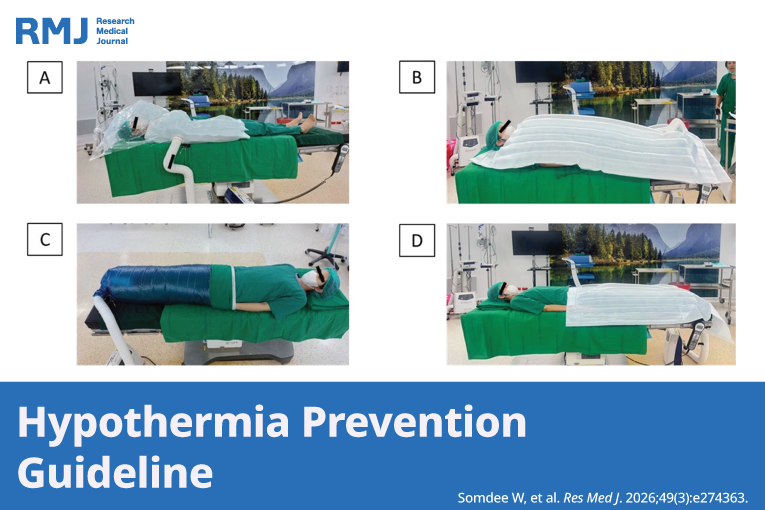
Methods: This retrospective descriptive study included adult patients undergoing general anesthesia, with or without regional anesthesia, at Srinagarind Hospital between 1 January 2023, and 30 April 2023. POH was defined as a core temperature below 36 °C. Following induction, all patients received forced-air warming using either upper-body warming (UBW) or lower-body warming (LBW) blankets, depending on the surgical procedure and patient position. Body temperature was recorded every 15 minutes for up to 120 minutes. Postoperative satisfaction with the CPG was assessed among patients and anesthesia nurses.
Results: A total of 356 patients, predominantly male with the American Society of Anesthesiologists (ASA) classifications I-II, were enrolled. Sixty-seven patients (18.8%) developed POH. Patients receiving LBW tended to experience POH more frequently than those receiving UBW, although the difference was not statistically significant (P = .444). No patient's temperature fell below 35.5 °C. High satisfaction with CPG implementation was reported by both patients (99.4%) and anesthesia nurses (100%).
Conclusions: Implementation of a CPG emphasizing forced-air warming effectively reduced the incidence of POH in adult patients. The CPG demonstrated high satisfaction among both patients and anesthesia nursing staff.
References
Yi J, Xiang Z, Deng X, et al. Incidence of inadvertent intraoperative hypothermia and its risk factors in patients undergoing general anesthesia in Beijing: a prospective regional survey. PLoS One. 2015;10(9):e0136136. doi:10.1371/journal.pone.0136136
Wongyingsinn M, Pookprayoon V. Incidence and associated factors of perioperative hypothermia in adult patients at a university-based, tertiary care hospital in Thailand. BMC Anesthesiol. 2023;23(1):137. doi:10.1186/s12871-023-02084-2
Zangmo K, Chatmongkolchart S, Sangsupawanich P. Perioperative risk factors for intraoperative hypothermia in adult patients undergoing elective surgery at a national referral hospital in Bhutan: a prospective observational study. J Health Sci Med Res. 2019;37(4):313-320. doi:10.31584/jhsmr.201966
Moola S, Lockwood C. Effectiveness of strategies for the management and/or prevention of hypothermia within the adult perioperative environment. Int J Evid Based Healthc. 2011;9(4):337-345. doi:10.1111/j.1744-1609.2011.00227.x
Yi J, Lei Y, Xu S, et al. Intraoperative hypothermia and its clinical outcomes in patients undergoing general anesthesia: national study in China. PLoS One. 2017;12(6):e0177221. doi:10.1371/journal.pone.0177221
McSwain JR, Yared M, Doty JW, Wilson SH. Perioperative hypothermia: causes, consequences and treatment. World J Anesthesiol. 2015;4(3):58-65. doi:10.5313/wja.v4.i3.58
Horosz B, Malec-Milewska M. Methods to prevent intraoperative hypothermia. Anaesthesiol Intensive Ther. 2014;46(2):96-100. doi:10.5603/AIT.2014.0019
Billeter AT, Hohmann SF, Druen D, Cannon R, Polk HC Jr. Unintentional perioperative hypothermia is associated with severe complications and high mortality in elective operations. Surgery. 2014;156(5):1245-1252. doi:10.1016/j.surg.2014.04.024
Austin PN. Forced-Air warmers and surgical site infections in patients undergoing knee or hip arthroplasty. Annu Rev Nurs Res. 2017;35(1):179-199. doi:10.1891/0739-6686.35.179
Sessler DI. Perioperative thermoregulation and heat balance. Lancet. 2016;387(10038):2655-2664. doi:10.1016/S0140-6736(15)00981-2
Matsukawa T, Sessler DI, Sessler AM, et al. Heat flow and distribution during induction of general anesthesia. Anesthesiology. 1995;82(3):662-673. doi:10.1097/00000542-199503000-00008
Bräuer A, English MJ, Steinmetz N, et al. Comparison of forced-air warming systems with upper body blankets using a copper manikin of the human body. Acta Anaesthesiol Scand. 2002;46(8):965-972. doi:10.1034/j.1399-6576.2002.460807.x
Campbell G, Alderson P, Smith AF, Warttig S. Warming of intravenous and irrigation fluids for preventing inadvertent perioperative hypothermia. Cochrane Database Syst Rev. 2015;2015(4):CD009891. doi:10.1002/14651858.CD009891.pub2
Madrid E, Urrútia G, Roqué i Figuls M, et al. Active body surface warming systems for preventing complications caused by inadvertent perioperative hypothermia in adults. Cochrane Database Syst Rev. 2016;4(4):CD009016. doi:10.1002/14651858.CD009016.pub2
Yoo JH, Ok SY, Kim SH, et al. Efficacy of active forced air warming during induction of anesthesia to prevent inadvertent perioperative hypothermia in intraoperative warming patients: comparison with passive warming, a randomized controlled trial. Medicine. 2021;100(12):e25235. doi:10.1097/MD.0000000000025235
Hooper VD, Chard R, Clifford T, et al. ASPAN's evidence-based clinical practice guideline for the promotion of perioperative normothermia: second edition. J Perianesth Nurs. 2010;25(6):346-365. doi:10.1016/j.jopan.2010.10.006
Wright R. The Essential Role of Perioperative Nurses in Preventing Hypothermia: Strategies and Guidelines for Maintaining Normothermia. Association of periOperative Registered Nurses. 16 September 2024. Accessed 6 August 2025. https://www.aorn.org/article/the-essential-role-of-perioperative-nurses-in-preventing-hypothermia--strategies-and-guidelines-for-maintaining-normothermia#:~:text=Strategies%20to%20Prevent%20Perioperative%20Hypothermia,which%20can%20lower%20core%20temperature
Wagner D, Byrne M, Kolcaba K. Effects of comfort warming on preoperative patients. AORN J. 2006;84(3):427-448. doi:10.1016/s0001-2092(06)63920-3
National Institute for Health and Care Excellence. Hypothermia: Prevention and Management in Adults Having Surgery, (CG65) Clinical Guideline. Published 23 April 2008. Updated 14 December 2016. Accessed 6 August 2025. https://www.nice.org.uk/guidance/cg65
Wongsripuemtet P, Leelanukrom R, Tangwiwat S, et al. Clinical guideline for prevention and management of perioperative hypothermia by the Royal College of Anesthesiologists of Thailand. Thai J Anesthesiol. 2024;50(4):287-300.
Sajid MS, Shakir AJ, Khatri K, Baig MK. The role of perioperative warming in surgery: a systematic review. Sao Paulo Med J. 2009;127(4):231-237. doi:10.1590/s1516-31802009000400009
Nieh HC, Su SF. Meta-analysis: effectiveness of forced-air warming for prevention of perioperative hypothermia in surgical patients. J Adv Nurs. 2016;72(10):2294-2314. doi:10.1111/jan.13010
Horn EP, Bein B, Böhm R, Steinfath M, Sahili N, Höcker J. The effect of short time periods of pre-operative warming in the prevention of peri-operative hypothermia. Anaesthesia. 2012;67(6):612-617. doi:10.1111/j.1365-2044.2012.07073.x
Alfonsi P. Postanaesthetic shivering: epidemiology, pathophysiology, and approaches to prevention and management. Drugs. 2001;61(15):2193-2205. doi:10.2165/00003495-200161150-00004
Simegn GD, Bayable SD, Fetene MB. Prevention and management of perioperative hypothermia in adult elective surgical patients: a systematic review. Ann Med Surg. 2021;72:103059. doi:10.1016/j.amsu.2021.103059
Augustine SD. Forced-air warming discontinued: periprosthetic joint infection rates drop. Orthop Rev. 2017;9(2):6998. doi:10.4081/or.2017.6998
Haeberle HS, Navarro SM, Samuel LT, et al. No evidence of increased infection risk with forced-air warming devices: a systematic review. Surg Technol Int. 2017;31:295-301.
Downloads
Published
How to Cite
Issue
Section
License
Copyright (c) 2026 by the Author(s). Licensee RMJ.

This work is licensed under a Creative Commons Attribution 4.0 International License.