
Vitamin D Deficiency and Bone Turnover in People Living With HIV Switching to Tenofovir Disoproxil Fumarate/Lamivudine/Dolutegravir Versus Continuing Nonnucleoside Reverse Transcriptase Inhibitor or Protease Inhibitor Regimens in Thailand
DOI:
https://doi.org/10.33165/rmj.2026.e274510Keywords:
HIV, Dolutegravir, Vitamin D deficiency, Bone turnover, Bone resorptionAbstract
Background: People living with HIV (PLWH) frequently have low bone mineral density, with vitamin D deficiency as a key risk factor. Recently, World Health Organization (WHO) and Thai national HIV guidelines recommend dolutegravir as first-line therapy, replacing nonnucleoside reverse transcriptase inhibitor (NNRTI)-based regimen.
Objectives: To compare vitamin D levels and bone changes in PLWH switching from NNRTI- or boosted protease inhibitor (PI)-containing regimens to DTG-based therapy versus those continuing NNRTI- or PI-based therapy.
Methods: This post hoc analysis used data from a randomized controlled trial (2020-2022) at Suddhavej Hospital, a university-affiliated tertiary care hospital in Maha Sarakham, Thailand. PLWH aged 18 years or older without virologic failure were randomized to either continue current NNRTI/boosted PI-containing combined antiretroviral therapy (control group, CG) or switch to tenofovir disoproxil fumarate/lamivudine/dolutegravir (TDF/3TC/DTG) (switch group, SG). The primary outcome was vitamin D deficiency at 48 weeks; secondary outcomes assessing changes in bone metabolism markers.
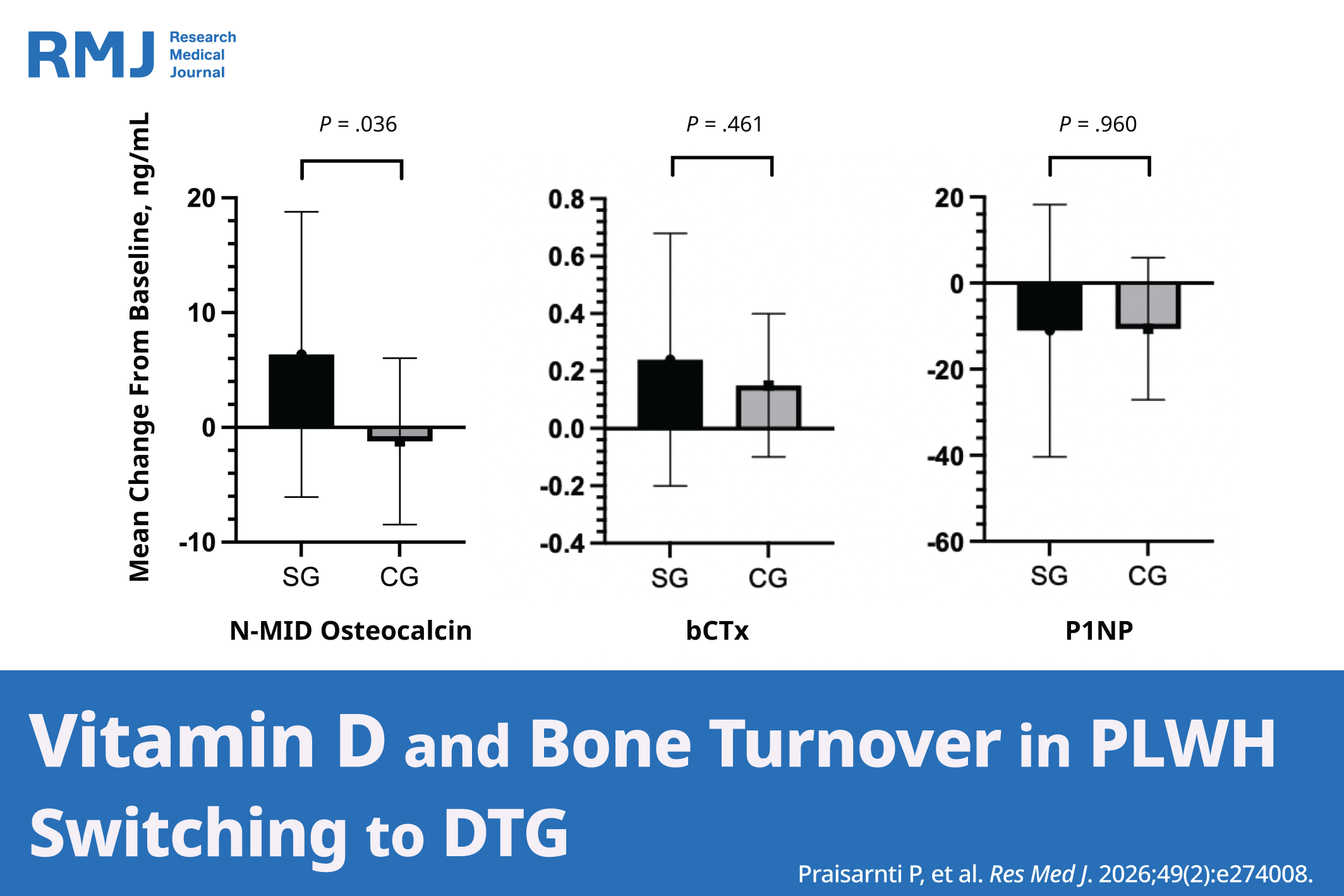
Results: Thirty-nine patients completed follow-up (20 CG, 19 SG). After 48 weeks, vitamin D deficiency prevalence increased in both groups (CG: 15% to 35%; SG: 15.8% to 31.6%) with no significant difference (P = .905). Osteocalcin increased in SG but decreased in CG (P = .036). Beta-crosslaps increased in both groups (P = .461 between groups). Procollagen type 1 amino-terminal propeptide showed a nonsignificant decrease in both (P = .960).
Conclusions: Switching to TDF/3TC/DTG had minimal impact on vitamin D status but was associated with increased osteocalcin, suggesting a possible positive effect on bone formation. No significant differences were seen in bone resorption or other formation markers.
References
UNAIDS. Global HIV & AIDS statistics — Fact sheet 2023. 13 Jul 2023. Accessed 25 June 2025. https://reliefweb.int/attachments/91440b97-b85d-419e-af05-be6673f9a217/UNAIDS_FactSheet_en.pdf
Ahmed M, Mital D, Abubaker NE, et al. Bone health in people living with HIV/AIDS: an update of where we are and potential future strategies. Microorganisms. 2023;11(3):789. doi:10.3390/microorganisms11030789
Shiau S, Broun EC, Arpadi SM, Yin MT. Incident fractures in HIV-infected individuals: a systematic review and meta-analysis. AIDS. 2013;27(12):1949-1957. doi:10.1097/QAD.0b013e328361d241
Tebas P, Powderly WG, Claxton S, et al. Accelerated bone mineral loss in HIV-infected patients receiving potent antiretroviral therapy. AIDS. 2000;14(4):F63-F67. doi:10.1097/00002030-200003100-00005
Mondy K, Yarasheski K, Powderly WG, et al. Longitudinal evolution of bone mineral density and bone markers in human immunodeficiency virus-infected individuals. Clin Infect Dis. 2003;36(4):482-490. doi:10.1086/367569
Gallant JE, Staszewski S, Pozniak AL, et al. Efficacy and safety of tenofovir DF vs stavudine in combination therapy in antiretroviral-naive patients: a 3-year randomized trial. JAMA. 2004;292(2):191-201. doi:10.1001/jama.292.2.191
World Health Organization. Update of Recommendations on First- And Second-Line Antiretroviral Regimens. World Health Organization; 2019. Accessed 25 June 2025. https://www.who.int/publications/i/item/WHO-CDS-HIV-19.15
Saag MS, Gandhi RT, Hoy JF, et al. Antiretroviral drugs for treatment and prevention of HIV infection in adults: 2020 recommendations of the international antiviral society-USA panel. JAMA. 2020;324(16):1651-1669. doi:10.1001/jama.2020.17025
European AIDS Clinical Society. EACS Guidelines Version 11.1. European AIDS Clinical Society (EACS); 2022. Accessed 25 June 2025. https://www.eacsociety.org/media/guidelines-11.1_final_09-10.pdf
Orrell C, Hagins DP, Belonosova E, et al. Fixed-dose combination dolutegravir, abacavir, and lamivudine versus ritonavir-boosted atazanavir plus tenofovir disoproxil fumarate and emtricitabine in previously untreated women with HIV-1 infection (ARIA): week 48 results from a randomised, open-label, non-inferiority, phase 3b study. Lancet HIV. 2017;4(12):e536-e546. doi:10.1016/S2352-3018(17)30095-4
Venter WDF, Moorhouse M, Sokhela S, et al. Dolutegravir plus two different prodrugs of tenofovir to treat HIV. N Engl J Med. 2019;381(9):803-815. doi:10.1056/NEJMoa1902824
Walmsley SL, Antela A, Clumeck N, et al. Dolutegravir plus abacavir-lamivudine for the treatment of HIV-1 infection. N Engl J Med. 2013;369(19):1807-1818. doi:10.1056/NEJMoa1215541
Ruxrungtham K, Chokephaibulkit K, Chetchotisakd P, et al. Thailand National Guidelines on HIV/AIDS Treatment and Prevention 2021/2022. Division of AIDS and STIs, Department of Disease Control; 2022. Accessed 25 June 2025. https://www.thaiaidssociety.org/wp-content/uploads/2022/10/HIV-AIDS-Guideline-2564_2565.pdf
Patamatamkul S, Chancharusiri K, Putcharoen O. 1597. Randomized-controlled trial evaluating the outcome between switching to tenofovir disoproxil fumarate (TDF)/lamivudine(3TC)/dolutegravir (DTG) versus maintaining the current NNRTI or boosted-pi-containing regimen in PLWH in Thailand – a pilot study from single center. Open Forum Infect Dis. 2023;10(Suppl 2):ofad500.1432. doi:10.1093/ofid/ofad500.1432
Rodríguez M, Daniels B, Gunawardene S, Robbins GK. High frequency of vitamin D deficiency in ambulatory HIV-positive patients. AIDS Res Hum Retroviruses. 2009;25(1):9-14. doi:10.1089/aid.2008.0183
Stephensen CB, Marquis GS, Kruzich LA, Douglas SD, Aldrovandi GM, Wilson CM. Vitamin D status in adolescents and young adults with HIV infection. Am J Clin Nutr. 2006;83(5):1135-1141. doi:10.1093/ajcn/83.5.1135
Chokephaibulkit K, Saksawad R, Bunupuradah T, et al. Prevalence of vitamin D deficiency among perinatally HIV-infected Thai adolescents receiving antiretroviral therapy. Pediatr Infect Dis J. 2013;32(11):1237-1239. doi:10.1097/INF.0b013e31829e7a5c
Aurpibul L, Sricharoenchai S, Wittawatmongkol O, et al. Vitamin D status in perinatally HIV-infected Thai children receiving antiretroviral therapy. J Pediatr Endocrinol Metab. 2016;29(4):407-411. doi:10.1515/jpem-2015-0203
Holick MF. Environmental factors that influence the cutaneous production of vitamin D. Am J Clin Nutr. 1995;61(3 Suppl):638S-645S. doi:10.1093/ajcn/61.3.638S
Bonfanti P, De Vito A, Ricci E, et al. Bone safety of dolutegravir-containing regimens in people living with HIV: results from a real-world cohort. Infect Drug Resist. 2020;13:2291-2300. doi:10.2147/IDR.S260449
Fabbriciani G, De Socio GV. Efavirenz and bone health. AIDS. 2009;23(9):1181. doi:10.1097/QAD.0b013e32832bab0f
Brown TT, McComsey GA, King MS, Qaqish RB, Bernstein BM, da Silva BA. Loss of bone mineral density after antiretroviral therapy initiation, independent of antiretroviral regimen. J Acquir Immune Defic Syndr. 2009;51(5):554-561. doi:10.1097/QAI.0b013e3181adce44
Duvivier C, Kolta S, Assoumou L, et al. Greater decrease in bone mineral density with protease inhibitor regimens compared with nonnucleoside reverse transcriptase inhibitor regimens in HIV-1 infected naive patients. AIDS. 2009;23(7):817-824. doi:10.1097/QAD.0b013e328328f789
Casado JL. Renal and bone toxicity with the use of tenofovir: understanding at the end. AIDS Rev. 2016;18(2):59-68.
Matuszewska A, Nowak B, Nikodem A, et al. Effects of efavirenz and tenofovir on bone tissue in Westar rats. Adv Clin Exp Med. 2020;29(11):1265-1275. doi:10.17219/acem/127684
Fux CA, Rauch A, Simcock M, et al. Tenofovir use is associated with an increase in serum alkaline phosphatase in the Swiss HIV Cohort Study. Antivir Ther. 2008;13(8):1077-1082.
Herzmann C, Arastéh K. Efavirenz-induced osteomalacia. AIDS. 2009;23(2):274-275. doi:10.1097/QAD.0b013e32831f4685
Trottier B, Lake JE, Logue K, et al. Dolutegravir/abacavir/lamivudine versus current ART in virally suppressed patients (STRIIVING): a 48-week, randomized, non-inferiority, open-label, Phase IIIb study. Antivir Ther. 2017;22(4):295-305. doi:10.3851/IMP3166
Downloads
Published
How to Cite
Issue
Section
License
Copyright (c) 2026 by the Author(s). Licensee RMJ.

This work is licensed under a Creative Commons Attribution 4.0 International License.