
Evaluation of an In-House Melting Curve Analysis Assay for HSV-1 and HSV-2 Detection via Multiplex Real-Time PCR
DOI:
https://doi.org/10.33165/rmj.48.04.e274724Keywords:
Multiplex real-time PCR, Melting curve analysis, HSV-1, HSV-2Abstract
Background: Herpes simplex virus (HSV) has developed mechanisms that allow it to evade the immune system and persist in the body, thus causing diseases and conditions such as sexually transmitted diseases and serious neurological infections.
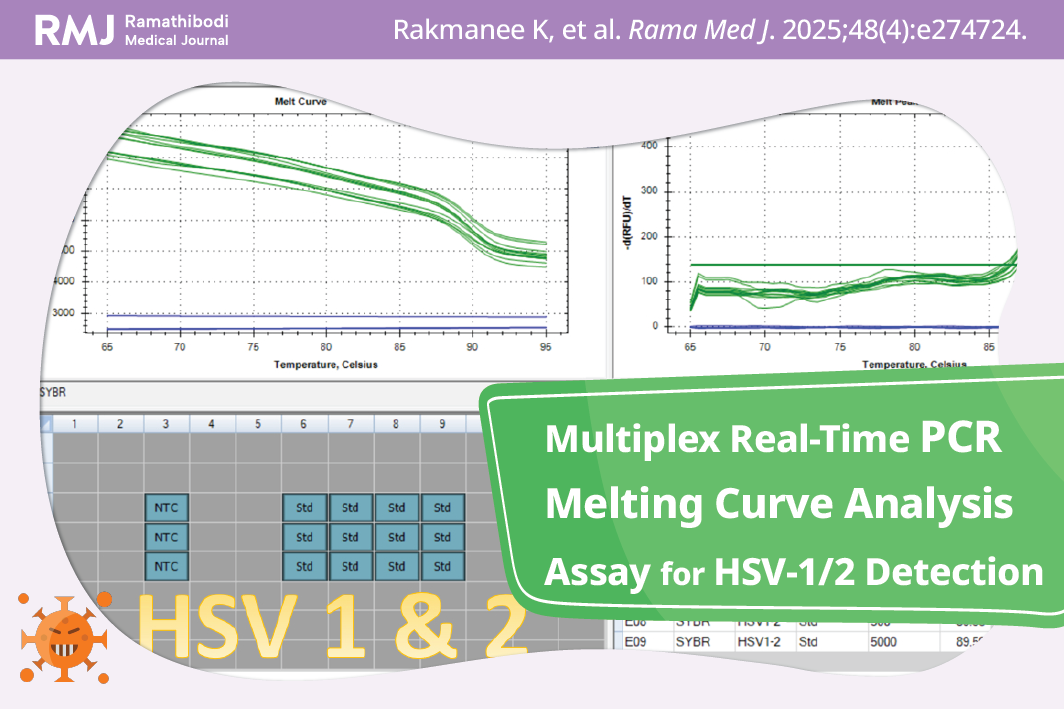
Objective: To evaluate an in-house melting curve analysis (IHMCA) assay for multiplex real-time polymerase chain reaction (PCR) product to minimize false positive and false negative results in HSV detection.
Methods: A total of 233 clinical specimens were subjected to analysis using the HSV1&2 VZV R-GENE® multiplex real-time PCR assay with melting curve analysis. This analysis was then compared to the Luminex ARIES HSV 1&2 assay.
Results: HSV-1 and HSV-2 demonstrated sensitivity of 90.91% and 96.77%, and specificity of 99.50% and 96.55%. The positive predictive values were 96.77% and 81.08% , and the negative predictive values were 98.51% and 99.49%. The overall accuracy was 98.28% and 96.58%. The assay demonstrated strong agreement with the reference method with statistically significant results (HSV-1: P < .001, SE = 0.04, = 0.93 [95% CI, 0.86-1.00]; HSV-2: P < .001, SE = 0.05,
= 0.86 [95% CI, 0.77-0.96]).
Conclusions: Amplicon analysis of the multiplexed real-time PCR product was performed in the same reaction tube without interference from multiple TaqMan probe signals due to the use of a DNA binding dye. The integration of multiplex real-time PCR with melting curve analysis enhances the accuracy and efficiency of HSV detection while potentially reducing costs and turnaround time. Importantly, the IHMCA should be considered as a complementary post-PCR method rather than a replacement for standard assays.
References
Rohani H, Arjmand R, Mozhgani SH, Shafiee A, Amini MJ, Forghani-Ramandi MM. The worldwide prevalence of herpes simplex virus encephalitis and meningitis: a systematic review and meta-analysis. Turk Arch Pediatr. 2023;58(6):580-587. doi:10.5152/TurkArchPediatr.2023.23007
Tenser RB, Edris WA, Gaydos A, Hay KA. Secondary herpes simplex virus latent infection in transplanted ganglia. J Virol. 1994;68(11):7212-7220. doi:10.1128/JVI.68.11.7212-7220.1994
Spallone A, Ariza-Heredia EJ, Chemaly RF. Acute and latent viral infections in immunocompromised patients: a tale of brave battles and menacing foes. Clin Microbiol Infect. 2022;28(10):1319-1320. doi:10.1016/j.cmi.2022.06.010
World Health Organization. Herpes simplex virus. World Health Organization. 30 May 2025. Accessed 30 July 2025. https://www.who.int/news-room/fact-sheets/detail/herpes-simplex-virus
World Health Organization. Massive proportion of world’s population are living with herpes infection. World Health Organization. 1 May 2020. Accessed 30 July 2025. https://www.who.int/news/item/01-05-2020-massive-proportion-world-population-living-with-herpes-infection
Kimberlin DW. Neonatal herpes simplex infection. Clin Microbiol Rev. 2004;17(1):1-13. doi:10.1128/CMR.17.1.1-13.2004
Arshad Z, Alturkistani A, Brindley D, Lam C, Foley K, Meinert E. Tools for the diagnosis of herpes simplex virus 1/2: systematic review of studies published between 2012 and 2018. JMIR Public Health Surveill. 2019;5(2):e14216. doi:10.2196/14216
Nagy A, Černíková L, Vitásková E, et al. Correction: MeltMan: optimization, evaluation, and universal application of a qPCR system integrating the TaqMan qPCR and melting analysis into a single assay. PLoS One. 2018;13(4):e0196444. doi:10.1371/journal.pone.0196444
Lind K, Ståhlberg A, Zoric N, Kubista M. Combining sequence-specific probes and DNA binding dyes in real-time PCR for specific nucleic acid quantification and melting curve analysis. Biotechniques. 2006;40(3):315-319. doi:10.2144/000112101
Public Health Agency of Canada. Pathogen Safety Data Sheets: Infectious Substances-Herpes simplex virus. Public Health Agency of Canada; 2011. Updated 22 July 2020. Accessed 30 July 2025. https://www.canada.ca/en/public-health/services/laboratory-biosafety-biosecurity/pathogen-safety-data-sheets-risk-assessment/herpes-simplex-virus.html
Downloads
Published
How to Cite
Issue
Section
License
Copyright (c) 2025 by the Author(s). Licensee RMJ.

This work is licensed under a Creative Commons Attribution 4.0 International License.