
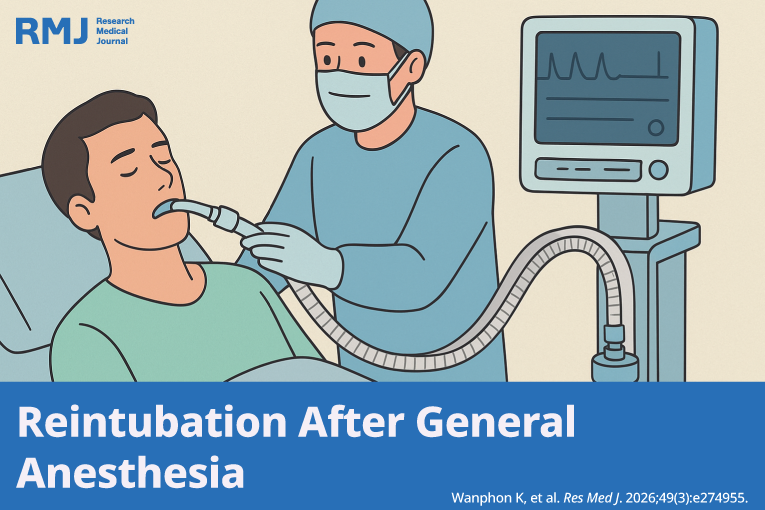
Incidence and Factors Related to Reintubation After Planned Extubation in Patients Receiving General Anesthesia in Srinagarind Hospital
DOI:
https://doi.org/10.33165/rmj.2026.e274955Keywords:
Incidence, Factors, Reintubation, RAP, General anesthesia, Planned extubationAbstract
Background: Reintubation after planned extubation (RAP) is associated with adverse outcomes. Understanding the incidence and related factors can reduce complications and improve outcomes.
Objectives: To identify the incidence, related factors, causes, and outcomes of RAP in patients undergoing general anesthesia (GA).
Methods: This retrospective descriptive study was done at the Srinagarind Hospital. After screening incident reports from January 2022 to June 2024, an RAP, which is defined as an intubation conducted within 24 hours after surgery was identified. The primary outcome was the incidence of RAP. The secondary outcomes were the characteristics, causes, and outcomes. Logistic regression analysis was used to identify the factors related to poor long-term outcomes.
Results: The incidence of RAP was 8.59 per 10 000 GA (40/46 543 patients). The incidence per 10 000 GA was higher among male (12.08), the elderly (22.80), patients with an American Society of Anesthesiologists (ASA) classification of 4 (24.72), patients with respiratory disease (63.09), and individuals undergoing hepatobiliary surgery (26.90). Most RAP (50%) occurred in the postanesthesia care unit. The most common indications for RAP were hypoxemia (32.5%), altered consciousness (25%), and airway obstruction (20%). RAP was primarily attributed to patient factor (65%). Male gender was associated with an odds ratio of 0.11 for poor long-term outcomes (95% CI, 0.02-0.51; P = .005).
Conclusions: RAP occurred at a lower rate than previously reported. Incidence of RAP was high among males, the elderly, classified as ASA 4, preexisting respiratory diseases, and hepatobiliary surgery. The major cause of RAP was related to patient-related factors.
References
Ruenhunsa T, Chinsatit P, Nonphiaraj S, et al. Comparison of the effectiveness of nasal cannula versus face mask with reservoir bag in postoperative patients undergoing general anesthesia: a prospective randomized controlled trial. Asian J Anesthesiol. 2023;61(2):81-88. doi:10.6859/aja.202306_61(2).0005
Chinachoti T, Chau-In W, Suraseranivongse S, Kitsampanwong W, Kongrit P. Postoperative reintubation after planned extubation in Thai anesthesia incidents study (THAI Study). J Med Assoc Thai. 2005;88 Suppl 7:S84-S94.
Rujirojindakul P, Geater AF, McNeil EB, et al. Risk factors for reintubation in the post-anaesthetic care unit: a case-control study. Br J Anaesth. 2012;109(4):636-642. doi:10.1093/bja/aes226
De la Garza Ramos R, Passias PG, Schwab F, Bydon A, Lafage V, Sciubba DM. Incidence, risk factors, and mortality of reintubation in adult spinal deformity surgery. Clin Spine Surg. 2017;30(7):E896-E900. doi:10.1097/BSD.0000000000000404
Duangngoen P, Ittichaikulthol W, Thamjamrassri T, Jiarpinitnun J. Risk factors of reintubation in post-anesthetic care unit after general anesthesia in Ramathibodi Hospital. Thai J Anesthesiol. 2016;42(1):33-41.
Uppan K, Jeerararuensak W, Chau-In W, Chairatana L, Promkhote P. Anesthesia related to reintubation after planned extubation within 24 hours after general anesthesia in Srinagarind Hospital: incidence and risk factors. Srinagarind Med J. 2011;26(4):325-332.
Cooper RM, Khan S. Extubation and reintubation of the difficult airway. In: Hagberg CA, ed. Benumof and Hagberg's Airway Management. 3rd ed. Saunders; 2013:1018-1046.e7. doi:10.1016/B978-1-4377-2764-7.00050-6
Bunchungmongkol N, Pipanmekaporn T, Punjasawadwong Y, Cenpakdee S. Reintubation in the postanesthesia care unit: an analysis from a database of 21,349 cases at Chiang Mai University Hospital, Thailand. Chiang Mai Med J. 2009;48(2):49-55.
Kacha S, Sawangsub B, Bunchungmongkol N, Pipanmekaporn T. Incidence, risk factors, and clinical outcomes of reintubation following planned extubation in a postanesthetic care unit: a case-control study. Biomedical Sciences and Clinical Medicine. 2023;62(3):115-122. doi:10.12982/BSCM.2023.16
Sangjun C. Incidences and causes of reintubation after undergoing general anesthesia at Songkhla Hospital. Journal of Health Sciences and Pedagogy. 2022;2(1):15-27.
Laporta ML, Sprung J, Weingarten TN. Respiratory depression in the post-anesthesia care unit: Mayo Clinic experience. Bosn J Basic Med Sci. 2021;21(2):221-228. doi:10.17305/bjbms.2020.4816
Moningi S, Patki A, Padhy N, Ramachandran G. Enhanced recovery after surgery: an anesthesiologist's perspective. J Anaesthesiol Clin Pharmacol. 2019;35(Suppl 1):S5-S13. doi:10.4103/joacp.JOACP_238_16
Sofjan I, Vazquez S, Dominguez J, et al. Risk factors for postoperative unplanned reintubation in a cohort of patients undergoing general anesthesia. Cureus. 2023;15(5):e38949. doi:10.7759/cureus.38949
Ting PC, Chou AH, Yang MW, Ho AC, Chang CJ, Chang SC. Postoperative reintubation after planned extubation: a review of 137,866 general anesthetics from 2005 to 2007 in a medical center of Taiwan. Acta Anaesthesiol Taiwan. 2010;48(4):167-171. doi:10.1016/j.aat.2010.12.003
Chen S, Zhang Y, Che L, Shen L, Huang Y. Risk factors for unplanned reintubation caused by acute airway compromise after general anesthesia: a case-control study. BMC Anesthesiol. 2021;21(1):17. doi:10.1186/s12871-021-01238-4
Wilson LA, Zubizarreta N, Bekeris J, et al. Risk factors for reintubation after anterior cervical discectomy and fusion surgery: evaluation of three observational data sets. Can J Anaesth. 2020;67(1):42-56. doi:10.1007/s12630-019-01492-8
Brovman EY, Steen TL, Urman RD. Associated risk factors and complications in vascular surgery patients requiring unplanned postoperative reintubation. J Cardiothorac Vasc Anesth. 2017;31(2):554-561. doi:10.1053/j.jvca.2016.11.013
Lin HT, Ting PC, Chang WY, Yang MW, Chang CJ, Chou AH. Predictive risk index and prognosis of postoperative reintubation after planned extubation during general anesthesia: a single-center retrospective case-controlled study in Taiwan from 2005 to 2009. Acta Anaesthesiol Taiwan. 2013;51(1):3-9. doi:10.1016/j.aat.2013.03.004
Punjaruk W, Suwanrungruag K, Wirasorn K. Cancers in Srinagarind Hospital: a 10 years period of hospital records. Srinagarind Med J. 2015;30(2):129-136.
Weingarten TN, Bergan TS, Narr BJ, Schroeder DR, Sprung J. Effects of changes in intraoperative management on recovery from anesthesia: a review of practice improvement initiative. BMC Anesthesiol. 2015;15:54. doi:10.1186/s12871-015-0040-x
Lat TI, McGraw MK, White HD. Gender differences in critical illness and critical care research. Clin Chest Med. 2021;42(3):543-555. doi:10.1016/j.ccm.2021.04.012
Downloads
Published
How to Cite
Issue
Section
License
Copyright (c) 2026 by the Author(s). Licensee RMJ.

This work is licensed under a Creative Commons Attribution 4.0 International License.