
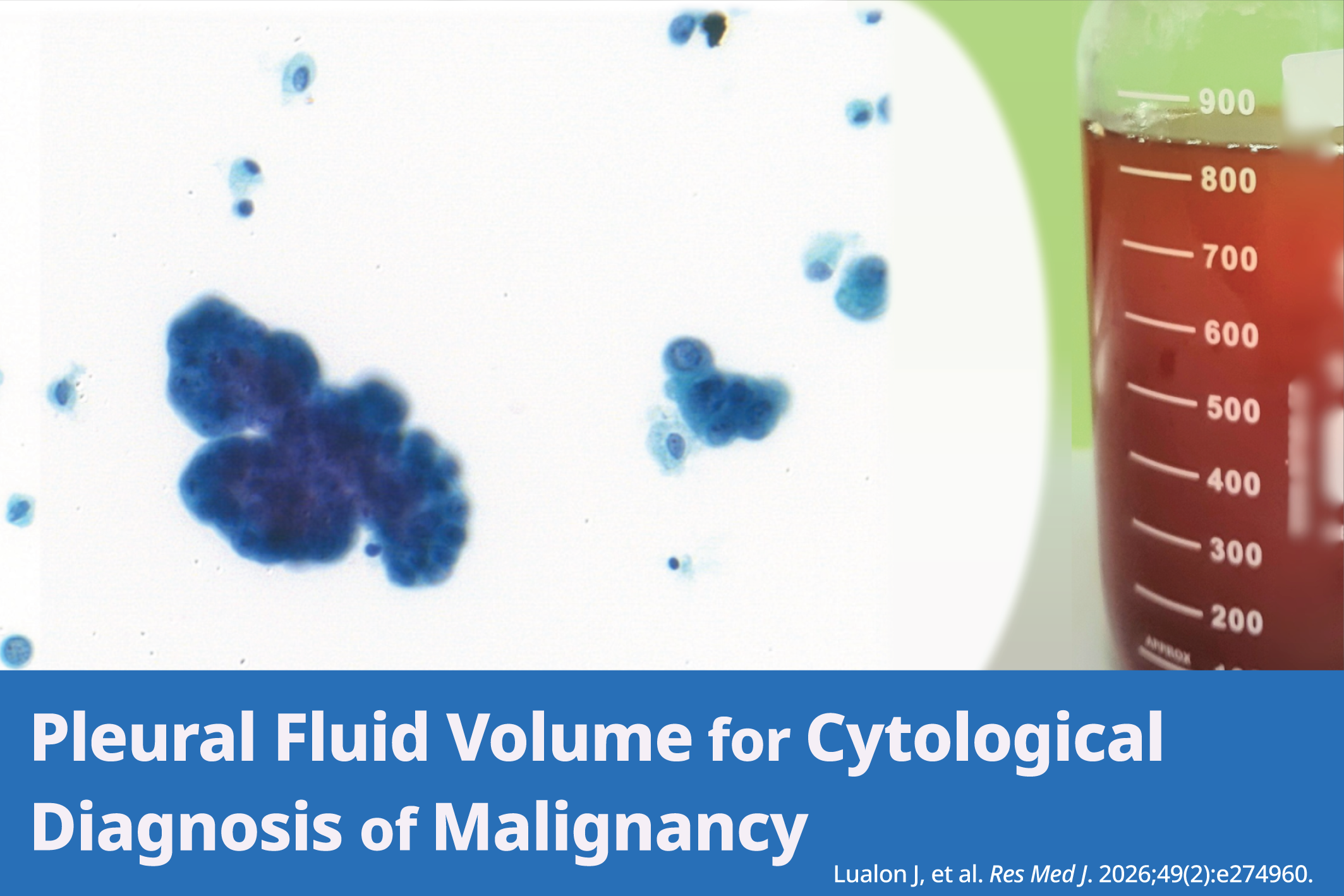
Pleural Fluid Volume for Cytological Diagnosis of Malignancy: How Much Is Optimum
DOI:
https://doi.org/10.33165/rmj.2026.e274960Keywords:
Pleural fluid, Volume, Malignancy, CytologyAbstract
Background: Pleural fluid cytology is essential for evaluating effusions and detecting atypical and malignant cells. However, the optimal fluid volume for accurate diagnosis remains unclear.
Objective: To determine the optimal pleural fluid volume for detecting atypical to malignant cells by analyzing diagnostic yield across different volume groups.
Methods: This retrospective study analyzed pleural fluid samples collected between 2020 and 2021, correlating to cases with confirmed malignancy in pleural cavities. Samples were categorized into volume groups and classified using the International System for Serous Fluid Cytopathology: nondiagnostic (ND), negative for malignancy (NFM), atypia of undetermined significance (AUS), suspicious for malignancy (SFM), and malignant (MAL).
Results: Of 1794 pleural fluid samples, the detection rates of atypical to malignant cells in the samples were < 25 mL (35.87%), 25-49 mL (40.77%), 50-74 mL (45.38%), 75-99 mL (37.89%), 100-249 mL (29.67%), 250-499 mL (21.99%), and ³ 500 mL (40.97%). Considering the samples with evidence of pleural involvement by malignancy (n = 497), detection rates of atypical to malignant cells in the samples were < 25 mL (83.72%), 25-49 mL (91.67%), 50-74 mL (90.41%), 75-99 mL (93.33%), 100-249 mL (72.06%), 250-499 mL (44.17%), and ³ 500 mL (82.14%). The proportion of AUS and SFM categories among the atypical and malignant samples were low (< 20%) in the 50-74 mL and 75-99 mL volume groups.
Conclusions: Intermediate volumes (50-100 mL) provide adequate cellular material while maintaining manageable sample processing. Implementing this volume range in clinical practice may enhance diagnostic accuracy.
References
Bibbo M, Draganova-Tacheva R, Naylor B. Pleural, peritoneal, and pericardial effusions. In: Bibbo M, Wilbur DC, eds. Comprehensive Cytopathology. 4th ed. Elsevier Saunders; 2015:403-448.
Laucirica R, Schultenover SJ. Body cavity fluids. In: Ramzy I, Mody DR, Laucirica R, eds. Clinical Cytopathology: Fundamental Principles and Practice. 3rd ed. McGraw Hill Education; 2018:373-391.
Chandra A, Crothers B, Kurtycz D, Schmitt F. Announcement: the international system for reporting serous fluid cytopathology. Acta Cytol. 2019;63(5):349-351. doi:10.1159/000501536
Chandra A, Crothers B, Iyama-Kurtycz D, Schmitt F. The International System for Serous Fluid Cytopathology. Springer; 2020. doi:10.1007/978-3-030-53908-5
Rooper LM, Ali SZ, Olson MT. A minimum fluid volume of 75 mL is needed to ensure adequacy in a pleural effusion: a retrospective analysis of 2540 cases. Cancer Cytopathol. 2014;122(9):657-665. doi:10.1002/cncy.21452
Thomas SC, Davidson LR, McKean ME. An investigation of adequate volume for the diagnosis of malignancy in pleural fluids. Cytopathology. 2011;22(3):179-183. doi:10.1111/j.1365-2303.2010.00786.x
Swiderek J, Morcos S, Donthireddy V, et al. Prospective study to determine the volume of pleural fluid required to diagnose malignancy. Chest. 2010;137(1):68-73. doi:10.1378/chest.09-0641
Rodriguez EF, Chowsilpa S, Maleki Z. The differential diagnosis in nonlymphoproliferative malignant pleural effusion cytopathology and its correlation with patients' demographics. Acta Cytol. 2018;62(5-6):436-442. doi:10.1159/000493336
Loveland P, Christie M, Hammerschlag G, Irving L, Steinfort D. Diagnostic yield of pleural fluid cytology in malignant effusions: an Australian tertiary centre experience. Intern Med J. 2018;48(11):1318-1324. doi:10.1111/imj.13991
Kassirian S, Hinton SN, Cuninghame S, et al. Diagnostic sensitivity of pleural fluid cytology in malignant pleural effusions: systematic review and meta-analysis. Thorax. 2023;78(1):32-40. doi:10.1136/thoraxjnl-2021-217959
Christofidis K, Theochari M, Mavropoulos Papoudas S, et al. Optimal volume assessment for serous fluid cytology. Biomedicines. 2024;12(4):899. doi:10.3390/biomedicines12040899
Abouzgheib W, Bartter T, Dagher H, Pratter M, Klump W. A prospective study of the volume of pleural fluid required for accurate diagnosis of malignant pleural effusion. Chest. 2009;135(4):999-1001. doi:10.1378/chest.08-2002
Torous VF. How much is enough: investigation of pleural fluid cytology findings related to sample volume. J Am Soc Cytopathol. 2022;11(2):94-101. doi:10.1016/j.jasc.2021.12.002
Coconubo DM, Baskota SU, Li R, Srivastava P, Cuda J, Khader S. Reassessing the optimal volume for malignancy detection in serous fluid cytology. Cancer Cytopathol. 2022;130(7):551-557. doi:10.1002/cncy.22577
Beg S, Zanettini C, Queiroz L, Marchionni L, Alperstein SA, Siddiqui MT. Optimal fluid volume for detecting malignancy in serous effusions: a single institution experience. J Am Soc Cytopathol. 2023;12(6):415-422. doi:10.1016/j.jasc.2023.06.003
Downloads
Published
How to Cite
Issue
Section
License
Copyright (c) 2026 by the Author(s). Licensee RMJ.

This work is licensed under a Creative Commons Attribution 4.0 International License.