
Psychometric Testing of the Thai Version of the Short-Form Practice Environment Scale of the Nursing Work Index Among Nurses Within the Thai Social Context
DOI:
https://doi.org/10.33165/rmj.2026.e275487Keywords:
Nurses, Practice Environment Scale of the Nursing Work Index, Validation, Psychometric propertiesAbstract
Background: A standardized assessment of the nursing practice environment is essential as a foundation for planning and implementing improvements that enhance the suitability and efficiency of nurses’ work settings. While comprehensive evaluations provide valuable insights, they can be resource-intensive, particularly in settings with limited capacity. The Practice Environment Scale of the Nursing Work Index (PES-NWI) is a widely validated instrument for assessing nursing work environments, and its short-form version, the PES-5, was developed to reduce respondent burden. Adapting the PES-5 to the Thai context ensures cultural and organizational appropriateness, thereby enhancing its applicability and utility in Thai healthcare settings.
Objectives: To translate the PES-5 into Thai and assess its psychometric properties among Thai nurses.
Methods: A cross-sectional design was employed. The PES-5 was translated into Thai using a systematic forward and backward translation process to ensure conceptual and linguistic equivalence. Data were collected from 250 full-time registered nurses working in public hospitals under Thailand’s Ministry of Public Health via an online survey. Psychometric evaluation was conducted using Rasch model analysis, performed with Jamovi software (version 2.6.26). Internal consistency was assessed using Cronbach a and item-total correlation. Rasch analysis was used to examine item fit, response category functioning, and person separation reliability.
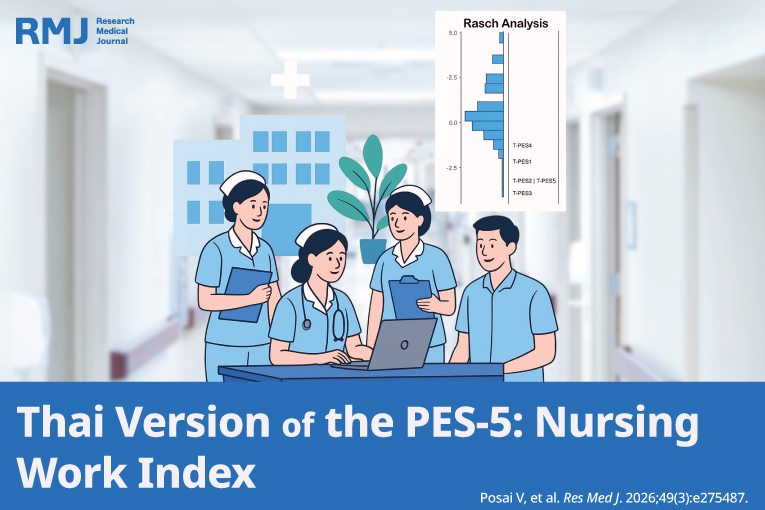
Results: The Thai version (T-PES-5) demonstrated excellent content validity (S-CVI = 1.00). Rasch analysis showed acceptable Infit and Outfit statistics (0.81-1.24 and 0.79-1.31, respectively), indicating good item fit. Cronbach a was 0.73, reflecting satisfactory internal consistency. The Wright map revealed a well-balanced item difficulty distribution with no evidence of floor or ceiling effects.
Conclusions: The T-PES-5 is a psychometrically sound instrument for evaluating the nursing practice environment in Thailand. Its brevity and validity make it particularly suitable for large-scale assessments in public healthcare settings, supporting efforts to improve work environments and, ultimately, patient care quality.
References
Jester R. Editorial - Global shortage of nurses - Rebecca jester for May 2023 issue. Int J Orthop Trauma Nurs. 2023;49:101018. doi:10.1016/j.ijotn.2023.101018
Turale S, Thummathai K. Addressing the global shortage of nurses: a call to arms. Nurs Health Sci. 2024;26(2):e13130. doi:10.1111/nhs.13130
Sirisub P, Suwannapong N, Tipayamongkholgul M, Howteerakul N, Noree T. Intention to extend working life among Thai registered nurses in Ministry of Public Health: a national survey. Nurs Res Pract. 2019;2019:7919404. doi:10.1155/2019/7919404
Figueiredo AR, Gaspar F, Baixinho C, Lucas P. How the nursing practice environment influences retention and turnover intention: an umbrella review protocol. Nurs Rep. 2024;14(4):3233-3241. doi:10.3390/nursrep14040235
Liu X, Guo Y, Zhou Y, Zhou Y. The present situation of the nursing practice environment and its influence on nursing quality in a post-epidemic era: a cross-sectional study. BMC Nurs. 2024;23(1):543. doi:10.1186/s12912-024-02202-6
Boudreau C, Rhéaume A. Impact of the work environment on nurse outcomes: a mediation analysis. West J Nurs Res. 2024;46(3):210-218. doi:10.1177/01939459241230369
Brooks Carthon JM, Hatfield L, Brom H, et al. System-level improvements in work environments lead to lower nurse burnout and higher patient satisfaction. J Nurs Care Qual. 2021;36(1):7-13. doi:10.1097/NCQ.0000000000000475
Lake ET. Development of the practice environment scale of the nursing work index. Res Nurs Health. 2002;25(3):176-188. doi:10.1002/nur.10032
Lake ET, Friese CR. Variations in nursing practice environments: relation to staffing and hospital characteristics. Nurs Res. 2006;55(1):1-9. doi:10.1097/00006199-200601000-00001
Lake ET, Gil J, Moronski L, McHugh MD, Aiken LH, Lasater KB. Validation of a short form of the practice environment scale of the nursing work index: the PES-5. Res Nurs Health. 2024;47(4):450-459. doi:10.1002/nur.22388
Swiger PA, Patrician PA, Miltner RSS, Raju D, Breckenridge-Sproat S, Loan LA. The Practice environment scale of the nursing work index: an updated review and recommendations for use. Int J Nurs Stud. 2017;74:76-84. doi:10.1016/j.ijnurstu.2017.06.003
Warshawsky NE, Havens DS. Global use of the practice environment scale of the nursing work index. Nurs Res. 2011;60(1):17-31. doi:10.1097/NNR.0b013e3181ffa79c
Lake ET, Rosenbaum KEF, Sauveur C, Buren C, Cho P. Translations of the practice environment scale of the nursing work index: a systematic review. Nurs Health Sci. 2023;25(3):365-380. doi:10.1111/nhs.13034
Nantsupawat A, Kunaviktikul W, Nantsupawat R, Wichaikhum OA, Thienthong H, Poghosyan L. Effects of nurse work environment on job dissatisfaction, burnout, intention to leave. Int Nurs Rev. 2017;64(1):91-98. doi:10.1111/inr.12342
Montgomery AP, Campbell CM, Azuero A, Swiger PA, Patrician PA. Using item response theory to develop a shortened practice environment scale of the nursing work index. Res Nurs Health. 2023;46(4):400-410. doi:10.1002/nur.22324
Smith AB, Rush R, Fallowfield LJ, Velikova G, Sharpe M. Rasch fit statistics and sample size considerations for polytomous data. BMC Med Res Methodol. 2008;8:33. doi:10.1186/1471-2288-8-33
Beaton DE, Bombardier C, Guillemin F, Ferraz MB. Guidelines for the process of cross-cultural adaptation of self-report measures. Spine. 2000;25(24):3186-3191. doi:10.1097/00007632-200012150-00014
Curtis K, Fry M, Shaban RZ, Considine J. Translating research findings to clinical nursing practice. J Clin Nurs. 2017;26(5-6):862-872. doi:10.1111/jocn.13586
Polit DF, Beck CT. The content validity index: are you sure you know what's being reported? critique and recommendations. Res Nurs Health. 2006;29(5):489-497. doi:10.1002/nur.20147
Mishra P, Pandey CM, Singh U, Gupta A, Sahu C, Keshri A. Descriptive statistics and normality tests for statistical data. Ann Card Anaesth. 2019;22(1):67-72. doi:10.4103/aca.ACA_157_18
Liu Q, Wang L. t-Test and ANOVA for data with ceiling and/or floor effects. Behav Res Methods. 2021;53(1):264-277. doi:10.3758/s13428-020-01407-2
Tavakol M, Dennick R. Making sense of Cronbach's alpha. Int J Med Educ. 2011;2:53-55. doi:10.5116/ijme.4dfb.8dfd
Zijlmans EAO, Tijmstra J, van der Ark LA, Sijtsma K. Item-score reliability as a selection tool in test construction. Front Psychol. 2019;9:2298. doi:10.3389/fpsyg.2018.02298
Tesio L, Caronni A, Simone A, Kumbhare D, Scarano S. Interpreting results from Rasch analysis 2. Advanced model applications and the data-model fit assessment. Disabil Rehabil. 2024;46(3):604-617. doi:10.1080/09638288.2023.2169772
Boone WJ. Rasch analysis for instrument development: Why, When, and How? CBE Life Sci Educ. 2016;15(4):rm4. doi:10.1187/cbe.16-04-0148
Widhiarso W. Rasch mixed model application in evaluating the measurement of self-esteem. Jurnal Penelitian Dan Evaluasi Pendidikan. 2013;17(1):172-187. doi:10.21831/pep.v17i1.1367
Smith EV Jr. Detecting and evaluating the impact of multidimensionality using item fit statistics and principal component analysis of residuals. J Appl Meas. 2002;3(2):205-231.
Walker CM. What’s the DIF? Why differential item functioning analyses are an important part of instrument development and validation. J Psychoeduc Assess. 2011;29(4):364-376. doi:10.1177/0734282911406666
Nunnally JC. Psychometric Theory 3E. Tata McGraw-Hill Education; 1994.
Taber KS. The use of Cronbach’s alpha when developing and reporting research instruments in science education. Res Sci Educ. 2018;48(6):1273-1296. doi:10.1007/s11165-016-9602-2
Burnard P, Naiyapatana W. Culture and communication in Thai nursing: a report of an ethnographic study. Int J Nurs Stud. 2004;41(7):755-765. doi:10.1016/j.ijnurstu.2004.03.002
Wieke Noviyanti L, Ahsan A, Sudartya TS. Exploring the relationship between nurses' communication satisfaction and patient safety culture. J Public Health Res. 2021;10(2):2225. doi:10.4081/jphr.2021.2225
Taylan C, Weber LT. "Don't let me be misunderstood": communication with patients from a different cultural background. Pediatr Nephrol. 2023;38(3):643-649. doi:10.1007/s00467-022-05573-7
Patrician PA, Campbell CM, Javed M, et al. Quality and safety in nursing: recommendations from a systematic review. J Healthc Qual. 2024;46(4):203-219. doi:10.1097/JHQ.0000000000000430
Pereira S, Ribeiro M, Mendes M, et al. Positive nursing practice environment: a concept analysis. Nurs Rep. 2024;14(4):3052-3068. doi:10.3390/nursrep14040222
Downloads
Published
How to Cite
Issue
Section
License
Copyright (c) 2026 by the Author(s). Licensee RMJ.

This work is licensed under a Creative Commons Attribution 4.0 International License.