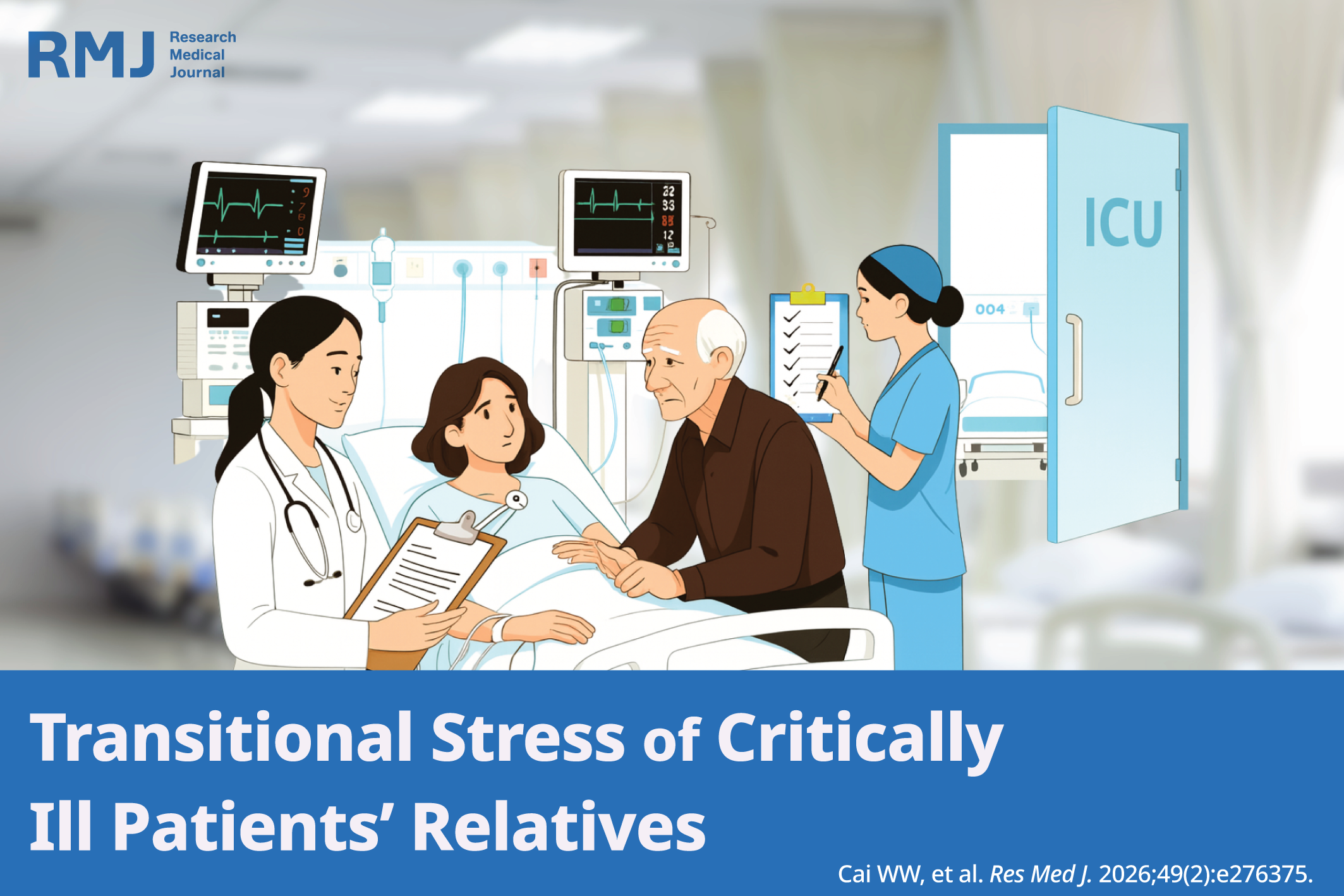
Factors Associated With Transitional Stress Among Relatives During Transferring Critically Ill Patients From ICU-to-Ward
DOI:
https://doi.org/10.33165/rmj.2026.e276375Keywords:
Hope, Intensive care unit, Preparedness, Relative, Transitional stress, UncertaintyAbstract
Background: The intensive care unit (ICU) provides effective care for critically ill patients and can significantly reduce mortality rates. However, ICU hospitalization is not only a crisis for patients, but also for their relatives, who often experience high levels of transitional stress. This stress can negatively impact their ability to provide loving care to the patient after the transfer to a general ward.
Objectives: To describe the level of transitional stress and determine the relationship between uncertainty, hope, and preparedness with transitional stress among relatives during transferring critically ill patients from ICU-to-Ward.
Methods: This study used a descriptive correlational cross-sectional research design. A total of 112 participants were recruited during December 2022 to September 2023 by selecting participants randomly, following the inclusion criteria. The research instruments included a demographic questionnaire, the Herth Hope Index, the Family Relocation Stress Scale, the Care Preparedness Scale, and the Parents’ Perception of Uncertainty in Illness Scale-Family Member. The reliability of the scales was 0.87, 0.88, 0.82, and 0.86, respectively. Descriptive statistics and Pearson product moment correlation were used to perform data analysis.
Results: The mean (SD) score of transitional stress was 36.5 (6.2), indicating a moderate level of stress. Uncertainty was positively correlated with transitional stress (r = 0.75, P < .001). However, hope and preparedness were negatively correlated with transitional stress (r = -0.40, P < .001; r = -0.44, P < .001 respectively).
Conclusions: Clinical nurses should develop nursing interventions to reduce transitional stress among a patient’s relatives by promoting their preparedness and hope, and communicate effectively to reduce the relatives’ uncertainty about the patient’s illness.
References
de Grood C, Leigh JP, Bagshaw SM, et al. Patient, family and provider experiences with transfers from intensive care unit to hospital ward: a multicentre qualitative study. CMAJ. 2018;190(22):E669-E676. doi:10.1503/cmaj.170588
Stelfox HT, Lane D, Boyd JM, et al. A scoping review of patient discharge from intensive care: opportunities and tools to improve care. Chest. 2015;147(2):317-327. doi:10.1378/chest.13-2965
Hua M, Gong MN, Brady J, Wunsch H. Early and late unplanned rehospitalizations for survivors of critical illness. Crit Care Med. 2015;43(2):430-438. doi:10.1097/CCM.0000000000000717
Parsons Leigh J, Stelfox HT. Continuity of care for complex medical patients: how far do we go? Am J Respir Crit Care Med. 2017;195(11):1414-1416. doi:10.1164/rccm.201611-2236ED
Op 't Hoog SAJJ, Dautzenberg M, Eskes AM, Vermeulen H, Vloet LCM. The experiences and needs of relatives of intensive care unit patients during the transition from the intensive care unit to a general ward: a qualitative study. Aust Crit Care. 2020;33(6):526-532. doi:10.1016/j.aucc.2020.01.004
Chabok SY, Yazdanshenas H, Naeeni AF, et al. The impact of body mass index on treatment outcomes among traumatic brain injury patients in intensive care units. Eur J Trauma Emerg Surg. 2014;40(1):51-55. doi:10.1007/s00068-013-0314-2
Choi J, Tate JA, Son Y-J. Challenges experienced by family caregivers of the adult intensive care unit patients in Korea: an integrative review. Clin Nurs Res. 2021;30(4):423-441. doi:10.1177/1054773820918433
Enger R, Andershed B. Nurses' experience of the transfer of ICU patients to general wards: a great responsibility and a huge challenge. J Clin Nurs. 2018;27(1-2):e186-e194. doi:10.1111/jocn.13911
Won MH, Son Y-J. Development and psychometric evaluation of the Relocation Stress Syndrome Scale-Short Form for patients transferred from adult intensive care units to general wards. Intensive Crit Care Nurs. 2020;58:102800. doi:10.1016/j.iccn.2020.102800
Cullinane JP, Plowright CI. Patients' and relatives' experiences of transfer from intensive care unit to wards. Nurs Crit Care. 2013;18(6):289-296. doi:10.1111/nicc.12047
Oh H, Lee S, Kim J, et al. Clinical validity of a relocation stress scale for the families of patients transferred from intensive care units. J Clin Nurs. 2015;24(13-14):1805-1814. doi:10.1111/jocn.12778
Bhowmik SR, Dasila P, Deshpande A, Bhattacharjee T. Impact of transitional care strategies on physical and psychological parameters among ICU patients. IOSR Journal of Nursing and Health Science. 2019;8(4):49-53. doi:10.9790/1959-0804024953
Białek K, Sadowski M. Stress, anxiety, depression and basic hope in family members of patients hospitalised in intensive care units - preliminary report. Anaesthesiol Intensive Ther. 2021;53(2):134-140. doi:10.5114/ait.2021.105728
Schröder H, Thaeter L, Henze L, Drachsler H, Rossaint R, Sopka S. Patient handoffs in undergraduate medical education: a systematic analysis of training needs. Z Evid Fortbild Qual Gesundhwes. 2018;135-136:89-97. doi:10.1016/j.zefq.2018.07.002
Shunxia S, Xiuni G, Chuanlai Z. Development of family relocation stress scale during patient transferred from intensive care unit. Chin J Pract Nurs. 2017;33(7):490-495.
Jiang T, Lu H, Su C, Ge Y. The needs of relatives of intensive care patients during the transition from the intensive care unit to a general ward in China: a mixed methods study. BMC Nurs. 2025;24(1):949. doi:10.1186/s12912-025-03608-6
Huang JW, Li RH, Lin LX. Analysis of migration stress status and influencing factors of family members of CCU patients. Acad J Guangzhou Med Univ. 2020;48(4):92-95.
Duncan AR, Jaini PA, Hellman CM. Positive psychology and hope as lifestyle medicine modalities in the therapeutic encounter: a narrative review. Am J Lifestyle Med. 2020;15(1):6-13. doi:10.1177/1559827620908255
Long LJ, Gallagher MW. Hope and posttraumatic stress disorder. In Gallagher MW, Lopez SJ, eds. The Oxford Handbook of Hope. Oxford University Press; 2018:233-242.
Ghorbanzadeh K, Ebadi A, Hosseini MA, Madah S, Khankeh H. The transition in intensive care unit patients: a concept analysis. Int J Africa Nurs Sci. 2022;17(3):100498. doi:10.1016/j.ijans.2022.100498
Sparks LA, Trentacosta CJ, Hicks MR, Kernsmith P, Smith-Darden J. Hope as a protective factor: relations to adverse childhood experiences, delinquency, and posttraumatic stress symptoms. J Child Fam Stud. 2021;30(12):3005-3015. doi:10.1007/s10826-021-02119-7
Zhang X, Zou R, Liao X, et al. Perceived stress, hope, and health outcomes among medical staff in China during the COVID-19 pandemic. Front Psychiatry. 2021;11:588008. doi:10.3389/fpsyt.2020.588008
Ghorbanzadeh K, Ebadi A, Hosseini MA, Madah S, Khankeh H. The transition in intensive care unit patients: a concept analysis. Int J Africa Nurs Sci. 2020. doi:10.21203/rs.3.rs-28837/v1
Zhou S, Wang JN, Wang J, Zha L. Relocation stress and its influencing factors of the families of patients transferred from ICU. Chin J Nurs. 2017;52(8):911-915.
Mazanec SR, Reichlin D, Gittleman H, Daly BJ. Perceived needs, preparedness, and emotional distress of male caregivers of postsurgical women with gynecologic cancer. Oncol Nurs Forum. 2018;45(2):197-205. doi:10.1188/18.ONF.197-205
Yun SH, Oh EG, Yoo YS, Kim SS, Jang YS. Development and effects of a transition nursing program for patients and family caregivers at a neurological ICU in Korea. Clin Nurs Res. 2017;26(1):27-46. doi:10.1177/1054773815616973
Uzer T. Validity and reliability testing of the transitional impact scale. Stress Health. 2020;36(4):478-486. doi:10.1002/smi.2944
Choi J, Lingler JH, Donahoe MP, Happ MB, Hoffman LA, Tate JA. Home discharge following critical illness: a qualitative analysis of family caregiver experience. Heart Lung. 2018;47(4):401-407. doi:10.1016/j.hrtlng.2018.04.003
Niecke A, Hartog C, Deffner T, Janssens U, Michels G. Need for psychological support in intensive care. Med Klin Intensivmed Notfmed. 2020;115(2):135-139. doi:10.1007/s00063-018-0523-x
Yonghua W, Shengwen S, Yiyu Z, Ge J. Chinesization of ICU patient's family relocation stress scale and it's reliability and validity evaluation. J Nurs Train. 2018;9:776-779
Archbold PG, Stewart BJ, Greenlick MR, Harvath T. Mutuality and preparedness as predictors of caregiver role strain. Res Nurs Health. 1990;13(6):375-384. doi:10.1002/nur.4770130605
Liu YJ, Wang M, Dong XF. Reliability and validity of the Chinese version of the caregiver readiness scale. Chin J Pract Nurs. 2016;32(14):1045-1048. doi:10.3760/cma.j.issn.1672-7088.2016.14.002
Mishel MH. Parents' perception of uncertainty concerning their hospitalized child. Nurs Res. 1983;32(6):324-330.
Chuang LL. The Study on Level of Uncertainty and Importance of Needs for Family of Patients in Intensive Care Unit. Dissertation. Chung Shan Medical University; 2006.
Meiers SJ, Eggenberger SK, Krumwiede NK, Deppa B. Measuring family members' experiences of integrating chronic illness into family life: preliminary validity and reliability of the family integration experience scale:chronic illness (FIES:CI). J Fam Nurs. 2020;26(2):111-125. doi:10.1177/1074840720902129
Scott P. Effects of a Structured Communication Strategy on Anxiety, Uncertainty and Satisfaction with Care in Families of Critically Ill Adults. Master’ thesis. University of Stirling; 2021. Accessed 23 July 2025. https://dspace.stir.ac.uk/bitstream/1893/34156/2/Pamela%20Scott%20Thesis%20Final%20Version%20STORRE.pdf
Herth K. Development and refinement of an instrument to measure hope. Sch Inq Nurs Pract. 1991;5(1):39-56.
Zhao H. Social Support and Hope In Hemodialysis Patients. Chiang Mai University; 1997.
Luo Y, Xie B, Zhou Q, Ji X. Effects of caregiver readiness on family relocation stress of patients transferred from ICU. J Nurs Adm. 2022;22(1):5-10.
Niewiński G, Starczewska M, Kański A. Prognostic scoring systems for mortality in intensive care units — the APACHE model. Anaesthesiol Intensive Ther. 2014;46(1):46-49. doi:10.5603/AIT.2014.0010
Seo EJ, Cha NH. The relationships between stress and ADL in elderly living alone. J Digit Converg. 2016;14(7):251-258. doi:10.14400/JDC.2016.14.7.251
Mehta KK. Stress among family caregivers of older persons in Singapore. J Cross Cult Gerontol. 2005;20(4):319-334. doi:10.1007/s10823-006-9009-z
Liu J, Liu Q, Huang Y, Wang W, He G, Zeng Y. Effects of personal characteristics, disease uncertainty and knowledge on family caregivers' preparedness of stroke survivors: a cross-sectional study. Nurs Health Sci. 2020;22(4):892-902. doi:10.1111/nhs.12743
Lutz BJ, Young ME, Creasy KR, et al. Improving stroke caregiver readiness for transition from inpatient rehabilitation to home. Gerontologist. 2017;57(5):880-889. doi:10.1093/geront/gnw135
Petrinec AB, Daly BJ. Post-traumatic stress symptoms in post-ICU family members: review and methodological challenges. West J Nurs Res. 2016;38(1):57-78. doi:10.1177/0193945914544176
Haines KJ, Denehy L, Skinner EH, Warrillow S, Berney S. Psychosocial outcomes in informal caregivers of the critically ill: a systematic review. Crit Care Med. 2015;43(5):1112-1120. doi:10.1097/CCM.0000000000000865
Cameron JI, Chu LM, Matte A, et al. One-year outcomes in caregivers of critically ill patients. N Engl J Med. 2016;374(19):1831-1841. doi:10.1056/NEJMoa1511160
Lee RY, Engelberg RA, Curtis JR, Hough CL, Kross EK. Novel risk factors for posttraumatic stress disorder symptoms in family members of acute respiratory distress syndrome survivors. Crit Care Med. 2019;47(7):934-941. doi:10.1097/CCM.0000000000003774
Naef R, von Felten S, Ernst J. Factors influencing post-ICU psychological distress in family members of critically ill patients: a linear mixed-effects model. Biopsychosoc Med. 2021;15(1):4. doi:10.1186/s13030-021-00206-1
Lotito M, Jamison M, Howell C, Liimakka A, Lange J, Chen AF. Age, sex, and education level predict telehealth engagement in total joint arthroplasty patients. Arthroplast Today. 2023;23:101191. doi:10.1016/j.artd.2023.101191
Garrouste-Orgeas M, Philippart F, Timsit JF, et al. Perceptions of a 24-hour visiting policy in the intensive care unit. Crit Care Med. 2008;36(1):30-35. doi:10.1097/01.CCM.0000295310.29099.F8
Kardaş Özdemir F, Küçük Alemdar D. Supporting of the fathers to visit their infants in neonatal intensive care unit decreases their stress level: a pretest-posttest quasi-experimental study. Community Ment Health J. 2017;53(4):490-495. doi:10.1007/s10597-016-0066-7
Zhu DP, Qiao YH, Wang HX, et al. Relocation stress and its influencing factors in family members of patients with severe traumatic brain injury transferred out of ICU. Chin Nurs Manag. 2023;23(6):860-866.
Minton C, Batten L, Huntington A. A multicase study of prolonged critical illness in the intensive care unit: families' experiences. Intensive Crit Care Nurs. 2019;50:21-27. doi:10.1016/j.iccn.2018.08.010
Byun E, Riegel B, Sommers M, Tkacs N, Evans L. Caregiving immediately after stroke: a study of uncertainty in caregivers of older adults. J Neurosci Nurs. 2016;48(6):343-351. doi:10.1097/JNN.0000000000000238
McKinney AA, Melby V. Relocation stress in critical care: a review of the literature. J Clin Nurs. 2002;11(2):149-157. doi:10.1046/j.1365-2702.2002.00577.x
Ghorbanzadeh K, Ebadi A, Hosseini M, Madah SSB, Khankeh H. Challenges of the patient transition process from the intensive care unit: a qualitative study. Acute Crit Care. 2021;36(2):133-142. doi:10.4266/acc.2020.00626
Hu Y, Ye B, Im H. Hope and post-stress growth during COVID-19 pandemic: the mediating role of perceived stress and the moderating role of empathy. Pers Individ Dif. 2021;178:110831. doi:10.1016/j.paid.2021.110831
Meleis AI. Transitions Theory: Middle-Range and Situation Specific Theories in Nursing Research and Practice. Publishing Company; 2010:52-83.
Wang D, Wang X, Xia N. How safety-related stress affects workers’ safety behavior: the moderating role of psychological capital. Saf Sci. 2018;103:247-259. doi:10.1016/j.ssci.2017.11.020
Corn BW, Feldman DB, Wexler I. The science of hope. Lancet Oncol. 2020;21(9):e452-e459. doi:10.1016/S1470-2045(20)30210-2
Schumacher KL, Stewart BJ, Archbold PG, Caparro M, Mutale F, Agrawal S. Effects of caregiving demand, mutuality, and preparedness on family caregiver outcomes during cancer treatment. Oncol Nurs Forum. 2008;35(1):49-56. doi:10.1188/08.ONF.49-56
Downloads
Published
How to Cite
Issue
Section
License
Copyright (c) 2026 by the Author(s). Licensee RMJ.

This work is licensed under a Creative Commons Attribution 4.0 International License.