ความชุกและความสัมพันธ์ระหว่างคุณภาพการนอนหลับกับความดันโลหิตสูงในผู้ใหญ่ที่มารับบริการที่แผนกผู้ป่วยนอก โรงพยาบาลพระมงกุฎเกล้า
คำสำคัญ:
ความดันโลหิตสูง, คุณภาพการนอนหลับ, แบบประเมินคุณภาพการนอนหลับ, ผู้ป่วยนอก, การวิจัยภาคตัดขวางบทคัดย่อ
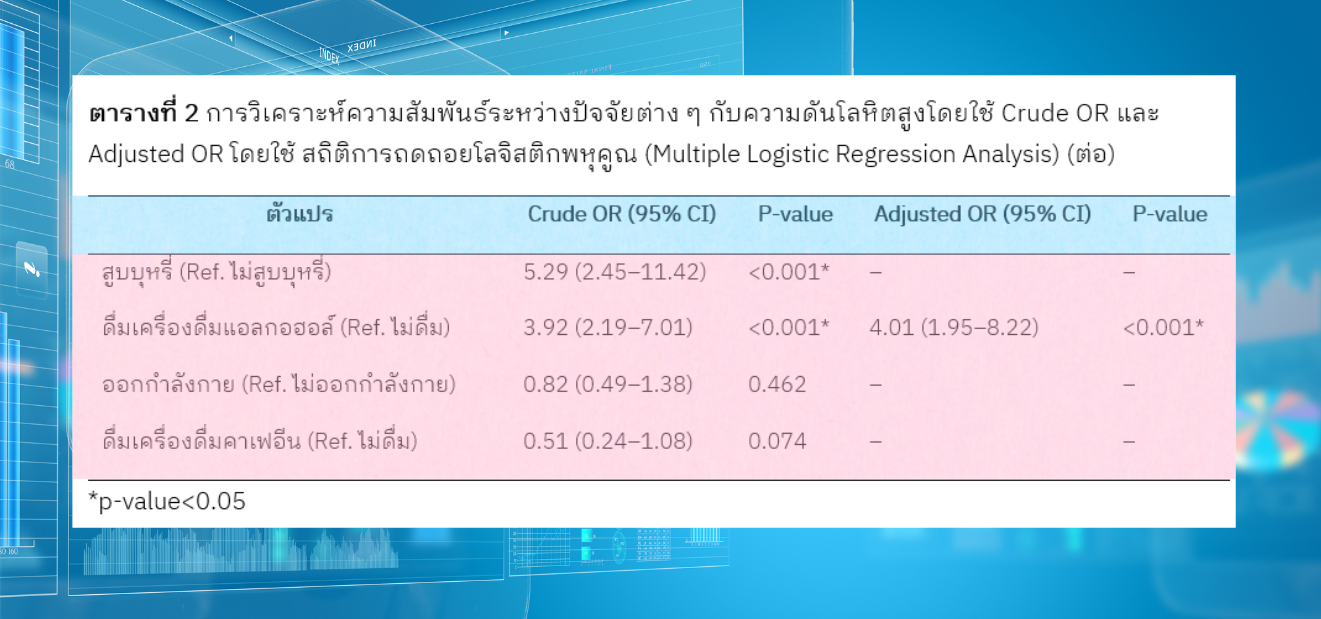
การวิจัยครั้งนี้เป็นการวิจัยแบบภาคตัดขวางเชิงวิเคราะห์ที่มีวัตถุประสงค์เพื่อศึกษาความสัมพันธ์ระหว่างคุณภาพการนอนหลับและความดันโลหิตสูงในกลุ่มผู้ป่วยนอกอายุระหว่าง 35–60 ปี ที่มารับบริการที่โรงพยาบาลพระมงกุฎเกล้า กลุ่มตัวอย่าง กลุ่มตัวอย่างมีจำนวน 246 คน ใช้ วิธีการสุ่มตัวอย่างแบบสะดวก (Convenience Sampling) การเก็บข้อมูลดำเนินการโดยใช้แบบสอบถามโครงสร้างที่รวบรวมข้อมูลด้านประชากรศาสตร์และสุขภาพ รวมถึงแบบสอบถาม Pittsburgh Sleep Quality Index (PSQI) เพื่อประเมินคุณภาพการนอนหลับ การวิเคราะห์ข้อมูลใช้สถิติเชิงพรรณนา ได้แก่ ค่าเฉลี่ย, ส่วนเบี่ยงเบนมาตรฐาน, ความถี่, ร้อยละ การทดสอบ Chi-square และการวิเคราะห์ถดถอยโลจิสติกพหุคูณ เพื่อประเมินความสัมพันธ์ระหว่างคุณภาพการนอนหลับและความดันโลหิตสูง ผลการศึกษาพบว่า จากกลุ่มตัวอย่างทั้งหมด 246 คน พบว่ามีผู้ที่มีคุณภาพการนอนหลับไม่ดี จำนวน 160 คน คิดเป็น ร้อยละ 65.0 ขณะที่ผู้ที่มีคุณภาพการนอนหลับดีมีจำนวน 86 คน คิดเป็น ร้อยละ 35.0 ผู้ที่มีคุณภาพการนอนหลับไม่ดีมีโอกาสเกิดความดันโลหิตสูงเพิ่มขึ้นอย่างมีนัยสำคัญ (AOR: 7.61, 95% CI: 3.40–16.89, p < 0.001) นอกจากนี้ ปัจจัยเสี่ยงอื่น ๆ ได้แก่ อายุที่มากกว่า 50 ปี (Adjusted OR: 3.45, p = 0.001) การดื่มเครื่องดื่มแอลกอฮอล์ (Adjusted OR: 4.01, p < 0.001) และประวัติครอบครัวของความดันโลหิตสูง (Adjusted OR: 5.39, p < 0.001) การศึกษานี้แสดงให้เห็นถึงบทบาทสำคัญของคุณภาพการนอนหลับและปัจจัยร่วมอื่น ๆ ในความดันโลหิตสูง การประเมินคุณภาพการนอนหลับและการแทรกแซงที่เหมาะสมควรนำมาใช้ในกระบวนการดูแลเพื่อป้องกันและลดความเสี่ยงต่อภาวะแทรกซ้อนในผู้ป่วยเอกสารอ้างอิง
Bjoroy, I., Jørgensen, V. A., Pallesen, S., & Bjorvatn, B. (2020). The Prevalence of Insomnia Subtypes in Relation to Demographic Characteristics, Anxiety, Depression, Alcohol Consumption and Use of Hypnotics. Frontiers in Psychology, 24(11). https://doi.org/10.3389/fpsyg.2020.00527
Chen, S., Song, X., Shi, H., Li, J., Ma, S., Chen, L., Lu, Y., Hong, C., Zhu, H., Sun, H., & Zhang, M. (2022). Association Between Sleep Quality and Hypertension in Chinese Adults: A Cross-Sectional Analysis in the Tianning Cohort. Nature and Science of Sleep, 28(14), 2097–2105. https://doi.org/10.2147/NSS.S388535
Chobanian, A. V., Bakris, G. L., Black, H. R., Cushman, W. C., Green, L. A., Izzo, J. L., Jones, D. W., Materson, B. J., Oparil, S., Wright, J. T., & Roccella, E. J. (2003). The seventh report of the joint national committee on prevention, detection, evaluation, and treatment of high blood pressure: The JNC 7 report. JAMA, 289(19), 2560–2572. https://doi.org/10.1001/jama.289.19.2560
CHOWDHURY, A. I., GHOSH, S., HASAN, MD. F., KHANDAKAR, K. A. S., & AZAD, F. (2021). Prevalence of insomnia among university students in South Asian Region: a systematic review of studies. Journal of Preventive Medicine and Hygiene, 61(4), E525–E529. https://doi.org/10.15167/2421-4248/jpmh2020.61.4.1634
Gangwisch, J. E. (2014). A Review of Evidence for the Link Between Sleep Duration and Hypertension. American Journal of Hypertension, 27(10), 1235–1242. https://doi.org/10.1093/ajh/hpu071
Grandner, M. A., & Drummond, S. P. A. (2007). Who are the long sleepers? Towards an understanding of the mortality relationship. Sleep Medicine Reviews, 11(5), 341–360. https://doi.org/10.1016/j.smrv.2007.03.010
Kim, J., & Jo, I. (2010). Age-Dependent Association Between Sleep Duration and Hypertension in the Adult Korean Population. American Journal of Hypertension, 23(12), 1286–1291. https://doi.org/10.1038/ajh.2010.166
Laugsand, L. E., Strand, L. B., Platou, C., Vatten, L. J., & Janszky, I. (2013). Insomnia and the risk of incident heart failure: a population study. European Heart Journal, 35(21), 1382–1393. https://doi.org/10.1093/eurheartj/eht019
Li, L., Li, L., Chai, J.-X., Xiao, L., Ng, C. H., Ungvari, G. S., & Xiang, Y.-T. (2020). Prevalence of Poor Sleep Quality in Patients With Hypertension in China: A Meta-analysis of Comparative Studies and Epidemiological Surveys. Frontiers in Psychiatry, 11. https://doi.org/10.3389/fpsyt.2020.00591
Liu, R.-Q., Qian, Z., Trevathan, E., Chang, J.-J., Zelicoff, A., Hao, Y.-T., Lin, S., & Dong, G.-H. (2015). Poor sleep quality associated with high risk of hypertension and elevated blood pressure in China: results from a large population-based study. Hypertension Research, 39(1), 54–59. https://doi.org/10.1038/hr.2015.98
Lo, K., Woo, B., Wong, M., & Tam, W. (2018). Subjective sleep quality, blood pressure, and hypertension: a meta-analysis. The Journal of Clinical Hypertension, 20(3), 592–605. https://doi.org/10.1111/jch.13220
Luyster, F. S., Strollo, P. J., Zee, P. C., & Walsh, J. K. (2012). Sleep: A Health Imperative. Sleep, 35(6), 727–734. https://doi.org/10.5665/sleep.1846
Shan, Z., Ma, H., Xie, M., Yan, P., Guo, Y., Bao, W., Rong, Y., Jackson, C. L., Hu, F. B., & Liu, L. (2015). Sleep Duration and Risk of Type 2 Diabetes: A Meta-analysis of Prospective Studies. Diabetes Care, 38(3), 529–537. https://doi.org/10.2337/dc14-2073
Sitasuwan, T., Bussaratid, S., Ruttanaumpawan, P., & Chotinaiwattarakul, W. (2014). Reliability and validity of the Thai version of the Pittsburgh Sleep Quality Index. Journal of the Medical Association of Thailand = Chotmaihet Thangphaet, 97 Suppl 3, S57-67. https://pubmed.ncbi.nlm.nih.gov/24772581/
Sofi, F., Cesari, F., Casini, A., Macchi, C., Abbate, R., & Gensini, G. F. (2012). Insomnia and risk of cardiovascular disease: a meta-analysis. European Journal of Preventive Cardiology, 21(1), 57–64. https://doi.org/10.1177/2047487312460020
Uchmanowicz, I., Markiewicz, K., Uchmanowicz, B., Kołtuniuk, A., & Rosińczuk, J. (2019). The relationship between sleep disturbances and quality of life in elderly patients with hypertension. Clinical Interventions in Aging, 2019(14), 155–165. https://doi.org/10.2147/cia.s188499
WHO Consultation on Obesity (1999: Geneva, S., & Organization, W. H. (2000). Obesity : preventing and managing the global epidemic : report of a WHO consultation. In apps.who.int. World Health Organization. https://apps.who.int/iris/handle/10665/42330
Wu, H., Qianwen Lv, Zhang, H., Qin, Y., Fang, F., Sun, H., & Wei, Y. (2019). The reduction of apnea–hypopnea duration ameliorates endothelial dysfunction, vascular inflammation, and systemic hypertension in a rat model of obstructive sleep apnea. Sleep & Breathing, 23(4), 1187–1196. https://doi.org/10.1007/s11325-019-01798-3
Zhan, Y., Zhang, F., Lu, L., Wang, J., Sun, Y., Ding, R., Hu, D., & Yu, J. (2014). Prevalence of dyslipidemia and its association with insomnia in a community based population in China. BMC Public Health, 14(1). https://doi.org/10.1186/1471-2458-14-1050
ดาวน์โหลด
เผยแพร่แล้ว
รูปแบบการอ้างอิง
ฉบับ
ประเภทบทความ
สัญญาอนุญาต
ลิขสิทธิ์ (c) 2025 วารสารสาธารณสุขและวิทยาศาสตร์สุขภาพ

อนุญาตภายใต้เงื่อนไข Creative Commons Attribution-NonCommercial-NoDerivatives 4.0 International License.
บทความทุกบทความที่ได้รับการตีพิมพ์ถือเป็นลิขสิทธิ์ของ วารสารสาธารณสุข