ความชุกและปัจจัยสัมพันธ์กับความรู้สึกว้าเหว่ของผู้สูงอายุที่มารับบริการที่กองตรวจโรคผู้ป่วยนอก โรงพยาบาลพระมงกุฏเกล้า
คำสำคัญ:
ความรู้สึกว้าเหว่, ผู้สูงอายุ, ภาวะซึมเศร้า, ปัจจัยทางสังคม, ผู้ป่วยนอกบทคัดย่อ
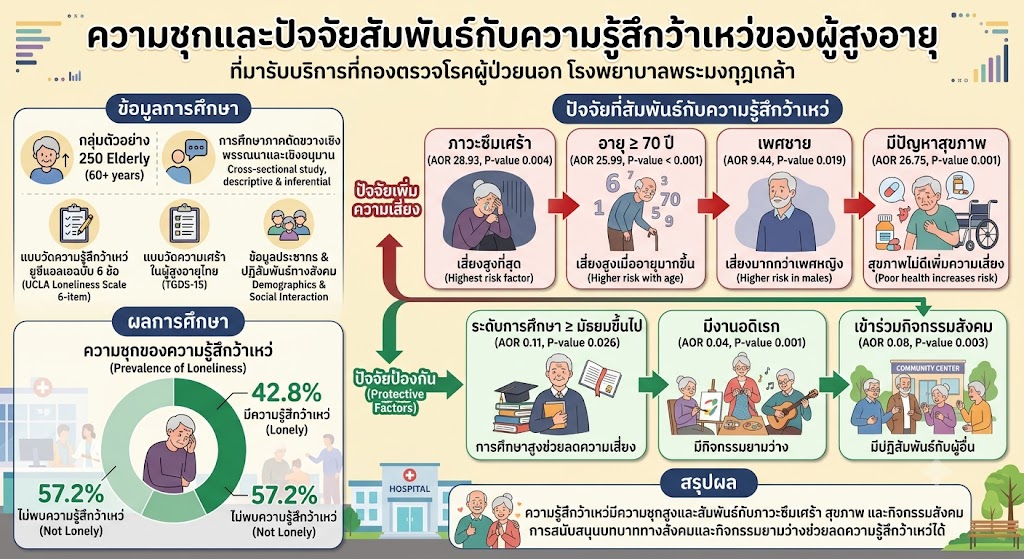
ความรู้สึกว้าเหว่ เป็นปัญหาด้านสาธารณสุขที่เพิ่มขึ้นในกลุ่มผู้สูงอายุ ซึ่งภาวะนี้ได้ถูกพูดถึงมาก โดยเฉพาะในยุคหลังจากที่มีการระบาดของไวรัสโควิด-19 ที่ส่งผลต่อพฤติกรรมทางสังคมในระยะยาว โดยภาวะนี้เชื่อมโยงกับผลกระทบด้านสุขภาพทั้งร่างกายและจิตใจ โดยการศึกษาภาคตัดขวางครั้งนี้มีวัตถุประสงค์เพื่อสำรวจความชุกของความรู้สึกว้าเหว่และปัจจัยสัมพันธ์กับความรู้สึกว้าเหว่ในผู้สูงอายุ ทำการศึกษาในผู้สูงอายุที่มารับบริการแผนกผู้ป่วยนอก โรงพยาบาลพระมงกุฎเกล้า ใช้การศึกษาแบบภาคตัดขวางเชิงพรรณนาและเชิงอนุมาน กลุ่มตัวอย่างจะถูกสุ่มอย่างง่าย ประกอบด้วยผู้สูงอายุตั้งแต่อายุ 60 ปีขึ้นไป และมีความสามารถในการสื่อสารได้ จำนวนทั้งหมด 250 คน ทั้งหมด จะได้รับประเมินความรู้สึกว้าเหว่ด้วยแบบวัดความรู้สึกว้าเหว่ยูซีแอลเอฉบับ 6 ข้อ และภาวะซึมเศร้าด้วยแบบวัดความเศร้าในผู้สูงอายุไทย 15 ข้อ (TGDS-15) พร้อมเก็บข้อมูลด้านประชากร สุขภาพ และการมีปฏิสัมพันธ์ทางสังคม ข้อมูลทั้งหมดจะถูกวิเคราะห์เพื่อหาความชุกของภาวะความรู้สึกว้าเหว่ และวิเคราะห์เพื่อหาปัจจัยสัมพันธ์
ผลการศึกษาพบว่าร้อยละ 42.8 มีความรู้สึกว้าเหว่ และพบปัจจัยที่เพิ่มความเสี่ยงอย่างมีนัยยะสำคัญ ได้แก่ ภาวะซึมเศร้า (AOR 28.93, p-value 0.004), อายุ ≥70 ปี (AOR 25.99, p-value < 0.001), เพศชาย (AOR 9.44, p-value 0.019) และมีปัญหาสุขภาพ (AOR 26.75, p-value 0.001) ในทางกลับกัน พบว่า ผู้ที่มีระดับการศึกษาตั้งแต่มัธยมขึ้นไป (AOR 0.11, p-value 0.026) ผู้ที่มีงานอดิเรก (AOR 0.04, p-value 0.001) และผู้ที่มีการเข้าร่วมกิจกรรมสังคม (AOR 0.08, p-value 0.003) ถือเป็นปัจจัยป้องกัน อย่างมีนัยยะสำคัญ สรุปได้ว่า ความรู้สึกว้าเหว่ในผู้สูงอายุมีความชุกที่สูงและมีสัมพันธ์กับภาวะซึมเศร้า ปัญหาสุขภาพและการเข้าร่วมกิจกรรมทางสังคม การสนับสนุนให้ผู้สูงอายุมีบทบาททางสังคมและมีกิจกรรมยามว่าง อาจสามารถช่วยลดความเสี่ยงในการเกิดความรู้สึกว้าเหว่ได้
เอกสารอ้างอิง
Aylaz, R., Akturk, U., Erci, B., Ozturk, H., & Aslan, H. (2012). Relationship between depression and loneliness in elderly and examination of influential factors. Archives of Gerontology and Geriatrics, 55(3), 548–554.
Cacioppo, J. T., & Cacioppo, S. (2018). The growing problem of loneliness. The Lancet, 391(10119), 426. doi:10.1016/S0140-6736(18)30142-9
Courtin, E., & Knapp, M. (2017). Social isolation, loneliness and health in old age: A scoping review. Health & Social Care in the Community, 25(3), 799–812. doi:10.1111/hsc.12311
Donovan, N. J., & Blazer, D. (2020). Social isolation and loneliness in older adults: Review and commentary of a national academies report. The American Journal of Geriatric Psychiatry, 28(12), 1233–1244. doi:10.1016/j.jagp.2020.08.005
Holt-Lunstad, J., Smith, T. B., Baker, M., Harris, T., & Stephenson, D. (2015). Loneliness and social isolation as risk factors for mortality: A meta-analytic review. Perspectives on Psychological Science, 10(2), 227–237. doi:10.1177/1745691614568352
Huang, P., Chi, M. J., Kuo, C. L., Wu, S. V., & Chuang, Y. H. (2021). Prevalence of loneliness and relatedfactors among older adults in Taiwan: Evidence from a nationally representative survey. INQUIRY: The Journal of Health Care Organization, Provision, and Financing, 58, 1–8. doi:10.1177/00469580211035745
JAMA Network Open. (2023). Social isolation, loneliness, and risk of mortality among adults. JAMA Network Open. doi:10.1001/jama.2023.11958
Kirkland, S. A., Griffith, L. E., Menec, V., Wister, A., Payette, H., Wolfson, C., & Raina, P. (2023). Increased prevalence of loneliness and associated risk factors during the COVID-19 pandemic: Findings from the Canadian Longitudinal Study on Aging (CLSA). BMC Public Health, 23, 872. doi:10.1186/s12889-023-15807-4
Lampraki, C., Hoffman, A., Roquet, A., & Jopp, D. S. (2022). Loneliness during COVID-19: Development and influencing factors. PLOS ONE, 17(3), e0265900. doi:10.1371/journal.pone.0265900
Lee, E. E., Depp, C., Palmer, B. W., Glorioso, D., Daly, R., Liu, J., Tu, X. M., Kim, H. C., Tarr, P., Yamada, Y., & Jeste, D. V. (2021). High prevalence and adverse health effects of loneliness in community-dwelling adults across the lifespan: Role of wisdom as a protective factor. International Psychogeriatrics, 33(3), 373–382. doi:10.1017/S1041610220002120
McGinty, E. E., Presskreischer, R., Han, H., & Barry, C. L. (2022). Persistent loneliness due to COVID-19 over 18 months of the pandemic: A prospective cohort study. Journal of Affective Disorders, 310, 134–141. doi:10.1016/j.jad.2022.04.024
Nakou, A., Dragioti, E., Bastas, N.-S., Zagorianakou, N., Kakaidi, V., Tsartsalis, D., Mantzoukas, S., Tatsis, F., Veronese, N., Solmi, M., & Gouva, M. (2025). Loneliness, social isolation, and living alone: A comprehensive systematic review, meta-analysis, and meta-regression of mortality risks in older adults. Aging Clinical and Experimental Research, 37(1), 29. doi:10.1007/s40520-024-02925-1
National Institute on Aging. (2023). Loneliness and social isolation—Tips for staying connected. Retrieved from https://www.nia.nih.gov/health/loneliness-and-social-isolation-tips-staying-connected
Patcharaporn, K., Patsri, S., & Supatcha, K. (2021). Prevalence and associated factors with depression in elderly at primary care, Phramongkutklao Hospital. Journal of Preventive Association of Thailand, 11, 30–49.
Peng, S., & Roth, A. R. (2022). Social isolation and loneliness before and during the COVID-19 pandemic: A longitudinal study of U.S. adults older than 50. The Journals of Gerontology: Series B, 77(7), e185–e190. doi:10.1093/geronb/gbab068
Saumya, B., Schwartz, R., Majnu, J., & Blain, G. (2022). Loneliness in older adults with major depression across the COVID-19 pandemic. The American Journal of Geriatric Psychiatry, 30(3 Suppl.), S82–S83. doi:10.1016/j.jagp.2021.12.082
Singh, A., & Misra, N. (2009). Loneliness, depression and sociability in old age. Industrial Psychiatry Journal, 18(1), 51–55. doi:10.4103/0972-6748.57861
Susanty, S., Nurjanah, N., & colleagues. (2022). Prevalence of loneliness and associated factors among community-dwelling older adults in Indonesia: A cross-sectional study.
International Journal of Environmental Research and Public Health, 19(8), 4911.doi:10.3390/ijerph19084911
The Lancet Commission on Social Connection. (2024). Global perspectives on loneliness and social isolation. The Lancet.
Wang, F., Zhang, Y., Wu, Y., Ye, Y., Xie, X., & colleagues. (2023). Social isolation and loneliness and risk of all-cause mortality: A meta-analysis of cohort studies. Nature Human Behaviour. doi:10.1038/s41562-023-01617-6
World Health Organization. (2023). Loneliness and social isolation as public health priorities. Retrieved from https://www.who.int/teams/social-determinants-of-health/demographic-change-and-healthy ageing/social-isolation-and-loneliness
World Health Organization. (2025). Commission on social connection: Global report. Retrieved from https://www.who.int/groups/commission-on-social-connection
ดาวน์โหลด
เผยแพร่แล้ว
รูปแบบการอ้างอิง
ฉบับ
ประเภทบทความ
สัญญาอนุญาต
ลิขสิทธิ์ (c) 2026 วารสารสาธารณสุขและวิทยาศาสตร์สุขภาพ

อนุญาตภายใต้เงื่อนไข Creative Commons Attribution-NonCommercial-NoDerivatives 4.0 International License.
บทความทุกบทความที่ได้รับการตีพิมพ์ถือเป็นลิขสิทธิ์ของ วารสารสาธารณสุข