การศึกษาคุณสมบัติในการยับยั้งเชื้อราแคนดิดาอัลบิแคนส์ สเตร็ปโตค็อกคัส มิวแทนส์ และเซลล์มะเร็งในช่องปากของสารสำคัญกรดอนาคาร์ดิกจากเปลือกเมล็ดมะม่วงหิมพานต์
คำสำคัญ:
กรดอนาคาร์ดิก, การยับยั้งจุลชีพ, ความเป็นพิษต่อเซลล์มะเร็งในช่องปาก, เปลือกเมล็ดมะม่วงหิมพานต์, มะม่วงหิมพานต์บทคัดย่อ
งานวิจัยนี้เป็นการทดลองโดยมีวัตถุประสงค์เพื่อสกัดและแยกกรดอ นาคาร์ดิกจากเปลือกเมล็ดมะม่วงหิมพานต์ พร้อมศึกษาฤทธิ์ความเป็นพิษต่อเซลล์มะเร็งช่องปาก และฤทธิ์การยับยั้งจุลชีพ Candida albicans และ Streptococcus mutans โดยได้นำเปลือกเมล็ดมะม่วงหิมพานต์มาสกัดด้วยตัวทำละลายเฮกเซนพร้อมทดสอบฤทธิ์ความเป็นพิษต่อเซลล์มะเร็งช่องปาก ด้วยวิธี MTT assay และฤทธิ์การยับยั้งจุลชีพ ด้วยวิธี Agar well diffusion และนำมาวิเคราะห์ทางสถิติโดยใช้ One-way ANOVA
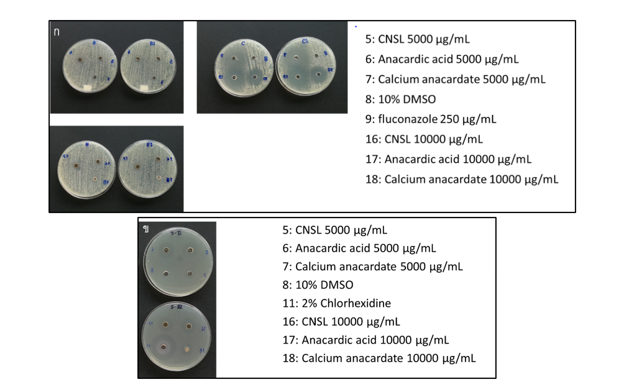
การทดสอบฤทธิ์ความเป็นพิษต่อเซลล์มะเร็งในช่องปาก พบว่า สาร Doxorubicin มีประสิทธิภาพสูงสุดในการยับยั้งเซลล์มะเร็งช่องปาก ตามด้วย Calcium anacardate ส่วน Anacardic acid มีประสิทธิภาพรองลงมา และ Cashew nut shell liquid มีประสิทธิภาพต่ำที่สุด สำหรับการทดสอบฤทธิ์การยับยั้งจุลชีพ พบว่า สารสกัดจากเปลือกเมล็ดมะม่วงหิมพานต์ทั้ง 3 ชนิดไม่มีฤทธิ์ยับยั้ง Candida albicans แต่มีฤทธิ์ยับยั้ง Streptococcus mutans เนื่องจากงานวิจัยนี้ใช้เปลือกเมล็ดมะม่วงหิมพานต์ที่มาจากแหล่งเดียว ซึ่งปัจจัยจากแหล่งปลูกไม่ว่าจะเป็น ดิน หรือน้ำ สภาพอากาศ อาจจะมีผลต่อชนิด และปริมาณสารสำคัญ รวมถึงฤทธิ์ในการยับยั้งเชื้อจุลชีพ และฤทธิ์ในการยับยั้งเซลล์มะเร็งในช่องปากได้ อีกทั้งกรดอนาคาร์ดิกมีฤทธิ์ที่ดีในการยับยั้งเชื้อแบคทีเรีย S. mutans และ Calcium anacardate มีฤทธิ์ที่ดีในการยับยั้งเซลล์มะเร็งช่องปาก ซึ่งควรจะมีการทดสอบความเป็นพิษเทียบกับเซลล์ปกติ รวมถึงมะเร็งช่องปากชนิดอื่นๆ และมีความน่าสนใจที่จะนำไปพัฒนาเป็นยาทางเลือกให้กับผู้บริโภคต่อไปในอนาคต แต่สารสกัด Calcium anacardate ละลายได้ค่อนข้างยาก หากมีการปรับเปลี่ยนหมู่โลหะเป็นโซเดียม หรือ โพแทสเซียมค่าการละลายน่าจะดีขึ้นทำให้สามารถนำไปใช้ในรูปแบบผลิตภัณฑ์ได้ง่ายขึ้น
เอกสารอ้างอิง
Ajileye, O. O., Obuotor, E. M., Akinkunmi, E. O., & Aderogba, M. A.. (2015). Isolation and characterization of antioxidant and antimicrobial compounds from Anacardium occidentale L. (Anacardiaceae) leaf extract. Journal of King Saud University, 27(3), 244-52.
Cruz, C., Freitas, E., Braz, N., Salles, R., & Silva, I. (2018). Blood parameters and enzymatic and oxidative activity in the liver of chickens fed with calcium anacardate. Revista ciência Agronômica, 49(2).
D'Angelo, N. A., Noronha, M. A., Câmara, M. C. C., Kurnik, I. S., Feng, C., Araujo, et al. (2022). Doxorubicin nanoformulations on therapy against cancer: An overview from the last 10 years. Biomaterials Advances, 133, 112623.
Da Silva, R. A.,Liberio, S. A., do Amaral, F. M. M., do Nascimento, F. R. F., Torres, L. M. B., Neto, V. M., et al. (2016). Antimicrobial and antioxidant activity of anacardium occidentalel. flowers in comparison to bark and leaves extracts. Journal of Biosciences and Medicines, 4, 87-99.
De Oliveira, S. N., Cunha, D. A., Sousa, R. N., Bezerra, T. T., Lomonaco, D., Mazzetto, S. E., Martins, C. H. G., Casemiro, L. A., & de Paulo, A. S. V. (2022). Physicochemical and microbiological assessment of a dental adhesive doped with cashew nut shell liquid. Odontology, 110(3), 434–443.
George, J. & Kuttan, R. (1997). Mutagenic, carcinogenic and cocarcinogenic activity of cashewnut shell liquid. Cancer Letters, 112(1), 11–16.
Gutiérrez-Venegas, G., Sánchez-Carballido, M. A., Delmas, S. C., Gómez-Mora, J. A., & Bonneau, N. (2020). Effects of flavonoids on tongue squamous cell carcinoma. Cell Biology International, 44(3), 686–720.
Hamad, F. B. & Mubofu, E. B. (2015). Potential biological applications of bio-based anacardic acids and their derivatives. International Journal of Molecular Sciences, 16(4), 8569– 8590.
Johnson, M. C., Bozzola, J. J., & Shechmeister, I. L. (1974). Morphological study of streptococcus mutans and two extracellular polysaccharide mutants. Journal of Bacteriology, 118(1), 304–311.
Jones C. G. (1997). Chlorhexidine: is it still the gold standard?. Periodontology 2000, 15, 55–62.
Kishore, A. H., Vedamurthy, B. M., Mantelingu, K., Agrawal, S., Reddy, B. A., Roy, S., et al. (2008). Specific small-molecule activator of aurora kinase a induces autophosphorylation in a cell-free system. Journal of Medicinal Chemistry, 51(4), 792–797.
Legut, M., Lipka, D., Filipczak, N., Piwoni, A., Kozubek, A., & Gubernator, J. (2014). Anacardic acid enhances the anticancer activity of liposomal mitoxantrone towards melanoma cell lines - in vitro studies. International Journal of Nanomedicine, 9, 653–668.
Loesche, W. (2007). Dental caries and periodontitis: contrasting two infections that have medical implications. Infectious Disease Clinics of North America, 21(2), 471–vii.
Murata, M., Irie, J., & Homma, S. (1997). Inhibition of lipid synthesis of bacteria, yeast and animal cells by anacardic acids, glycerol-3-phosphate dehydrogenase inhibitors from ginkgo. LWT- Food Science and Technology, 30(5), 458-63.
Muroi, H. & Kubo, I. (1996). Antibacterial activity of anacardic acid and totarol, alone and in combination with methicillin, against methicillin-resistant Staphylococcus aureus. The Journal of Applied Bacteriology, 80(4), 387–394.
Paramashivappa, R., Kumar, P. P., Vithayathil, P. J., & Rao, A. S. (2001). Novel method for isolation of major phenolic constituents from cashew (Anacardium occidentale L.) nut shell liquid. Journal of Agricultural and Food Chemistry, 49(5), 2548–2551.
Park, M., Upton, D., Blackmon, M., Dixon, V., Craver, S., Neal, et al. (2018). Anacardic acid inhibits pancreatic cancer cell growth, and potentiates chemotherapeutic effect by Chmp1A - ATM - p53 signaling pathway. BMC complementary and alternative medicine, 18(1), 71.
Poppolo, D. F. & Ouanounou, A. (2022). Chlorhexidine in dentistry: pharmacology, uses, and adverse effects. International Dental Journal, 72(3), 269–277.
Sudjaroen, Y. (2018). Inappropriate of in vitro antimicrobial and anticancer activities from cashew (Anacardium occidentale L.) nut shell extracts. Journal of Pharmaceutical Negative Results, 9(1), 33-38
Talapko, J., Juzbašić, M., Matijević, T., Pustijanac, E., Bekić, S., Kotris, I., & Škrlec, I. (2021). Candida albicans-the virulence factors and clinical manifestations of infection. Journal of Fungi (Basel,Switzerland), 7(2), 79.
Tan, J., Jiang, X., Yin, G., He, L., Liu, J., Long, et al, (2017). Anacardic acid induces cell apoptosis of prostatic cancer through autophagy by ER stress/DAPK3/Akt signaling pathway. Oncology Reports, 38(3), 1373–1382.
Zhao, Q., Zhang, X., Cai, H., Zhang, P., Kong, D., Ge, et al, (2018). Anticancer effects of plant derived anacardic acid on human breast cancer mda-mb-231 cells. American Journal of Translational Research, 10(8), 2424–24.
ดาวน์โหลด
เผยแพร่แล้ว
รูปแบบการอ้างอิง
ฉบับ
ประเภทบทความ
สัญญาอนุญาต
ลิขสิทธิ์ (c) 2025 วิทยาลัยพยาบาลบรมราชชนนี นครศรีธรรมราช

อนุญาตภายใต้เงื่อนไข Creative Commons Attribution-NonCommercial-NoDerivatives 4.0 International License.
บทความที่ได้รับการตีพิมพ์เป็นลิขสิทธิ์ของ วิทยาลัยพยาบาลบรมราชชนนี นครศรีธรรมราช
ข้อความที่ปรากฏในบทความแต่ละเรื่องในวารสารวิชาการเล่มนี้เป็นความคิดเห็นส่วนตัวของผู้เขียนแต่ละท่านไม่เกี่ยวข้องกับวิทยาลัยพยาบาลบรมราชชนนี นครศรีธรรมราช และบุคคลากรท่านอื่น ๆ ในวิทยาลัยฯ แต่อย่างใด ความรับผิดชอบองค์ประกอบทั้งหมดของบทความแต่ละเรื่องเป็นของผู้เขียนแต่ละท่าน หากมีความผิดพลาดใดๆ ผู้เขียนแต่ละท่านจะรับผิดชอบบทความของตนเองแต่ผู้เดียว