
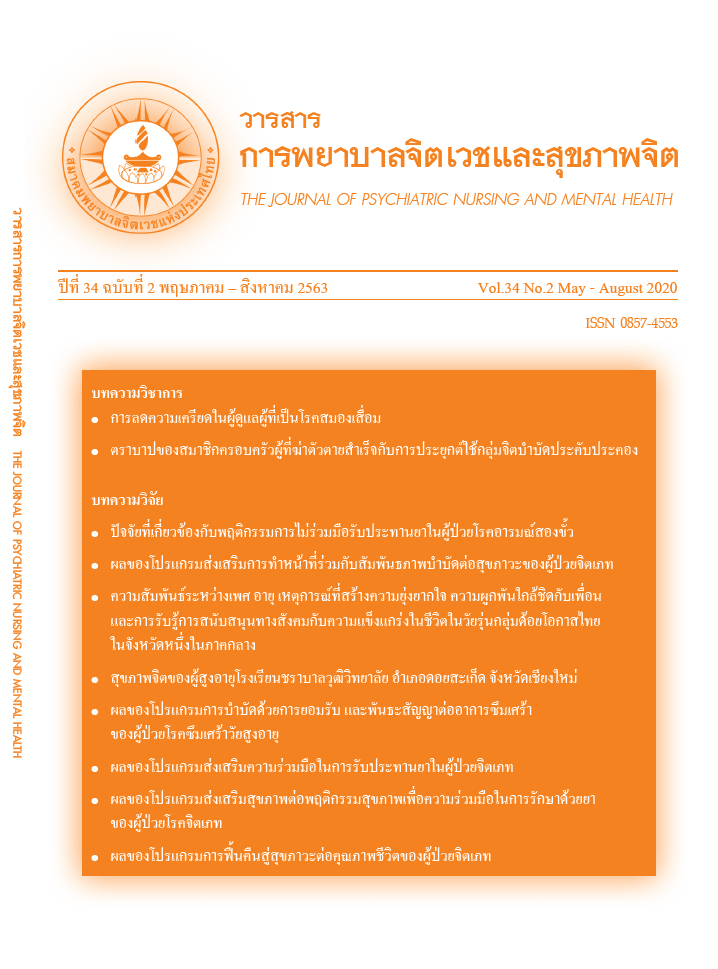
ผลของโปรแกรมการบำบัดด้วยการยอมรับและพันธะสัญญาต่ออาการซึมเศร้าของผู้ป่วยโรคซึมเศร้าวัยสูงอายุ
Article Sidebar
Main Article Content
บทคัดย่อ
บทคัดย่อ
วัตถุประสงค์: การวิจัยกึ่งทดลองครั้งนี้ มี วัตถุประสงค์เพื่อศึกษาผลของโปรแกรมการบำบัด ด้วยการยอมรับและพันธะสัญญาต่ออาการซึมเศร้า ของผู้ป่วยโรคซึมเศร้าวัยสูงอายุ
วิธีการศึกษา: กลุ่มตัวอย่างเป็นผู้ป่วย โรคซึมเศร้าที่มารับการรักษาแผนกผู้ป่วยนอก โรงพยาบาลจิตเวชแห่งหนึ่ง อายุ 60 ปีบริบูรณ์ขึ้นไป ได้รับการคัดเลือกตามเกณฑ์คุณสมบัติแล้วสุ่ม อย่างง่ายเข้ากลุ่มทดลองและกลุ่มควบคุม กลุ่มละ 30 คน เครื่องมือที่ใช้ในการวิจัย คือ 1) โปรแกรม การบำบัดด้วยการยอมรับและพันธะสัญญา ที่ผ่านการตรวจสอบความตรงตามเนื้อหาโดย ผู้ทรงคุณวุฒิจำนวน 5 ท่าน 2) แบบประเมินอาการ ซึมเศร้าของแฮมิลตัน และ 3) แบบประเมินความ ยืดหยุ่นทางจิตใจ ซึ่งตรวจสอบความเที่ยงของ แบบสอบถามทั้งสองนี้ได้ค่าสัมประสิทธิ์แอลฟา ของครอนบาคเท่ากับ .83 และ .91 ตามลำดับ วิเคราะห์ข้อมูลโดยใช้สถิติเชิงพรรณนาและสถิติ ทดสอบค่าที
ผลการศึกษา: คะแนนเฉลี่ยอาการซึมเศร้า ของผู้ป่วยหลังได้รับโปรแกรมการบำบัดด้วยการ ยอมรับและพันธะสัญญาต่ำกว่าก่อนทดลอง อย่าง มีนัยสำคัญทางสถิติ (t = -23.57, p < .05) และ ผลต่างค่าเฉลี่ยอาการซึมเศร้าก่อนและหลังการ ทดลองของผู้ป่วยที่ได้รับโปรแกรมการบำบัดด้วย การยอมรับและพันธะสัญญามากกว่ากลุ่มที่ได้รับ การพยาบาลตามปกติ อย่างมีนัยสำคัญทางสถิติ (t = 12.67, p < .05).
สรุป: โปรแกรมการบำบัดด้วยการยอมรับ และพันธะสัญญาสามารถลดอาการซึมเศร้าใน ผู้ป่วยโรคซึมเศร้าวัยสูงอายุได้อย่างมีประสิทธิภาพ
Article Details
บทความที่ได้รับการตีพิมพ์แล้ว เป็นลิขสิทธิ์ของสมาคมพยาบาลจิตเวชแห่งประเทศไทย
เอกสารอ้างอิง
ธรณินทร์ กองสุข และคณะ. (2551). ความชุกของ โรคซึมเศร้าในคนไทย: การสำรวจระบาดวิทยา โรคทางจิตเวชระดับชาติ ปี 2551. นนทบุรี: กรมสุขภาพจิต กระทรวงสาธารณสุข.
มาโนช หล่อตระกูล, ปราโมทย์ สุขนิชย์ เเละ จักรกฤษณ์ สุขยิ่ง. (2539). การพัฒนาแบบวัด Hamilton Rating Scale for Depression ฉบับภาษาไทย. วารสารสมาคมจิตแพทย์ แห่งประเทศไทย, 41(4), 235 - 246.
รังสิมันต์ สุนทรไชยา. (2561). การบำบัดทางจิตสังคมสำหรับผู้สูงอายุ. ปทุมธานี: มหาวิทยาลัยธรรมศาสตร์.
วนิชา น้อยผล. (2560). ความเที่ยงและความเชื่อมั่น ของแบบประเมินความยืดหยุ่นทางจิตใจในผู้ป่วยโรคซึมเศร้าฉบับภาษาไทย. เชียงใหม่: โรงพยาบาลสวนปรุง กรมสุขภาพจิต.
วิไลวรรณ ทองเจริญ. (2554). ศาสตร์และศิลป์ การพยาบาลผู้สูงอายุ. กรุงเทพฯ: โครงการ ตำราคณะ พยาบาลศาสตร์ มหาวิทยาลัย มหิดล.
อรพรรณ ลือบุญธวัชชัย. (2554). การพยาบาล สุขภาพจิตและจิตเวช. (พิมพ์ครั้งที่4). กรุงเทพฯ: จุฬาลงกรณ์มหาวิทยาลัย.
Andrew, D., & Dulin, P. (2007). The relationship between self-reported health and mental health problems among older adults in New Zealand: Experiential avoidance as a moderator. Aging and Mental Health, 11(5), 596-603.
Ayers, C. R., Petkus, A., Liu, L., Patterson, T. L., & Wetherell, J. L. (2010). Negative life events and avoidant coping are associated with poorer long-term outcome in older adults treated for generalized anxiety disorder. Journal of Experimental Psycho-pathology, 1(1), 146-154.
Bohlmeijer, E. T., Fledderus, M., Rokx, T. A. J. J., & Pieterse, M. E. (2011). Efficacy of an early intervention based on acceptance and commitment therapy for adults with depressive symptomatology: Evaluation in a randomized controlled trial. Behavior Research and Therapy, 49(1), 62-67. doi: https://doi.org/10.1016/j.brat.2010.10.003
Bruine de Bruin, W., Dombrovski, A. Y., Parker, A. M., & Szanto, K. (2016). Late life depression, suicidal ideation, and attempted suicide: The role of individual differences in maximizing, regret, and negative decision outcomes. Journal of Behavioral Decision Making, 29(4), 363-371.
Cukrowicz, K. C., Ekblad, A., Cheavens, J., Rosenthal, M., & Lynch, T. R. (2008). Coping and thought suppression as predictors of suicidal ideation in depressed older adults with personality disorders. Aging and Mental Health, 12(1), 149-157.
Davison, T. E., Eppingstall, B., Runci, S., & O’Connor, D. W. (2017). A pilot trial of ACT for symptoms of depression and anxiety in older adults residing in long-term care facilities. Aging & Mental Health, 21(7), 766-773.
Gholamhoseini, B., Koolaee, A. K., & Taghvaee, D. (2015). The effectiveness of Acceptance and Commitment Group Therapy on depression and body image in women with Obesity. Community Health (Salmat-i ijtim), 2(2), 72-79.
Hayes, L., Boyd, C. P., & Sewell, J. (2011). ACT for the treatment of adolescent depression: A pilot study in a psychiatric outpatient setting. Mindfulness, 2(2), 86-94.
Hayes, S. C., Luoma, J. B., Bond, F. W., Masuda, A., & Lillis, J. (2006). ACT: Model, processes and outcomes. Behaviour Research and Therapy, 44(1), 1-25.
Kato, T. (2016). Psychological inflexibility and depressive symptoms among Asian English speakers: A study on Indian, Philippine, and Singaporean samples. Psychiatry Research, 238, 1-7. doi: 10.1016/ j.psychres.2016.02.007
Roberts, S. L., & Sedley, B. (2016). ACT with older adults: Rationale and case study of an 89-year-old with depression and generalized anxiety disorder. Clinical Case Studies, 15(1), 53-67.
Saedy, M., Kooshki, S., Firouzabadi, M. J., Emamipour, S., & Ardani, A. R. (2015). Effectiveness of acceptance-commitment therapy on anxiety and depression among patients on methadone treatment: a pilot study. Iranian Journal of Psychiatry and Behavioral Sciences, 9(1). doi:10.17795/ ijpbs222
World Health Organization (WHO). ( 1992) . The ICD-10 classification of mental and behavioural disorders: clinical descriptions and diagnostic guidelines. Geneva: World Health Organization. https://apps.who.int/ iris/handle/10665/37958
World Health Organization (WHO). (2015). World report on ageing and health. Geneva: World Health Organization.
Zivin, K., Wharton, T., & Rostant, O. (2013). The economic, public health, and caregiver burden of late-life depression. The Psychiatric Clinics of North America, 36(4), 631.
