
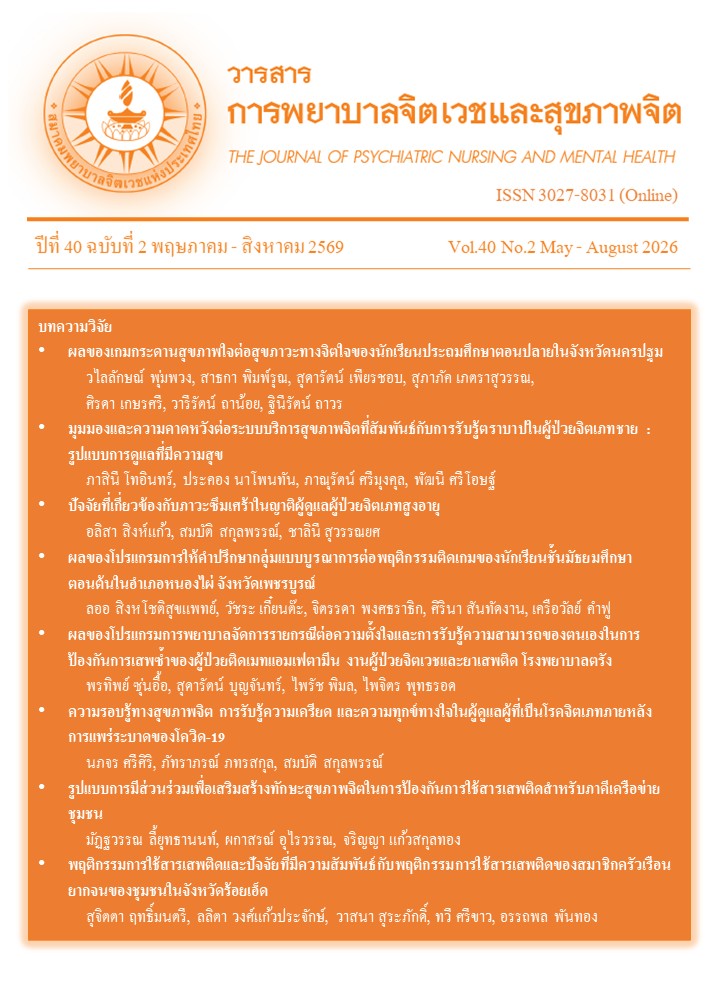
ผลของโปรแกรมการให้คำปรึกษากลุ่มแบบบูรณาการต่อพฤติกรรมติดเกมของนักเรียนชั้นมัธยมศึกษาตอนต้นในอำเภอหนองไผ่ จังหวัดเพชรบูรณ์
Article Sidebar
Main Article Content
บทคัดย่อ
วัตถุประสงค์ : เพื่อศึกษาผลของพฤติกรรมการติดเกมของนักเรียนระดับมัธยมศึกษาตอนต้นก่อนและหลังได้รับโปรแกรมการให้คำปรึกษากลุ่มแบบบูรณาการ
วิธีการศึกษา : กลุ่มตัวอย่างเป็นนักเรียนที่มีคะแนนการทดสอบคัดกรองการติดเกม (GAST) บ่งชี้ระดับ “การมีส่วนร่วมสูง” หรือ “การเสพติด” คัดเลือกกลุ่มตัวอย่างโดยการสุ่มอย่างง่ายจากประชากร โดยแบ่งออกเป็นกลุ่มทดลองและกลุ่มควบคุม กลุ่มละ 16 คน กลุ่มทดลองได้รับการเข้าร่วมโปรแกรมให้คำปรึกษากลุ่มแบบบูรณาการที่ผู้วิจัยพัฒนาขี้น โดยยึดหลักทฤษฎีทางสังคมและความรู้ความเข้าใจ ร่วมกับการบำบัดพฤติกรรมทางปัญญา (CBT) ประกอบด้วย 8 ครั้ง ได้แก่ 1) การประเมินตนเองผ่านการเล่า ฟัง ถาม สะท้อนความรู้สึก รับรู้ประสบการณ์ความตระหนักถึงผลของการติดเกมต่อชีวิตประจำวัน 2) การค้นหาปัจจัยที่ทำให้ติดเกม โครงสร้างทางความคิด อารมณ์และความรู้สึกและการปรับโครงสร้างทางความคิดและการเสริมแรง 3) การตั้งเป้าหมาย วางแผนทักษะการแก้ไขปัญหาตามแผน การรับมือกับอารมณ์และความรู้สึก การเสริมแรงและทำสัญญากับตนเอง 4) ฝึกทักษะการควบคุมตนเอง บันทึกกิจกรรมรายวัน 5) การลงมือปฏิบัติและการเสริมแรง 6) การติดตามสะท้อนการปฏิบัติ ครั้งที่ 1 7) การติดตาม สะท้อนการปฏิบัติ ครั้งที่ 2 8) การประเมินผลและถอดบทเรียนส่วนกลุ่มควบคุมได้รับการดูแลปกติ เครื่องมือที่ใช้ในการวิจัยประกอบด้วย 1) โปรแกรมการให้คำปรึกษากลุ่มแบบบูรณาการ 2) แบบทดสอบการติดเกมฉบับเด็กและวัยรุ่น ซึ่งเครื่องมือได้ผ่านการทดสอบความตรงเชิงเนื้อหาจากผู้ทรงคุณวุฒิจำนวน 3 ท่าน มีค่าความเที่ยง (0.68) สัมประสิทธิ์อัลฟาของครอนบาคเท่ากับ (0.92) วิเคราะห์ข้อมูลโดยใช้สถิติทดสอบค่าที
ผลการศึกษา : 1) พฤติกรรมติดเกมของนักเรียนชั้นมัธยมศึกษาตอนต้นหลังได้รับโปรแกรมให้คำปรึกษากลุ่มแบบบูรณาการดีกว่าก่อนได้รับโปรแกรม อย่างมีนัยสำคัญทางสถิติที่ระดับ .05 2) พฤติกรรมติดเกมของนักเรียนชั้นมัธยมศึกษาตอนต้นที่ได้รับโปรแกรมการให้คำปรึกษากลุ่มแบบบูรณาการดีกว่ากลุ่มที่ได้รับการดูแลตามปกติ อย่างมีนัยสำคัญทางสถิติที่ระดับ .05
สรุป : โปรแกรมให้คำปรึกษากลุ่มแบบบูรณาการทำให้พฤติกรรมการติดเกมในนักเรียนมัธยมศึกษาตอนต้นดีขึ้น สามารถเป็นวิธีการป้องกันและแก้ไขการติดเกมในระยะยาว
Article Details

อนุญาตภายใต้เงื่อนไข Creative Commons Attribution-NonCommercial-NoDerivatives 4.0 International License.
บทความที่ได้รับการตีพิมพ์แล้ว เป็นลิขสิทธิ์ของสมาคมพยาบาลจิตเวชแห่งประเทศไทย
เอกสารอ้างอิง
กมลจิตร ช่างเงิน, พัชราภรณ์ ศรีสวัสดิ์ และ ครรชิต แสนอุบล. (2565). การให้คำปรึกษากลุ่มแบบบูรณาการเพื่อลดพฤติกรรมการติดเกม ของนักเรียนชั้นมัธยมศึกษาตอนต้น. วารสารวิจัยธรรมศึกษา, 5(2), 140-152.
กรมสุขภาพจิต กระทรวงสาธารณสุข. (2564). รายงานสถานการณ์สุขภาพจิตเด็กและวัยรุ่นไทย. กรมสุขภาพจิต กระทรวงสาธารณสุข.
นิยม จันทร์นวล, ปวีณา ลิมปีทีปราการ, และสุทาพร ปินะกาพัง. (2556). ปัจจัยที่มีความสัมพันธ์กับพฤติกรรมติดเกมออนไลน์ ของนักเรียนมัธยมศึกษาตอนต้น อำเภอนาดูน จังหวัดมหาสารคาม. สรรพสิทธิเวชสาร, 3(1), 1-12.
ลออ สิงหโชติสุขแพทย์, นภัทร์ธมณฑ์ น้อยหมอกุลเดช, รัตติยา วงศ์ลาภพานิช, กัลย์นพร เกียรติบัณฑิต, และ วัชระ เกี๋ยนต๊ะ. (2568). ปัจจัยที่มีความสัมพันธ์กับพฤติกรรมการติดเกมของนักเรียนชั้นมัธยมศึกษาตอนต้น ในอำเภอหนองไผ่ จังหวัดเพชรบูรณ์ [รายงานวิจัยฉบับสมบูรณ์]. คณะพยาบาลศาสตร์ มหาวิทยาลัยราชภัฏเพชรบูรณ์.
ศวรรยา ธนสุวรรณธาร, ทรงวุฒิ อยู่เอี่ยม, และเพ็ญนภา กุลนภาดล. (2562). ผลการปรึกษากลุ่มทฤษฎีเผชิญความจริงต่อพฤติกรรมการติดเกมออนไลน์ของนิสิตปริญญาตรี. E-Journal of Education Studies, Burapha University, 1(2), 46-61.
สถาบันสุขภาพจิตเด็กและวัยรุ่นราชนครินทร์ กรมสุขภาพจิต. (มปป). คู่มือการใช้แบบทดสอบการติดเกม (GAST) ฉบับเด็กและวัยรุ่น. https://www.camri.go.th/th/data_file/ att_knowledge/4-KW-180-12-1754052173.pdf
สำนักงานเขตพื้นที่การศึกษามัธยมศึกษาเพชรบูรณ์. (2566). รายงานผลการคัดกรองนักเรียนระบบดูแลช่วยเหลือนักเรียน ปีการศึกษา 2566 [รายงานการสำรวจ]. สำนักงานเขตพื้นที่การศึกษามัธยมศึกษาเพชรบูรณ์.
อธิษฐ์ ทวีธนธาตรี, พิชญาณี พูนพล และอังศินันท์ อินทรกำแหง. (2565). ผลของโปรแกรมให้คำปรึกษากลุ่มด้วยวิธีกำรบำบัดความคิดและพฤติกรรม เพื่อลดพฤติกรรมเสี่ยงติดเกมของนักเรียนชั้นมัธยมศึกษาตอนต้น. วารสารพฤติกรรมศาสตร์, 28(2), 1-18.
Apisitwasana, N., Perngparn, U., & Cottler, L. (2018). Effectiveness of school- and family-based interventions to prevent gaming addiction among grades 4–5 students in Bangkok, Thailand. Psychology Research and Behavior Management, Volume 11, 103-115.
Bandura, A. (1991). Social cognitive theory of self-regulation. Organizational Behavior and Human Decision Processes, 50(2), 248-287.
Bender, P. K., Kim, E.-L., & Gentile, D. A. (2020). Gaming Disorder in Children and Adolescents: Risk Factors and Preventive Approaches. Current Addiction Reports, 7(4), 553-560.
Blasi, M. D., Giardina, A., Giordano, C., Coco, G. L., Tosto, C., Billieux, J., & Schimmenti, A. (2019). Problematic video game use as an emotional coping strategy: Evidence from a sample of MMORPG gamers. Journal of Behavioral Addictions, 8(1), 25-34.
Bonnaire, C., Liddle, H. A., Har, A., Nielsen, P., & Phan, O. (2019). Why and how to include parents in the treatment of adolescents presenting Internet gaming disorder? Journal of Behavioral Addictions, 8(2), 201-212.
Boonen, H., Vanderplasschen, W., Sinclair, D. L., Flayelle, M., & Billieux, J. (2024). Group-Based Interventions for Adolescents with Gaming Disorder or Problematic Gaming Behavior: A Systematic Review. Current Addiction Reports, 11(3), 551-564.
Bore, P., Leo, J., Garpenhag, L., & Claesdotter-Knutsson, E. (2025). Adolescents’ experiences of psychological treatment for gaming disorder: A qualitative study. Frontiers in Psychiatry, 16, 1601851.
Choi, J. I., Kim, G. M., Kim, J. A., & Jeong, E. J. (2025). Parenting attitudes and pathological gaming: Multifaceted influences of harsh-negative parenting on adolescent pathological gaming. Frontiers in Psychology, 16, 1521013.
HDC. (2567). ข้อมูลสุขภาพจิต เขตสุขภาพที่ 2. https://hdc.moph.go.th/plk/public/standard-report-detail/f140502196c78b4a5c6a379f0d2a769f
Hendarsyah, A., Tobing, C. M. H., & Fitriyanti, E. (2025). The Effect of Group Counseling with Self-Control Technique to Reduce Online Game Addiction among Students. Journal of Counseling and Educational Research, 2(1), 49-58.
Hu, Y., Chen, S., Qi, D., & Zhu, S. (2025a). Problematic Gaming and Self-Control Among Adolescents and Emerging Adults: A Systematic Review and Meta-Analysis. Cyberpsychology, Behavior, and Social Networking, 28(5), 301-317.
Hu, Y., Chen, S., Qi, D., & Zhu, S. (2025b). Problematic Gaming and Self-Control Among Adolescents and Emerging Adults: A Systematic Review and Meta-Analysis. Cyberpsychology, Behavior, and Social Networking, 28(5), 301-317.
Ji, Y., & Wong, D. F. K. (2023). Effectiveness of an integrated motivational cognitive–behavioral group intervention for adolescents with gaming disorder: A randomized controlled trial. Addiction, 118(11), 2093-2104.
Kim, J. A., Choi, J. I., Lee, S. J., & Jeong, E. J. (2025). The influence of negative emotions on adolescents’ pathological gaming: The role of self-control in the associations with aggression, academic stress, and pathological gaming. Frontiers in Psychology, 16, 1539162.
Lee, Y., Krajewski, A., Kim, J., & Hull, K. A. (2025). Exploring the Relationship Between Stress and Excessive Gaming: The Role of Game Efficacy. Deviant Behavior, 46(3), 299-311.
Li, H., Peng, K., Wu, Y., Wang, L., & Luo, Z. (2025). Investigating parental factors that lead to adolescent Internet Gaming Addiction (IGA). PLOS One, 20(4), e0322117.
Liao, Z., Chen, X., Huang, Q., & Shen, H. (2022). Prevalence of gaming disorder in East Asia: A comprehensive meta-analysis. Journal of Behavioral Addictions, 11(3), 727-738.
Lindenberg, K., Kindt, S., & Szász-Janocha, C. (2022). Effectiveness of Cognitive Behavioral Therapy–Based Intervention in Preventing Gaming Disorder and Unspecified Internet Use Disorder in Adolescents: A Cluster Randomized Clinical Trial. JAMA Network Open, 5(2), e2148995.
Liu, J., Nie, J., & Wang, Y. (2017). Effects of Group Counseling Programs, Cognitive Behavioral Therapy, and Sports Intervention on Internet Addiction in East Asia: A Systematic Review and Meta-Analysis. International Journal of Environmental Research and Public Health, 14(12), 1470.
Nuyens, F., Kuss, D. J., Lopez-Fernandez, O., & Griffiths, M. D. (2023). Academic impacts of gaming disorder in youth: A systematic review. Educational Psychology Review, 35, 1145-1169.
Park, J. J., Stryjewski, A., Chen, B., & Potenza, M. N. (2025). Treatment of Gaming Disorder in Children and Adolescents: A Systematic Review. Journal of the Korean Academy of Child and Adolescent Psychiatry, 36(3), 106-121.
Ranieri, S., Ferrari, L., Danioni, F. V., Canzi, E., Barni, P., Rosnati, R., & Rodriguez, M. R. (2021). Adoptees facing adolescence: What accounts for their psychological well‐being? Journal of Adolescence, 89(1), 10-17.
Reangsing, C., Wongchan, W., Trakooltorwong, P., Thaibandit, J., & Oerther, S. (2025). Effects of cognitive behavioral therapy (CBT) on addictive symptoms in individuals with internet gaming disorders: A systematic review and meta-analysis. Psychiatry Research, 348, 116425.
Rodríguez-Ruiz, F., Marí-Sanmillán, M. I., Benito, A., Castellano-García, F., Sánchez-Llorens, M., Almodóvar-Fernández, I., & Haro, G. (2023). Relationship of Gaming Disorder with parenting based on low affection-communication and personality trait of neuroticism in adolescents. Frontiers in Psychology, 14, 1147601.
Rumpf, H.-J., Achab, S., Billieux, J., Bowden-Jones, H., Carragher, N., Demetrovics, Z., Higuchi, S., King, D. L., Mann, K., Potenza, M., Saunders, J. B., Abbott, M., Ambekar, A., Aricak, O. T., Assanangkornchai, S., Bahar, N., Borges, G., Brand, M., Chan, E. M.-L., … Poznyak, V. (2018). Including gaming disorder in the ICD-11: The need to do so from a clinical and public health perspective: Commentary on: A weak scientific basis for gaming disorder: Let us err on the side of caution (van Rooij et al., 2018). Journal of Behavioral Addictions, 7(3), 556-561.
Satapathy, P., Khatib, M. N., Balaraman, A. K., R, R., Kaur, M., Srivastava, M., Barwal, A., Prasad, G. V. S., Rajput, P., Syed, R., Sharma, G., Kumar, S., Singh, M. P., Bushi, G., Chilakam, N., Pandey, S., Brar, M., Mehta, R., Sah, S., … Samal, S. K. (2025). Burden of gaming disorder among adolescents: A systemic review and meta-analysis. Public Health in Practice, 9, 100565.
Stevens, M. W. R., King, D. L., Dorstyn, D., & Delfabbro, P. H. (2019). Cognitive–behavioral therapy for Internet gaming disorder: A systematic review and meta‐analysis. Clinical Psychology & Psychotherapy, 26(2), 191-203.
Taechoyotin, P., Tongrod, P., Thaweerungruangkul, T., Towattananon, N., Teekapakvisit, P., Aksornpusitpong, C., Sathapornpunya, W., Hempatawee, N., Rangsin, R., Mungthin, M., & Piyaraj, P. (2020). Prevalence and associated factors of internet gaming disorder among secondary school students in rural community, Thailand: A cross-sectional study. BMC Research Notes, 13(1), 11.
Tan, X., Liu, C., Yang, W., Hui, X., Zhang, L., Chen, S., & He, Y. (2024). Who has the greatest influence on adolescent gaming disorder: Parents, teachers, or peers? An interpersonal relationships network model of gaming disorder. Frontiers in Psychiatry, 15, 1419014.
Tse, N., Siu, A., Tsang, S., & Jensen, M. P. (2024). Group Motivational Interviewing for Adolescents at Risk of Internet Gaming Disorder: A Mixed-Methods Preliminary Evaluation. Clinical Social Work Journal.
World Health Organization. (2019). Addictive behaviours: Gaming disorder. https://www.who.int/news-room/questions- and-answers/item/addictive-behaviours-gaming-disorder
Zhou, R., Morita, N., Ogai, Y., Saito, T., Zhang, X., Yang, W., & Yang, F. (2024). Meta-Analysis of Internet Gaming Disorder Prevalence: Assessing the Impacts of DSM-5 and ICD-11 Diagnostic Criteria. International Journal of Environmental Research and Public Health, 21(6), 700.
Zhou, R., Morita, N., Zhu, C., Ogai, Y., Saito, T., Yang, W., Ogawa, M., & Zhang, H. (2024). The relationship between self-control and internet gaming disorder and problematic social networking site use: The mediation effects of internet use motives. Frontiers in Psychiatry, 15, 1369973.
Zhou, Y., Lv, X., Wang, L., Li, J., & Gao, X. (2023). What increases the risk of gamers being addicted? An integrated network model of personality–emotion–motivation of gaming disorder. Computers in Human Behavior, 141, 107647.
Žmavc, M., Horvat, J., Židan, M., & Selak, Š. (2025). The effectiveness of school-based interventions to reduce problematic digital technology use and screen time: A systematic review and meta-analysis. Journal of Behavioral Addictions, 14(2), 571-589.
