
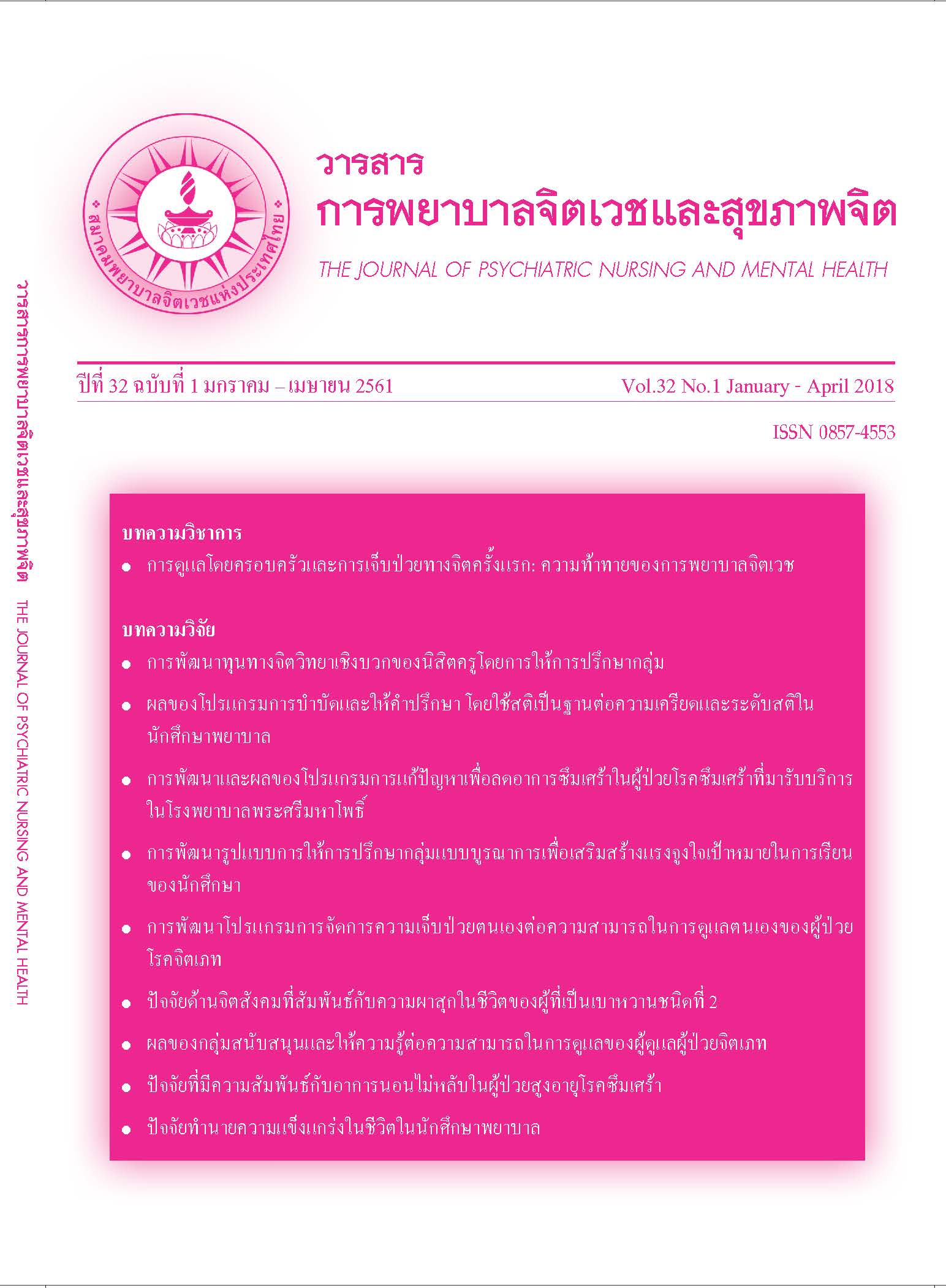
FACTORS RELATED TO INSOMNIA AMONG ELDERLY PATIENTS WITH MAJOR DEPRESSIVE DISORDER
Article Sidebar
Main Article Content
Abstract
Objectives: The objectives of this descriptive correlational research were to 1) examine insomnia among elderly patients with Major Depressive Disorder (MDD) and 2) study the relationships between gender, physiological arousal, cognitive arousal, depression, dysfunctional beliefs and attitudes about sleep, number of physical disorders and stressful life events and insomnia in elderly patients with Major Depressive Disorder (MDD).
Methods: A sample was 138 patients with major depressive disorder, aged ≥ 60 years, who were randomly selected from the outpatient department at general hospital. The research instruments were: 1) Personal Questionnaire, 2) Hamilton Rating Scale for Depression (HRS-D), 3) Insomnia Severity Index (ISI), 4) The Geriatric Social Readjustment Rating Scale (GSRRS), 5) Dysfunction belief and attitude scale (DBAS-16) and 6) Pre-Sleep Arousal Scale (PSAS). All instruments were verified for validity and reliability with Content Validity Index ranged from .86 - 1 and Chronbach Alpha ranged from .70 - .89, respectively. Data were analyzed by using descriptive statistics, Chi square, Spearman’s Rank and Pearson’s correlation Coefficient.
Results: 1) 81.2% of elderly patients with MDD experienced insomnia and 40.6 % were at severe level ( = 17.54, SD = 8.49). 2) Cognitive arousal and dysfunctional beliefs and attitudes about sleep were significantly and positively correlated with insomnia among elderly patients with MDD (r = .636, .607; p < .001, respectively). Physiological arousal and depression had significant and moderate positive correlation with insomnia (r = .558, .572; p < .001, respectively), and a number of physical disorders had significant and low positive correlation with insomnia among elderly patients with MDD (r = .243; p < .001). Gender and stressful life events were not significantly correlated with insomnia in elderly patients with MDD.
Article Details
บทความที่ได้รับการตีพิมพ์แล้ว เป็นลิขสิทธิ์ของสมาคมพยาบาลจิตเวชแห่งประเทศไทย
References
เทพฤทธิ์ วงศ์ภูมิ, จักรกฤษณ์ สุขยิ่ง และอุมาพร อุดมทรัพยากุล. (2554).ความชุกของโรคซึมเศร้าในประชากรสูงอายุจังหวัดเชียงใหม่.วารสารสมาคมจิตแพทย์แห่งประเทศไทย, 48(4), 103-116.
นิษา สมานทรัพย์. (2554). ปัจจัยคัดสรรที่มีความสัมพันธ์กับความสิ้นหวังในผู้ป่วยโรคซึมเศร้าวัยสูงอายุ.วิทยานิพนธ์ปริญญามหาบัณฑิต, จุฬาลงกรณ์มหาวิทยาลัย.
พัทรีญา แก้วแพง. (2547). ความสัมพันธ์ระหว่างปัจจัยคัดสรรกับอาการนอนไม่หลับในผู้ป่วยมะเร็งวัยผู้ใหญ่.วิทยานิพนธ์ปริญญามหาบัณฑิต, จุฬาลงกรณ์มหาวิทยาลัย.
มาโนช หล่อตระกูล และปราโมทย์สุคนิชย์. (2548). จิตเวชศาสตร์รามาธิบดี. (พิมพ์ครั้งที่ 2). กรุงเทพฯ: เอ็นเตอร์ไพรซ์.
รัตน์ศิริ ทาโต. (2552). การวิจัยทางการพยาบาลศาสตร์: แนวคิดสู่การประยุกต์ใช้. กรุงเทพ ฯ:โรงพิมพ์แห่งจุฬาลงกรณ์มหาวิทยาลัย.
ลัดดาวัลย์ พิบูลย์ศรี และสุนทรี ศรีโกไสย . (2557). การใช้ดัชนีชี้วัดการพยาบาลผู้ป่วยโรคซึมเศร้าที่เข้ารับการรักษาในโรงพยาบาล: ผลลัพธ์ด้านผู้ป่วยและพยาบาล. พยาบาลสาร, 41(1), 109-121.
สมภพ เรืองตระกูล. (2549). จิตเวชศาสตร์พื้นฐานและโรคทางจิตเวช. (พิมพ์ครั้งที่ 1). กรุงเทพฯ: เรือนแก้วการพิมพ์.
สุดารัตน์ ชัยอาจ และพวงพยอม ปัญญา. (2548). การนอนไม่หลับและปัจจัยที่เกี่ยวข้อง. วารสารสภาการพยาบาล, 20(2), 1-20.
สำนักงานสถิติแห่งชาติ. (2557). การสำรวจประชากรสูงอายุในประเทศไทย. เข้าถึงเมื่อ 20 พฤษภาคม 2560, จาก https://service.nso.go.th/ nso/nsopublish/themes/files/elderlyworkFullReport57-1.pdf
อัจฉราพร สี่หิรัญวงศ์. (2549). การประเมินอาการซึมเศร้า:ข้อคิดในการใช้เครื่องมือ. วารสารสภาการพยาบาล, 21(2), 17-30.
Benca, R. M., & Peterson, M. J. (2008). Insomnia and depression. Sleep Medicine, 9Suppl.1, s3-s9.
Blazer, D. G. (2003). Depression in late life:review and commentary. The Journal of Gerontology: Medical Sciences, 58, 249-65.
Bluestein, D., Rutledge, C. M., & Healey, A.C. (2010). Psychosocial correlates of insomnia severity in primary care. Journal of American Broad of Family Medicine, 23(2), 204-211.
Carney, C. E., Edinger, J. D., Manber, R., Garson, C., & Segal, Z. V. (2007). Beliefs about sleep in disorders characterized by sleep and mood disturbance. Journal of psychosomatic Research, 62(2), 179 - 88.
Gindin, J., Shochat, T., Chetrit, A., Epstein, S., Ben Israel, Y., Levi, S., et al. (2014). Insomnia in long-term care facilities: A comparison of seven European countries and Israel: The services and health for elderly in long-term care study. Clinical Investigations,
62(11), 2033-2039.
Graci, G. (2005). Pathogenesis and management of cancer-related insomnia. The Journal of Support Oncology, 3(5), 349-359.
Han, C., Jo, S. A., Jo, I., Kwak, J., Pae, C., Park, M. H., & Steffens, D. L. (2008). Validation of the Patient Health Questionnaire-9 Korean version in the elderly population: the Ansan Geriatric study. Comprehensive Psychiatry, 49(2), 218-23.
Hoertel, N., Strat, Y. L., Gorwood, P., Potelle, C. B., Schuster, J. P., Manetti, A., Dubertret, C., & Limosin, F. (2013). Why does the lifetime prevalence of major depressive disorder in the elderly appear to be lower than in younger adults? Results from a national
representative sample. Journal of Affective Disorders, 149, 160-165.
Kim, J., Kim, S., Stewart, R., Shin, I., Yang, S., & Yoon, J. (2009). Insomnia, depression, and physical disorders in late life: A 2-year longitudinal community study in Koreans. Sleep, 32(9), 1221-28.
Lee, E., Cho, J. H., Olmstead, R., Levin, J. M., Oxman, N. M., & Irwin, R. M. (2013). Persistent sleep disturbance: A risk factor for recurrent depression in community-dwelling older adults. Sleep, 36(11), 1685-91.
Lundh, L. G., & Broman, J. E. (2000). Insomnia as an interaction between sleep interfering and sleep interpreting processes. Journal of Psychosomatic Research, 49(5), 299-310.
Lundt, L., (2005). Use of the Epworth Sleepiness Scale to evaluate the symptom of excessive sleepiness in major depressive disorder. General Hospital Psychiatry, 27, 146-148.
Lushington, K., Dawson, D., & Lack, L. (2000). Core body temperature is elevated during constant wakefulness in elderly poor sleepers. Sleep, 23, 504–10.
Morin, C. M. (1993). Insomnia: Psychological assessment and management. NewYork: Guilford Press.
Nicassio, P. M., Mendlowitz, D. R., Fussell, J. J., & Petras, L. (1985). The phenomenology of the pre-sleep state: The development of the pre-sleep arousal scale. Behavior Research and Therapy, 23, 263-271.
Pigeon, W. R., Hegel, M., Unutzer, J., Fan, M. Y., Sateia, M. J., Lyness, J. M., et al. (2008). Is insomnia a perpetuating factor for late-life depression in the IMPACT cohort?. Sleep, 31(4), 481-488.
Reynolds, C. F., Frank, E., Houck, P. R., & Mazumdar, S. (1997). Which elderly patients with remitted depression remain well with continued interpersonal psychotherapy after discontinuation of antidepressant medication?. American Journal Psychiatry, 154(7),
958-962.
Spiegelhalder, K., Regen, W., Feige, B., Hirscher, V., Unbehaun, T., Nissen, C., Riemann, D., & Baglioni, C. (2012). Sleep-related arousal versus general cognitive arousal in primary insomnia. Journal of Clinical Sleep Medicine, 8(4), 431-7.
