
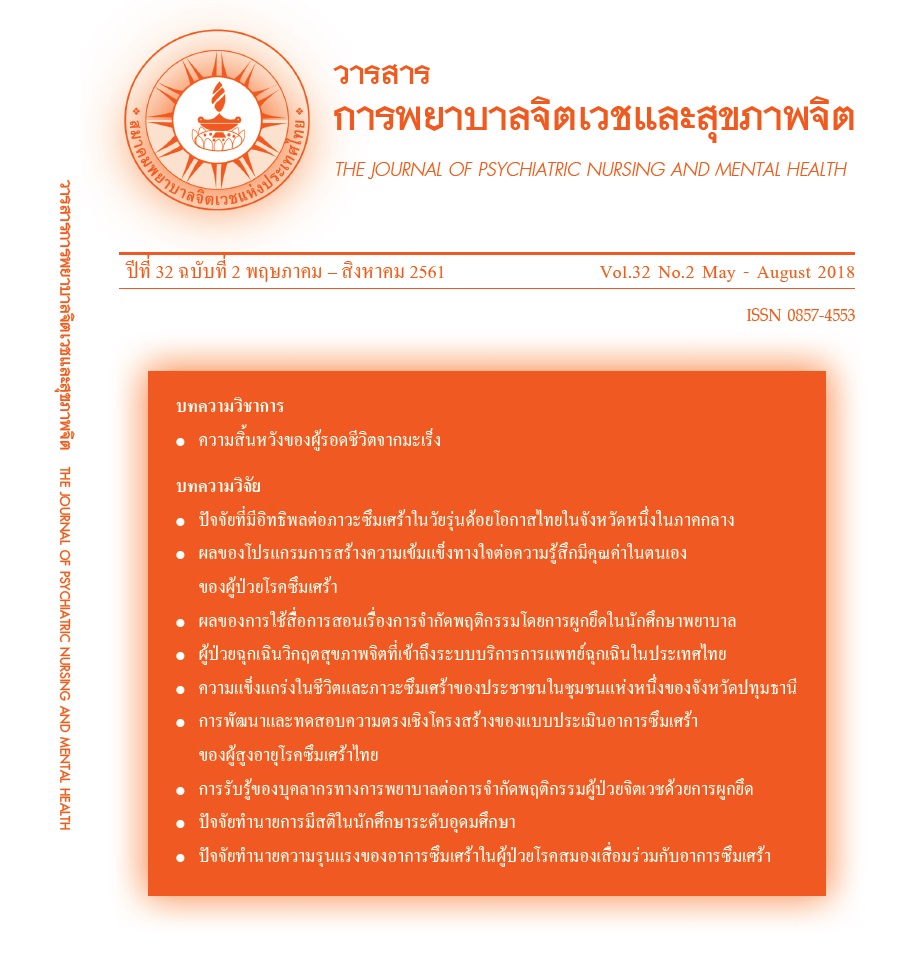
THE EFFECT OF RESILIENCE ENHANCEMENT PROGRAM ON SELF-ESTEEM OF DEPRESSIVE PATIENTS
Article Sidebar
Main Article Content
Abstract
Objectives: The purposes of this quasi-experimental research were to compare the self-esteem in depressive patients before and after receiving the resilience enhancement program, and to compare the self-esteem of patients who received the resilience enhancement program and those who received routine nursing care.
Methods: The samples were 40 patients with major depressive disorder who met the inclusion criteria and received services at the out-patient department in a hospital, Central Region. They were matched-pair with age and gender and then randomly assigned to the experimental and the control group, 20 subjects in each group. Research instruments consisted of: 1) The resilience enhancement program, and 2) Self-esteem scale. All instruments were verified for content validity by 5 professional experts. The reliability of the instrument was reported by Cronbach’s Alpha as of .87. Data were analyzed using descriptive statistics, dependent and independent t-test.
Results: The self-esteem of patients with major depressive disorder after receiving the resilience enhancement program was significantly higher than that before, at p.05 level. And the self-esteem of patients with major depressive disorder who received the resilience enhancement program were significantly higher than those who received routine nursing care at p.05 level.
Conclusion: The resilience enhancement program is effective in increasing self-esteem of other psychiatric disorder. The program promotes patients’ positive thoughts, and solve their problems.
Article Details
บทความที่ได้รับการตีพิมพ์แล้ว เป็นลิขสิทธิ์ของสมาคมพยาบาลจิตเวชแห่งประเทศไทย
References
กรรณิการ์ ผ่องโต. (2555). ผลของโปรแกรมเสริม สร้างความเข้มแข็งทางใจต่อความคิดฆ่า ตัวตายในผู้ที่พยายามฆ่าตัวตาย. วิทยานิพนธ์ พยาบาลศาสตรมหาบัณฑิต สาขาการ พยาบาลสุขภาพจิตและจิตเวช, คณะ พยาบาลศาสตร์, จุฬาลงกรณ์มหาวิทยาลัย.
ฐปนีย์ ตั้งจิตภักดีสกุล. (2545). ปัจจัยที่สัมพันธ์กับการเห็นคุณค่าในตนเองและความรู้สึก สิ้นหวังในเด็กและเยาวชนที่กระทำผิดใน สถานพินิจและคุ้มครองเด็กและเยาวชน กลาง. วิทยานิพนธ์มหาบัณฑิต วิทยาศาสตร์ (จิตวิทยาศึกษา) มหาวิทยาลัยมหิดล.
ณรงค์ สหเมธาพัฒน์. (2556). บทความเหตุการณ์ ความเครียด. สืบค้นเมื่อ 5 กุมภาพันธ์ 2557, จากwww.prachachat.net/news_detail.php
เทียนทอง หาระบุตร. (2555). ปัจจัยคัดสรรที่มี ความสัมพันธ์กับพลังสุขภาพจิตของผู้ดูแล ผู้ป่วยจิตเภทในชุมชน. วิทยานิพนธ์พยาบาล ศาสตรมหาบัณฑิต สาขาวิชาสุขภาพจิตและ การพยาบาลจิตเวช, คณะพยาบาลศาสตร์, จุฬาลงกรณ์มหาวิทยาลัย.
ธรณินทร์ กองสุข. (2558). โรคซึมเศร้าความ สูญเสียอันยิ่งใหญ่แห่งมวลมนุษยชาติ: การแก้ไขปัญหาความสูญเสียอันเนื่อง มาจากโรคซึมเศร้าและผลการดำเนินงาน ในระบบการแก้ไขปัญหาโรคซึมเศร้า ของไทย. การประชุมวิชาการสุขภาพจิต นานาชาติ ครั้งที่ 14 ประจำปี 2558. ณ โรงแรมมิราเคิลแกรนด์
คอนเวนชั่น, กรุงเทพฯ.
นพมาศ อุ้งพระ. (2555). จิตวิทยาสังคม (พิมพ์ ครั้งที่ 1). กรุงเทพฯ: มหาวิทยาลัยธรรมศาสตร์.
พรพรรณ สุดใจ และเพ็ญพักตร์ อุทิศ. (2555). ผลของโปรแกรมกลุ่มบำบัดทางจิตสังคม แบบบูรณาการต่อภาวะซึมเศร้าและการทำหน้าที่ทางสังคมของผู้ป่วยโรคซึมเศร้าใน ชุมชน. วารสารพยาบาลศาสตร์ จุฬาลงกรณ์ มหาวิทยาลัย, 24 (พิเศษ), 53-63.
พัชรี คำธิตา, อัมพวรรณ ถากาศ และชนากานต์ แสงสิงห์ชัย. (2550). รูปแบบการดูแลและ ช่วยเหลือผู้ที่พยายามฆ่าตัวตายซ้ำโดย กระบวนการสร้างความเข้มแข็งทางใจ. การประชุมวิชาการสุขภาพจิตนานาชาติ ครั้งที่ 6 เรื่อง สุขภาพจิต: ชีวิตชาวเมือง โรงแรมปรินซ์พาเลซ, กรุงเทพมหานคร.
รังสิมันต์ สุนทรไชยา. (2554). คู่มือการบำบัดทาง จิตสังคม (พิมพ์ครั้งที่ 1). นครปฐม: มิสเตอร์ ก๊อปปี้.
วชิระ เพ็งจันทร์. (2556). Quality of Life manager online. สืบค้นเมื่อ 5 กุมภาพันธ์ 2557, จาก www.manager.co.th
สมชาย จักรพันธุ์. (2551). สถานการณ์ข่าวสุขภาพ. สืบค้นเมื่อ 2 กุมภาพันธ์ 2557, จาก https:// www.hiso.or.th/hiso/health_event/ghealth
สำนักพัฒนาระบบข้อมูลข่าวสารสุขภาพ กระทรวง สาธารณสุข (2552). อัตราป่วยโรคซึมเศร้า. สืบค้นเมื่อ 2 พฤษภาคม 2558, จาก http// www.hiso.or.th/hiso/visualize/index.php
อรพรรณ ลือบุญธวัชชัย. (2554). การพยาบาล สุขภาพจิตและจิตเวช (พิมพ์ครั้งที่ 4). กรุงเทพมหานคร: จุฬาลงกรณ์มหาวิทยาลัย.
Beck, A. T. (1967). Depression: Clinical, experi¬mental, and theoretical aspects. New York: Hoeber.
Coopersmith, S. (1981). The Antecedent of self-Esteem 2. California: Consulting Psychologist.
De Raedt, R., Schacht, R., Franck, E., & De Houwer, J. (2006). Self-esteem and depression revisited: Implicit positive self-esteem in depressed patient? Behaviour Research and Therapy, 44, 1017-1028.
Franck, E., & Raedt, R. D. (2007). Self-esteem reconsidered : Unstable self –esteem outperforms level of self-esteem as vulnerability marker for depression. Behavior Research and Therapy, 45, 1531-1541
Grotberg, E. (1995). A guide to promoting resilience in children: Strengthening the human spirit. Retrieved Fabruary 2, 2014 from: https://resilience.uiuc.edu/library/ grotb95.html.
Grotberg, E. H. (1999). Countering depression with the five building blocks of resilience. Reaching Today’s Youth, 4, 66-72.
