
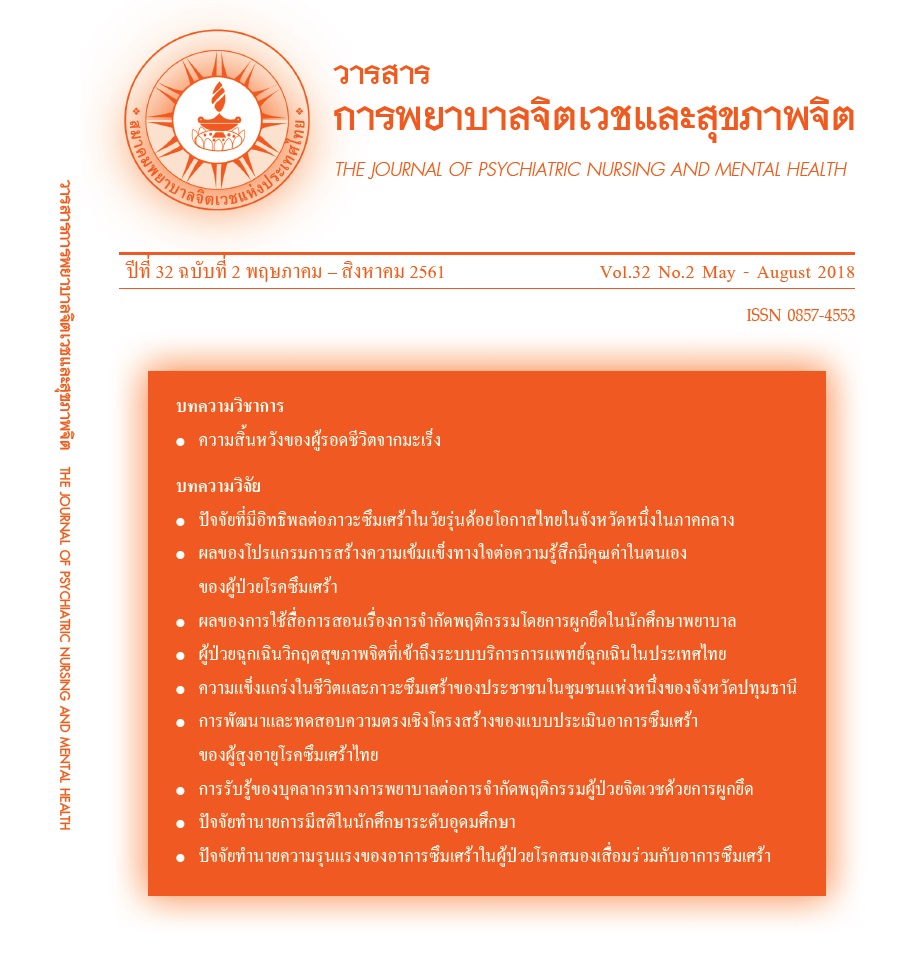
PERCEPTIONS OF NURSING STAFF ON LIMIT PSYCHIATRIC PATIENTS’ BEHAVIORS BY USING PHYSICAL RESTRAINT
Article Sidebar
Main Article Content
Abstract
Objective: To explore perceptions of nursing staff on limitting psychiatric patients’ behaviors by using physical restraint.
Methods: This qualitative research was conducted on 14 nursing staffs working in a psychiatric ward from a tertiary hospital in Bangkok. The participants were selected by purposive sampling and the inclusion criteria was having experienced in caring for physical restraint patients. Data were collected by using semi-structured in-depth interview. Data were analyzed by using content analysis
Results: Six themes were emerged in relation to perceptions of nursing staff on limitting psychiatric patients’ behaviors by using physical restraint as followed: 1) The purpose of physical restraint, 2) The physical restraint causes frustration and conflict, 3) The physical restraint has a negative impact on patients and relatives, 4) The physical restraint is a risk factor for nursing staffs, 5) Restraint is a treatment used to physically and psychologically care for patients throughout the process, and 6) Problems and obstacles affecting physical restraint performance.
Conclusion: Although physical restraint may have impact on patients, it is still an effective way to limit psychiatric patients’ behaviors. The findings of this study provided the basic knowledge for developing the effective nursing care guidelines for physical restraint.
Article Details
บทความที่ได้รับการตีพิมพ์แล้ว เป็นลิขสิทธิ์ของสมาคมพยาบาลจิตเวชแห่งประเทศไทย
References
นิภาพร ปานสวัสดิ์. (2559). คุณลักษณะของ พยาบาลวิชาชีพที่ได้รับรางวัลดีเด่นกับวิถี การสร้างบารมีของพระโพธิสัตว์. วารสาร สันติศึกษาปริทรรศน์ มจร, 4(2), 120- 132.
นันทวัช สิทธิรักษ์, ศิริรัตน์ คุปติวุฒิ, ณัฏฐา สายเสวย, วรภัทร รัตอาภา, พนม เกตุมาน, วีระนุช รอบสันติสุข และคณะ. (2552). แนวทางการดูแลผู้ป่วยที่ได้รับการผูกยึด. วารสารสมาคมจิตแพทย์แห่งประเทศไทย, 54(4), 385-398.
วิลาสินี หทัยพิทักษ์, อานนท์ วิทยานนท์ และ กมลรัชต์ ส่งวรกุลพันธ์. (2557). ผลของ การให้ข้อมูลย้อนกลับต่อความคับข้องใจ ของผู้ป่วยจิตเวชที่ถูกผูกมัดในโรงพยาบาล สงขลานครินทร์. สงขลานครินทร์เวชสาร, 32(5), 317-326.
สำนักงาน ก.พ. (2559). การสร้างทีมงานที่มี ประสิทธิภาพ. หนังสืออิเล็กทรอนิกส์. เข้าถึง เมื่อ 27 พ.ค. 61 จาก http://www.ocsc.go.th/.
Capezzuti, E., Strumpf, N. E., Evans, L. K., Grisso, J. A., & Maislin, G. (1998). The relationship between physical restraint removal and fall and injuries among nursing home residents. Journal of Gerontology: Medical Sciences, 53A(1), 47-52.
Gelkopf, M., Roffe, Z., Behrbalk, P., Melamed, Y., Werbloff, N., & Bleich, A. (2009). Attitudes, opinions, behaviors, and emotions of the nursing staff toward patient restraint. Issues in Mental Health Nursing, 30, 758-763.
Goulet, M. H. & Larue, C. (2016). Post- seclusion and/ or restraint review in psychiatry: A scoping review. Archives of Psychiatric Nursing, 30, 120-128.
Hendryx, M., Trusevich, Y., Coyle, F., Short, R., & Roll, J. (2010). The distribution and frequency of seclusion and/or restraint among psychiatric inpatients. Journal of Behavioral Health Services & Research, 37(2), 272-281.
Jiang, H., Li, C., Gu, Y., & He, Y. (2015). Nurses’ perceptions and practice of physical restraint in China. Nursing Ethics, 22(6), 652-660.
Lai, C. K. Y. (2007). Nurses using physical restraints: Are the accused also the victims? – A study using focus group interviews. BioMed Central Nursing, 6(5). doi:10.1186 /1472-6955-6-5
Laiho, T., Kattainen, E., Astedt-Kurki, P., Lindberg, N., & Kylma, J. (2013). Clinical decision making involved in secluding and restraint an adult psychiatric patient: An integrative literature review. Journal of Psychiatric and Mental Health Nursing, 20, 830-839.
Larue, C., Dumais, A., Boyer, R., Goulet, M. H., Bonin, J. P. & Baba, N. (2013). The experience of seclusion and restraint in psychiatric settings: Perspectives of patients. Issues in Mental Health Nursing, 34, 317-324.
Lancaster, G. A., Whitington, R., Lane, S., Riley, D., & Meehan, C. (2008). Does the position of restraint of disturbed psychiatric patients have any association with staff and patient injuries? Journal of Psychiatric and Mental Health Nursing, 15, 306–31.
Lee, S., Gray, R., Gournay, K., Wright, S., Parr, M., & Sayer, J. (2003). Views of nursing staff on the use of physical restraint. Journal of Psychiatric and Mental Health Nursing, 10, 425–430.
Mahmoud, A. B. (2017). Psychiatric nurses’ attitude and practice toward physical restraint. Archives of Psychiatric Nursing, 31, 2-7.
Marangos-Frost, S. & Well, D. (2000). Psychiatric nurses’ thoughts and feeling about restraint use: A decision dilemma. Journal Advanced Nursing, 31, 362-369.
Moghadam, M. F., Khoshknab, M. F., & Pazargadi, M. (2014). Psychiatric nurses’ perceptions about physical restraint; A qualitative study. International Journal of Community Based Nursing and Midwifery, 2(1), 20-30.
Mohr, W. K. (2010). Restraints and the code of ethics: An uneasy fit. Archives of Psychiatric Nursing, 24(1), 3-14.
Mohr, W., Petti, T., & Mohr, B. (2003). Adverse effects associated with physical restraint. Canadian Journal of Psychiatry, 48(5), 330–337.
Moylan, L. B. (2009). Physical restraint in acute care psychiatry a humanistic and realistic nursing approach. Journal of Psychosocial Nursing, 47(3), 41-47.
Oster, G., Gerance, A., Thomson, D., & Muir- Cochrane, E. (2016). Seclusion and restraint use in adult inpatient mental health care: An Australian perspective. Collegian, 23, 183-190.
Ralph, M., & Gabriele, M. (2014). Attitudes of nurses towards the use of physical restraints in geriatric care: A systematic review of qualitative and quantitative studies. International Journal of Nursing Studies, 51, 274-288.
Soininen, P., Valimaki, M., Noda, T., Puukka, P., Korkeila, J., Joffe, G., et al. (2013). Secluded and restrained patients’ perceptions of their treatment. International Journal of Mental Health Nursing, 22, 47-55.
Stewart, D., Bowers, L., Simpson, A., Ryan, C., & Tziggili, M. (2009). Manual restraint of adult psychiatric inpatients: A literature review. Journal of Psychiatric and Mental Health Nursing, 16, 749-757.
Suen, L. K. P., Lai, C. K. Y., Wong, T. K. S., Chow, S. K. Y., Kong, S. K. F., Ho. J. Y. L., et al. (2006). Use of physical restraints in rehabilitation setting: Staff knowledge, attitudes and predictors. Journal of Advanced Nursing, 55(1), 20-28.
Sze, T. W., Leng, C. Y., Lin, S. K. (2012). The effectiveness of physical restraints in reducing falls among adults in acute care hospitals and nursing homes: A systematic review. The Joanna Briggs Institute Library of Systematic Reviews, 10(5), 307-351.
The Joanna Briggs Institute. (2002). Physical restraint part 1: Use in acute and residential care facilities. Best practice: Evidence based practice information sheets for health professionals, 6(3), 1874-1879.
Vedana, K. G.G., Da Silva, D. M., Ventura, C. A. A., Giacon, B. C. C., Zanetti, A. C. G., Maiasso, A. I., et al. (2018). Physical and mechanical restraint in psychiatric units: Perceptions and experiences of nursing staff. Archives of Psychiatric Nursing, 32, 367-372.
