
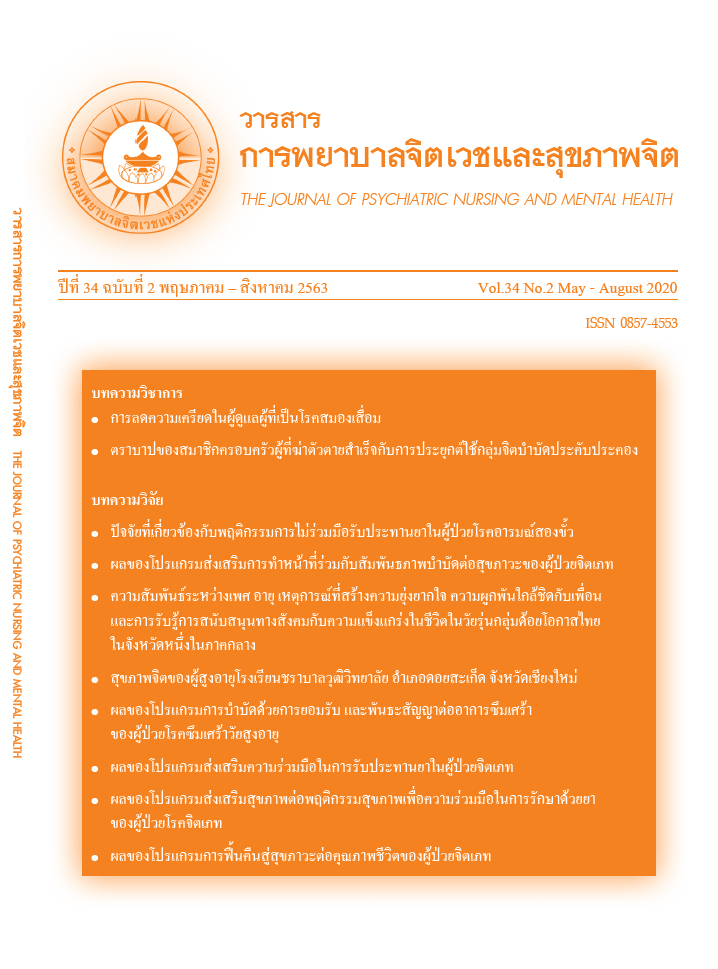
FACTORS ASSOCIATED WITH MEDICATION NONADHERENCE BEHAVIOR AMONG PERSONS WITH BIPOLAR DISORDER
Article Sidebar
Main Article Content
Abstract
Objectives: This descriptive correlational study examined relationships between age, occupational status, attitude towards medication, frequency of medication intake per day, medication side effects, and social support with medication nonadherence behavior in patients with Bipolar Disorder.
Methods: The participants were 84 persons with Bipolar Disorder who met the inclusion criteria, visiting in psychiatric outpatient clinic of a university hospital in Bangkok, Thailand. Data were collected by interview using five questionnaires including socio-demographic questionnaires, Drug Attitude Inventory-10, Liverpool University Neuroleptic Side Effect Rating Scale, Medical outcomes Study Social Support Survey and Medication Adherence Report Scale. Descriptive statistics, Spearman’s rank-order correlation, and Point-Biserial correlation were used for data analysis.
Results: Results showed that persons with Bipolar disorder who have positive attitude towards medication and having high score on social support are more likely to have high medication adherence behavior or to have low medication nonadherence behavior (rs = .263, .245, p < .05, respectively). And patients who have high frequency of medication intake per day and having high score on medication side
effects are less likely to have low medication adherence behavior or to have high medication nonadherence behavior (rs = -.258, -.282, p < .05, respectively). Age and occupational status were not correlated to medication nonadherence.
Conclusion: Results from this study provided important information for use to plan for enhancing medication adherence behavior in patients with Bipolar Disorder.
Article Details
บทความที่ได้รับการตีพิมพ์แล้ว เป็นลิขสิทธิ์ของสมาคมพยาบาลจิตเวชแห่งประเทศไทย
References
คลังข้อมูลการแพทย์และสุขภาพ กระทรวง สาธารณสุข. (2561ก). จำนวนผู้ป่วยนอก จิตเวชที่มารับบริการจำแนกรายกลุ่มโรค และสิทธิ ปี 2561. สืบค้นเมื่อ 11 มีนาคม 2562, จาก https://hdcservice.moph.go.th/ hdc/reports/report.php?source=pformated/ format_fix_col2.php&cat_id=ea11bc4bbf 333b78e6f53a26f7ab6c89&id=67ce3cd10 f4ed5d2b3517f1373ef273d
เติมทรัพย์ จั่นเพชร. (2557). การพัฒนาตนเองของ ผู้ใหญ่ Self Development of Adults. วารสาร เกื้อการุณย์, 21(1), 17-23.
นันทศักดิ์ ธรรมานวัตร์ และกฤษณา ตรียมณีรัตน์. (2559). เมื่อย่างเข้าสู่การเป็นผู้สูงอายุ. สืบค้นเมื่อ 28 มิถุนายน 2561, จาก http:// www.thaicam.go.th/index.php?option= com_content& view=article&id=336:2010- 10-01-04-07-50&catid=81:2010-08-06-03- 4356&Itemid =147
ธวัชชัย ลีฬหานาจ. (2549). การรักษา Bipolar Disorder: หลักการทั่วไป. ใน ธวัชชัย ลีฬหานาจ และสรยุทธ วาสิกนานนนท์ (บ.ก.), ตำราโรคไบโพล่าร์ (หน้า 91–106). กรุงเทพฯ: สมาคมจิตแพทย์แห่งประเทศไทย.
พิชัย อิฏฐสกุล. (2558). โรคอารมณ์สองขั้ว. ใน มาโนช หล่อตระกูล และปราโมชย์ สุคนิชย์ (บ.ก.), ตำราจิตเวชศาสตร์รามาธิบดี (หน้า 155-166). กรุงเทพฯ: ภาควิชาจิตเวชศาสตร์ คณะแพทยศาสตร์โรงพยาบาลรามาธิบดี มหาวิทยาลัยมหิดล.
พันธุ์นภา กิตติรัตนไพบูลย์, ธรณินทร์ กองสุข, วชิระ เพ็งจันทร์, จินตนา ลี้จงเพิ่มพูน, วรวรรณ จุฑา, และเกษราภรณ์ เคนบุปผา. (2556). ระบาดวิทยาโรคจิตเวชร่วมใน คนไทย: การศึกษาระดับชาติ 2551. วารสาร สุขภาพจิตแห่งประเทศไทย, 21(1), 1-14.
ภควัต วิวัฒนวรเศรษฐ์ และจารุรินทร์ ปิตานุพงศ์. (2560). คุณภาพชีวิตของผู้ป่วยโรคอารมณ์ สองขั้วในโรงพยาบาลสงขลานครินทร์. วารสารสมาคมจิตแพทย์แห่งประเทศไทย, 62(4), 299-308.
รณชัย คงสกนธ์, สมบัติ ศาสตร์รุ่งภัค, อวยชัย โรจนนิรันกิจ, และอุไร บูรณเชษฐ. (2546). การพัฒนาแบบประเมิน Montgomery Asberg Depression Rating Scale (MADRS) ฉบับภาษาไทย. วารสารสมาคมจิตแพทย์ แห่งประเทศไทย, 48(4), 211-219.
โศรดา สุรเทวมิตร และรังสิมันต์ สุนทรไชยา. (2554). ปัจจัยคัดสรรที่สัมพันธ์กับการทำหน้าที่ของผู้ป่วยโรคอารมณ์แปรปรวน สองขั้ว. วารสารการพยาบาลจิตเวชและ สุขภาพจิต, 25(1), 63-74.
สำนักพัฒนานโยบายสุขภาพระหว่างประเทศ. (2551). การศึกษาค่าความสูญเสียปีสุขภาวะ เนื่องจากความบกพร่องทางสุขภาพจาก ความผิดปกติทางจิตของประชากรไทย พ.ศ.2547. กรุงเทพฯ: สถาบันวิจัยระบบ สาธารณสุข.
American Psychiatric Association [APA]. (2013). Diagnostic and statistical manual of mental disorders. (5th ed.). Arlington, VA: American Psychiatric.
American Psychiatric Association. (2015). What are bipolar disorders? Retrieved April 25, 2016, from https://www.psychiatry.org/ patients-families/bipolar-disorders/what-are-bipolar-disorders.
Baldessarini, R. J., Perry, R., & Pike, J. (2008). Factors associated with treatment nonadherence among US bipolar disorder patients. Human Psychopharmacology, 23(2), 95-105. doi:10.1002/hup.908
Bates, J. A., Whitehead, R., Bolge, S. C., & Kim, E. (2010). Correlates of medication adherence among patients with bipolar disorder: Results of the bipolar evaluation of satisfaction and tolerability (best) study: A nationwide cross-sectional survey. Primary Care Companion to The Journal of Clinical Psychiatry, 12(5), PCC.09m00883. doi:10.4088/PCC.09m00883yel
Bauer, R., Glenn, T., Alda, M., Sagduyu, K., Marsh, W., Grof, P., et al. (2013). Antidepressant dosage taken by patients with bipolar disorder: Factors associated with irregularity. International Journal of Bipolar Disorders, 1(26). doi:10.1186/2194- 7511-1-26
Bener, A., Dafeeah, E. E., & Salem, M. O. (2013). A study of reasons of non-compliance of psychiatric treatment and patients’ attitudes towards illness and treatment in Qatar. Issues in Mental Health Nursing, 34(4), 273-280. doi:10.3109/01612840.20 12.745039
Berk, L., Hallam, K. T., Colom, F., Vieta, E., Hasty, M., Macneil, C., et al. (2010). Enhancing medication adherence in patients with bipolar disorder. Human Psychopharmacology, 25(1), 1-16. doi: 10.1002/hup.1081
Bressert, S. (2018). Cyclothymic disorder symptoms & cyclothymia. Retrieved on August 17, 2018, from https://psychcentral. com/disorders/cyclothymic-disorder-cyclothymia/
Chaiyajan, W., Sitthimongkol, Y., Yuttatri, P., & Klainin, P. (2009). Effects of a psychoeducational program on attitude toward medication and compliance with first appointment after discharge in schizophrenic patients. Journal of Nursing Science, 27(3), 73 – 81.
Chapman, S. C., & Horne, R. (2013). Medication nonadherence and psychiatry. Current Opinion in Psychiatry, 26(5), 446-452. doi:10.1097/YCO.0b013e3283642da4
Cohen, J. (1988). Statistical power analysis for the behavioral sciences. (2nd ed.). Hillsdale, NJ: Lawrence Erlbaum Associates.
Col, S. E., Caykoylu, A., Karakas-Ugurlu, G., & Ugurlu, M. (2014). Factors affecting treatment compliance in patients with bipolar I disorder during prophylaxis: A study from Turkey. General Hospital Psychiatry, 36(2), 208-213. doi:10.1016/j. genhosppsych. 2013.11.006
Correard, N., Consoloni, J-L., Raust, A., Etain, B., Guillot, R., Job, S., et al. (2017). Neuropsychological functioning, age, and medication adherence in bipolar disorder. Public Library of Science ONE, 12(9), e0184313. doi:10.1371/journal. pone.0184313
Day, J. C., Wood, G., Dewey, M., & Bentall, R. P. (1995). A self-rating scale for measuring neuroleptic side-effects: Validation in a group of schizophrenic patients. British Journal of Psychiatry, 166(5), 650-653.
Depp, C. A., & Lebowitz, B. D. (2007). Enhancing medication adherence: In older adults with bipolar disorder. Psychiatry (Edgmont), 4(6), 22-32.
Depp, C. A., Moore, D. J., Patterson, T. L., Lebowitz, B. D., & Jeste, D. V. (2008). Psychosocial interventions and medication adherence in bipolar disorder. Dialogues in Clinical Neuroscience, 10(2), 239-250.
Ghaffari-Nejad, A., Mashayekhi, A., Mazhari, S., & Ghayoumi, A. (2014). Factors associated with drug non-adherence after discharge among patients with mood disorders hospitalized in Shahid Beheshti Hospital in Kerman: A prospective study. Zahedan Journal of Research in Medical Sciences, 17(4), e968.
Herrmann, N., Black, S. E., Lawrence, J., Szekely, C., & Szalai, J. P. (1998). The Sunnybrook Stroke Study: A prospective study of depressive symptoms and functional outcome. Stroke, 29(3), 618-624.
Hibdye, G., Dessalegne, Y., Debero, N., Bekan, L., & Sintayehu, M. (2015). Prevalence of drug non adherence and associated factors among patients with bipolar disorder at outpatient unit of Amanuel Hospital, Addis Ababa, Ethiopia, 2013. Journal of Psychiatry, S1(003). doi:10.4172/2378- 5756.S1-003
Hogan, T. P., Awad, A. G., & Eastwood, R. (1983). A self-report scale predictive of drug compliance in schizophrenics: Reliability and discriminative validity. Psychological Medicine, 13(1), 177-183.
Horne, R. (1996). The medication adherence report scale (MARS). Hastings, UK: University of Brighton.
Ibrahim, A. W., Pindar, S. K., Yerima, M. M., Rabbebe, I. B., Shehu, S., Garkuwa, H. A., et al. (2015). Medication-related factors of non-adherence among patients with schizophrenia and bipolar disorder: Outcome of a cross-sectional survey in Maiduguri, North-eastern Nigeria. Journal of Neuroscience and Behavioral Health, 7(5), 31-39. doi:10.5897/JNBH2015.0128
Jawad, I., Watson, S., Haddad, P. M., Talbot, P. S., & McAllister-Williams, R. H. (2018). Medication nonadherence in bipolar disorder: A narrative review. Therapeutic Advances in Psychopharmacology, 8(12), 349-363. doi:10.1177/2045125318804364
Jonsdottir, H., Opjordsmoen, S., Birkenaes, A. B., Simonsen, C., Engh, J. A., Ringen, P. A., et al. (2013). Predictors of medication adherence in patients with schizophrenia and bipolar disorder. Acta Psychiatrica Scandinavica, 127(1), 23-33. doi:10.1111/ j.1600-0447.2012.01911.x
Kongsakon, R., & Bhatanaprabhabhan, D. (2005). Validity and reliability of the young mania rating scale: Thai version. Journal of the Medical Association of Thailand, 88(11), 1598-1604.
Kriegshauser, K., Sajatovic, M., Jenkins, J. H., Cassidy, K. A., Muzina, D., Fattal, O., et al. (2010). Gender differences in subjective experience and treatment of bipolar disorder. The Journal of Nervous and Mental Disease, 198(5), 370-372. doi: 10.1097/NMD.0b013e3181da8ef7
Kutzelnigg, A., Kopeinig, M., Chen, C. K., Fábián, Á., Pujol-Luna, M. G., Shin, Y., et al., (2014). Compliance as a stable function in the treatment course of bipolar disorder in patients stabilized on olanzapine: Results from a 24-month observational study. International Journal of Bipolar Disorders, 2(13). doi:10.1186/s40345-014-0013-x
Leelahanaj, T., Kongsakon, R., Choovanichvong, S., Tangwongchai, S., Paholpak, S., Kongsuk, T., et al. (2013). Time to relapse and remission of bipolar disorder: Findings from a 1-year prospective study in Thailand. Neuropsychiatric Disease and Treatment, 9, 1249-1256. doi:10.2147/ndt.s47711
Maneesakorn, S., Robson, D., Gournay, K., & Gray, R. (2007). An RCT of adherence therapy for people with schizophrenia in Chiang Mai, Thailand. Journal of Clinical Nursing, 16(7), 1302-1312. doi:10.1111/ j.1365-2702.2007.01786.x
Merikangas, K. R., Jin, R., He, J. P., Kessler, R. C., Lee, S., Sampson, N. A., et al. (2011). Prevalence and correlates of bipolar spectrum disorder in the world mental health survey initiative. Archives of General Psychiatry, 68(3), 241-251.
Miasso, A. I., Monteschi, M., & Giacchero, K. G. (2009). Bipolar affective disorder: Medication adherence and satisfaction with treatment and guidance by the health team in a mental health service. Revista Latino- Americana de Enfermagem, 17(4), 548-556.
Moljord, I. E. O., Lara-Cabrera, M. L., Perestelo- Pérez, L., Rivero-Santana, A., Eriksen, L., & Linaker, O. M. (2015). Psychometric properties of the Patient Activation Measure-13 among out-patients waiting for mental health treatment: A validation study in Norway. Patient Education and Counseling, 98(11), 1410-1417.
Montes, J. M., Maurino, J., de Dios, C., & Medina, E. (2013). Suboptimal treatment adherence in bipolar disorder: Impact on clinical outcomes and functioning. Patient Prefer Adherence, 7, 89-94. doi:10.2147/ppa. s39290
Montgomery, S. A., & Asberg, M. (1979). A new depression scale designed to be sensitive to change. British Journal of Psychiatry, 134, 382-389.
Morselli, P. L., Elgie, R., & Cesana, B. M. (2004). GAMIAN-Europe/BEAM survey II: Cross-national analysis of unemployment, family history, treatment satisfaction and impact of the bipolar disorder on life style. Bipolar Disorders, 6, 487–497.
National Institute of Mental Health. (2016). Bipolar disorder. Retrieved July 10, 2016, from https://www.nimh.nih.gov/health/ topics/bipolar-disorder/index.shtml.
Novick, D., Montgomery, W., Treuer, T., Aguado, J., Kraemer, S., & Haro, J. M. (2015). Relationship of insight with medication adherence and the impact on outcomes in patients with schizophrenia and bipolar disorder: Results from a 1-year European outpatient observational study. BioMed Central Psychiatry, 15(189). doi:http://doi. org/10.1186/s12888-015-0560-4
Pareek, B., & Kalia, R. (2013). Factors affecting non-compliance to psychotropic drugs of patients with psychosis as perceived by their family members attending the psychiatric outpatient department at selected hospital, Mangalore. Nursing and Midwifery Research Journal, 9(2), 56-62.
Rabinovitch, M., Cassidy, C., Schmitz, N., Joober, R., & Malla, A. (2013). The influence of perceived social support on medication adherence in first-episode psychosis. Canadian Journal of Psychiatry, 58(1), 59-65. doi:10.1177/070674371305800111
Rungruangsiripan, M., Sitthimongkol, Y., Maneesriwongul, W., Talley, S., & Vorapongsathorn, T. (2011). Mediating role of illness representation among social support, therapeutic alliance, experience of medication side effects, and medication adherence in persons with schizophrenia. Archives of Psychiatric Nursing, 25(4), 269-283.
Ruscher, S. M., de Wit, R., & Mazmanian, D. (1997). Psychiatric patients’ attitudes about medication and factors affecting noncompliance. Psychiatric Services, 48(1), 82-85. doi:10.1176/ps.48.1.82
Sajatovic, M., Ignacio, R. V., West, J. A., Cassidy, K. A., Safavi, R., Kilbourne, A. M., et al. (2009). Predictors of non-adherence among individuals with bipolar disorder receiving treatment in a community mental health clinic. Comprehensive Psychiatry, 50(2), 100–107.
Sajatovic, M., Valenstein, M., Blow, F. C., Ganoczy, D., & Ignacio, R. V. (2006). Treatment adherence with antipsychotic medications in bipolar disorder. Bipolar Disorders, 8(3), 232-241. doi:10.1111/ j.1399-5618.2006.00314.x
Sajatovic, M., Valenstein, M., Blow, F., Ganoczy, D., & Ignacio, R. (2007). Treatment adherence with lithium and anticonvulsant medications among patients with bipolar disorder. Psychiatric Services, 58(6), 855-863. doi:10.1176/ps.2007.58.6.855
Savas, H. A., Unal, A., & Vırıt, O. (2011). Treatment adherence in bipolar disorder. Journal of Mood Disorders, 1(3), 95-102. doi: 10.5455/jmood.20110827015615
Sharifi, A., Shabani, A., & Ahmadzad-Asl, M. (2009). The pattern of adherence in patients with bipolar I disorder an eight weeks study. Iranian Journal of Psychiatry and Behavioral Sciences, 3(2), 39-43.
Sherbourne, C. D., & Stewart, A. L. (1991). The MOS social support survey. Social Science and Medicine, 32(6), 705-714.
Stentzel, U., van den Berg, N., Schulze, L. N., Schwaneberg, T., Radicke, F., Langosch, J. M., et al. (2018). Predictors of medication adherence among patients with severe psychiatric disorders: Findings from the baseline assessment of a randomized controlled trial (Tecla). BioMed Central Psychiatry, 18, 155. doi:10.1186/s12888- 018-1737-4
Taj, F., Tanwir, M., Aly, Z., Khowajah, A. A., Tariq, A., Syed, F. K. et al. (2008). Factors associated with non-adherence among psychiatric patients at a tertiary care hospital, Karachi, Pakistan: A questionnaire based cross-sectional study. Journal of Pakistan Medical Association, 58(8), 432-436.
Tang, C. H., Hsieh, M. H., Hung, S. T., Lee, I. H., Lin, Y. J., & Yang, Y. K. (2010). One-year post-hospital medical costs and relapse rates of bipolar disorder patients in Taiwan: A population-based study. Bipolar Disorders, 12(8), 859-865. doi: 10.1111/j.1399-5618.2010.00878.x
Teferra, S., Hanlon, C., Beyero, T., Jacobsson, L., & Shibre, T. (2013). Perspectives on reasons for non-adherence to medication in persons with schizophrenia in Ethiopia: A qualitative study of patients, caregivers and health workers. BioMed Central Psychiatry, 13(1), 168. doi:10.1186/1471- 244x-13-168
Velligan, D. I., Weiden, P. J., Sajatovic, M., Scott, J., Carpenter, D., Ross, R., et al. (2009). The expert consensus guideline series: Adherence problems in patients with serious and persistent mental illness. Journal of Clinical Psychiatry, 70(Suppl 4), 1-37.
Velligan, D. I., Weiden, P. J., Sajatovic, M., Scott, J., Carpenter, D., Ross, R., et al. (2010). Assessment of adherence problems in patients with serious and persistent mental illness: Recommendations from the expert consensus guidelines. Journal of Psychiatric Practice, 16(1), 34-45. doi: 10.1097/01.pra.0000367776.96012.ca
Vieta, E., Azorin, J. M., Bauer, M., Frangou, S., Perugi, G., Martinez, G., et al. (2012). Psychiatrists’ perceptions of potential reasons for non- and partial adherence to medication: Results of a survey in bipolar disorder from eight European countries. Journal of Affective Disorders, 143(1-3), 125-130. doi:10.1016/j.jad.2012.05.041
World Health Organization [WHO]. (1999). The world health report. Geneva: World Health.
World Health Organization. (2017). Mental disorder. Retrieved January 17, 2016, from http://www.who.int/mediacentre/ factsheets/fs396/en/.
Young, R. C., Biggs, J. T., Ziegler, V. E., & Meyer, D. A. (1978). A rating scale for mania: Reliability, validity and sensitivity. British Journal of Psychiatry, 133, 429-435.
