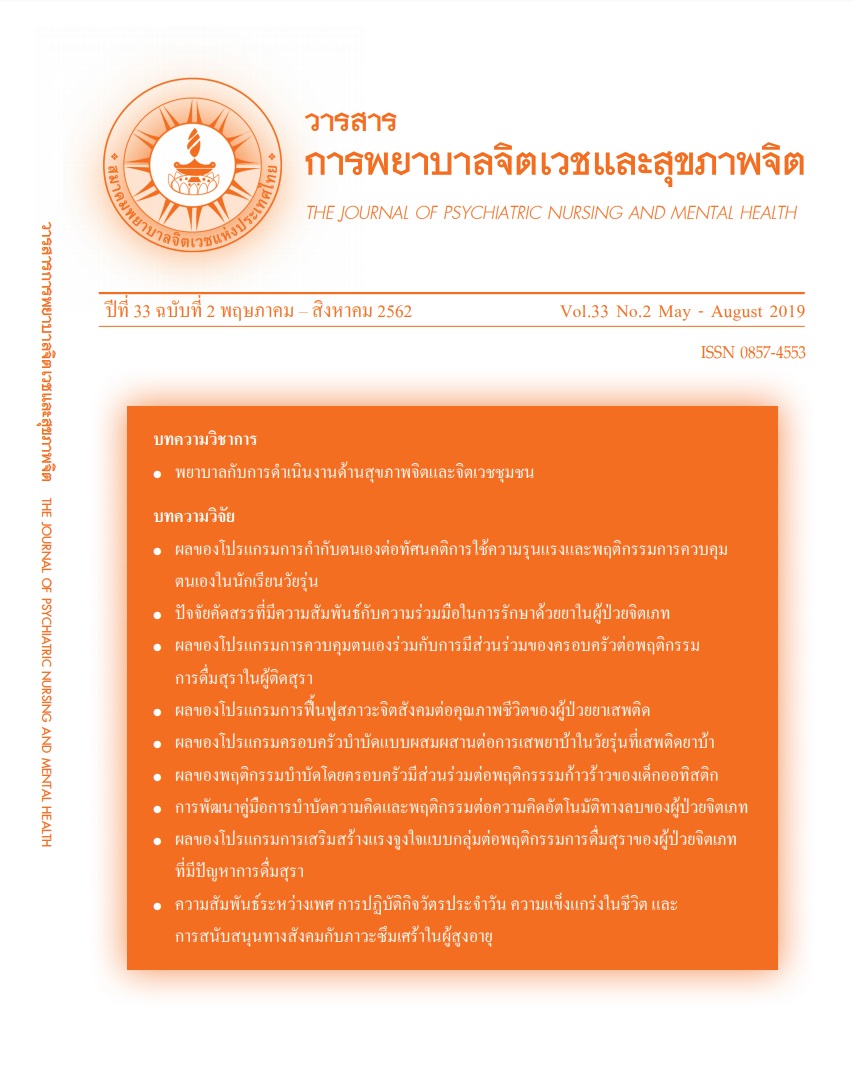
THE EFFECT OF SELF - CONTROL WITH FAMILY PARTICIPATION PROGRAM ON ALCOHOL DRINKING BEHAVIORS OF ALCOHOL DEPENDENCE
Article Sidebar
Main Article Content
Abstract
Objectives: The purposes of this quasi-experimental research were to compare the alcohol drinking behavior of alcohol dependence patients before and after receiving the self-control with family participation program, and to compare the alcohol drinking behavior between the experimental group who participated in the self-control with family participation program and the control group.
Methods: The samples were 40 male with alcohol dependence and their family caregivers receiving care in inpatient service who met inclusion criteria. They were matched pair and then randomly assigned into experimental group and control group with 20 subjects in each group. Research instruments comprised of: 1) The self-control with family participation program, and 2) Alcohol Use Disorders Identification Test. All instruments were verified for content validity by 5 professional experts. The reliability of the instrument was reported by Cronbach’s Alpha as of .81. Data were analyzed using descriptive statistics and t-test.
Results:
The alcohol drinking behavior of alcohol dependence patients after receiving the self-control with family participation program was significantly lower than that before (p <.05).
The alcohol drinking behavior of alcohol dependence patients who received the self-control with family participation program was significantly lower than that of the group who received regular caring (p <.05).
Article Details
บทความที่ได้รับการตีพิมพ์แล้ว เป็นลิขสิทธิ์ของสมาคมพยาบาลจิตเวชแห่งประเทศไทย
References
บัณฑิต ศรไพศาล. (2550). รายงานสถานการณ์สุรา ประจำปี พ.ศ. 2550. กรุงเทพฯ: ศูนย์วิจัยปัญหาสุรา
ปนัดดา ธีระเชื้อ, หรรษา เศรษฐบุปผา และ สิริลักษณ์ วรรธนะพงษ์. (2550). ผลของโปรแกรมการควบคุมตนเองต่อพฤติกรรมการดื่มของผู้ติดสุรา. พยาบาลสาร, 35(3), 142-153.
ปริทรรศ ศิลปะกิจ และพันธุ์นภา กิตติรัตนไพบูลย์. (2552). แบบประเมินปัญหาการดื่มสุราแนวปฏิบัติสำหรับสถานพยาบาลปฐมภูมิ. กรุงเทพมหานคร: ทานตะวันเปเปอร์.
พัชชราวลัย กนกจรรยา. (2554). ผลของโปรแกรมการบำบัดผสมผสานแบบสั้นโดยการใช้การเสริมสร้างแรงจูงใจร่วมกับการปรับเปลี่ยนความคิดและพฤติกรรมต่อภาวะซึมเศร้า และพฤติกรรมการเสพสุราในผู้เสพติดสุรา. วิทยานิพนธ์ปริญญามหาบัณฑิต สาขาวิชาการพยาบาลสุขภาพจิตและจิตเวช, คณะ พยาบาลศาสตร์, จุฬาลงกรณ์มหาวิทยาลัย.
พันธุ์นภา กิตติรัตนไพบูลย์. (2553). คู่มือสำหรับผู้อบรมการดูแลผู้มีปัญหาการดื่มสุราเบื้องต้นสำหรับบุคลากรสุขภาพ. เชียงใหม่: วนิดาการพิมพ์.
พันธุ์นภา กิตติรัตน์ไพบูลย์ และสุนันท์ จำรูญสวัสดิ์ .(2557). สรุปบทเรียนการนิเทศโครงการ พัฒนารูปแบบการดูแลผู้มีปัญหาการดื่มสุราในระบบสุขภาพ. แผนงานการพัฒนาระบบ รูปแบบและวิธีการบำบัดรักษาผู้มีปัญหา การบริโภคสุราแบบบูรณาการ. เชียงใหม่: วนิดาการพิมพ์.
พิชัย แสงชาญชัย. (2552). จิตสังคมบำบัดสำหรับผู้ติดสุรา. แผนงานการพัฒนาระบบรูปแบบและวิธีการบำบัดรักษาผู้มีปัญหาการบริโภค สุราแบบบูรณาการ. เชียงใหม่: วนิดา การพิมพ์.
พิทักษ์ สุริยะใจ และคณะ. (2550). การสนับสนุนทางสังคมกับการหยุดดื่มของผู้ติดสุรา. ศูนย์บำบัดรักษายาเสพติดเชียงใหม่. กรมการแพทย์ กระทรวงสาธารณสุข.
มะลิ แสวงผล. (2556). ผลของโปรแกรมการฝึกควบคุมพฤติกรรมตนเองต่อการบริโภคแอลกอฮอล์ของผู้เสพติดแอลกอฮอล์ชายที่ได้รับการบำบัดด้วยยา. วิทยานิพนธ์ปริญญามหาบัณฑิต สาขาวิชาการพยาบาลสุขภาพจิตและจิตเวช, คณะพยาบาลศาสตร์, จุฬาลงกรณ์มหาวิทยาลัย.
โรงพยาบาลพระศรีมหาโพธิ์. (2557). สถิติผู้ป่วยโรงพยาบาลพระศรีมหาโพธิ์. ศูนย์สารสนเทศ โรงพยาบาลพระศรีมหาโพธิ์.
สดุดี น้อยกรณ์. (2552). ปัจจัยทำนายการมีส่วนร่วมของครอบครัวในการลดพฤติกรรมการดื่มสุราในผู้ป่วยติดสุรา. วิทยานิพนธ์ปริญญามหาบัณฑิต สาขาวิชาการพยาบาลสุขภาพจิต และจิตเวช, คณะพยาบาลศาสตร์, มหาวิทยาลัยธรรมศาสตร์.
สำนักงานสถิติแห่งชาติ. (2554). การสำรวจพฤติกรรมการสูบบุหรี่และการดื่มสุราของประชากร พ.ศ. 2554. กรุงเทพมหานคร: กองสถิติสังคมสำนักงานสถิติแห่งชาติ
Carey, M. P., Carey, K. B., Carnrike, C. L. Jr, Meisler, A. W. (1990). Learned resource¬fulness, drinking, And smoking in young adults. The Journal of Psychology, 124(4), 391-395.
Copello, A. G., Velleman, R. D., Templeton, L. J. (2005). Family interventions in the treatment of alcohol and drug problems. Drug Alcohol Rev, 24, 369 - 385.
Friedman, M. (2003). Family Nursing: Theory and Practice (5th ed). Stamford. CT: Appleton & Lange.
Hull, J. G., & Slone, L. B. (2004). Alcohol and self-regulation. Handbook of self-regulation: Research, theory, and applications, 466-491.
Panitrat, R. (2001). The relationships among dysfunctional attitudes, learned resource¬fulness, and amphetamine use in Thai adolescents. Unpublished doctoral dissertation, Case Western Reserve University, Ohio.
Piquero, A. R., Gibson, C. L., & Tibbetts, S. G. (2002). Does self - control account for the relationship between binge drinking and alcohol-related behaviors. Criminal Behavior and Mental Health 12(2), 135-154.
Pokhrel, P., Sussman, S., Rohrbach, L. A., & Sun, P. (2007). Prospective associations of social self-control with drug use among youth from regular and alternative high schools. Substance Abuse Treatment, Prevention, and Policy, 2(22), 1-8.
Rosenbaum, M. (1980). A schedule for assessing self-control behaviors, preliminary finding. Behavior Therapy, 11, 109-121.
Rosembaum, M. (1990). Learned Resourcefulness: on coping skill, Self - control, and adaptive behavior. New York, Springer Publishing Company.
Slattery, J., Chick, J., Cochrane, M., Craig, J., Godfrey, C., Kohli, H., et al. (2003). Prevention of Relapse in Alcohol Dependence; HTA Advice 3. Health Technology Board for Scotland, Glasgow.
Sussman, S., McCuller, W. J., & Dent, C. W. (2003). The associations of social self- control, personality disorders, and demographics with drug use among high risk youth. Addictive Behavior, 28(6), 1159 -1166.
World Health Organization. (2001) . AUDIT: The Alcohol Use Disorders Identification Test: Guidelines for use in primary health care. (2nd ed). Geneva: World Health Organization.
World Health Organization. (2011). Global Status Report on Alcohol and Health. Geneva, Switzerland: World Health Organization.
