
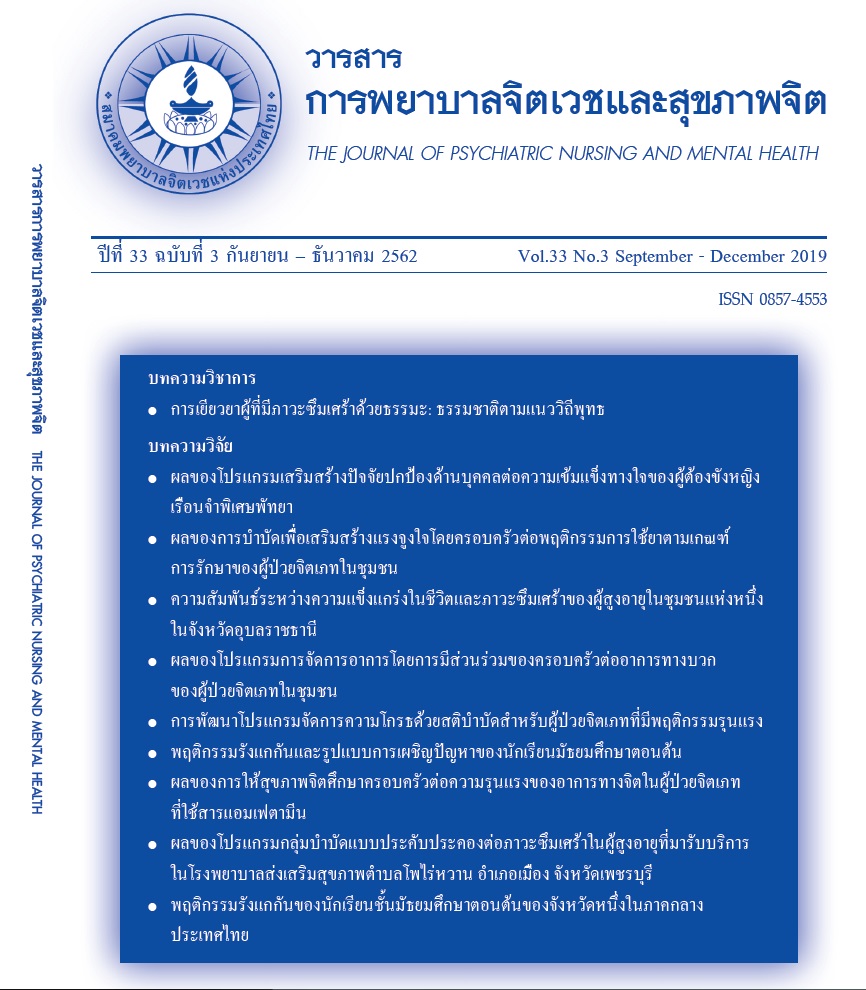
THE EFFECT OF INDIVIDUAL PROTECTIVE FACTOR ENHANCEMENT PROGRAM ON RESILIENCE AMONG FEMALE PRISONERS IN PATTAYA REMAND PRISON
Article Sidebar
Main Article Content
Abstract
Objective: Enhancement of resilience among prisoners is an alternative option that helps them to be ready to face and handle with problems during their times of confinement and when returning back to society. The purpose of this quasi-experimental study was to examine the effect of individual protective factor enhancement program on resilience among female prisoners at Pattaya Remand Prison in Chon Buri Province.
Methods: The sample consisted of 24 female prisoners who met the inclusion criteria. They were randomly assigned into either the experimental or the control groups with 12 subjects in each group. The experimental group participated in the individual protective factor enhancement program for 3-week period with 2 sessions per week for 6 sessions. Each session took about 90 minutes. Participants in the control group received routine care provided by the remand prison. Resilience scale developed by Auchariya Nacajud (2011) was administered to the participants in both groups for three phases including pre - post tests and one-month follow - up. This scale yielded Cronbach’s alpha of .81. Descriptive statistics, independent t-test, two – way repeated measure ANOVA, and Bonferroni method for pairwise comparisons were employed to analyze the data.
Results: The results revealed that the mean scores of resilience at post-test and 1 month follow up phases in the experimental group were significantly different from the control group (p < .001). In the experimental group, the mean score of resilience at post - test (X = 60.58; SD = 5.85) and at 1 month follow-up (X = 65.08; SD = 3.26) were significantly higher than that at pre - test (X = 39.33; SD = 2.46) with p < .001.
Conclusion: The findings suggest that the individual protective factor enhancement program could enrich resilience among these female prisoners. Therefore, related health care providers should learn about this program and take into consideration of applying this program to promote resilience in female prisoners or other vulnerable groups.
Article Details
บทความที่ได้รับการตีพิมพ์แล้ว เป็นลิขสิทธิ์ของสมาคมพยาบาลจิตเวชแห่งประเทศไทย
References
กรมสุขภาพจิต. (2560). แผนยุทธศาสตร์กรมสุขภาพจิตในช่วงแผนพัฒนาเศรษฐกิจและสังคมแห่งชาติ ฉบับที่ 12 (พ.ศ. 2560-2564). สำนักงานยุทธศาสตร์สุขภาพจิต กรมสุขภาพจิต กระทรวงสาธารณสุข.
กุลภา วจนสาระ. (2561). ป่วยไข้ในเรือนจำ: ปัญหาสุขภาพและการเข้าถึงบริการ. สถาบันวิจัยประชากรและสังคม มหาวิทยาลัยมหิดล.
ประเวช ตันติพิวัฒนสกุล. (2550). แนวทางการจัดกิจกรรมการเรียนรู้การสร้างความเข้มแข็งทางใจสำหรับนักเรียนชั้นมัธยมศึกษา. นนทบุรี: กรมสุขภาพจิต กระทรวงสาธารณสุข.
มลวิภา เหมือยพรหม. (2554). โปรแกรมเสริมสร้างความเข้มแข็งทางใจในการป้องกันการฆ่าตัวตายในกลุ่มนักเรียนมัธยมศึกษาตอนปลาย. รายงานการศึกษาอิสระพยาบาลศาสตรมหาบัณฑิต สาขาวิชาการพยาบาล สุขภาพจิตและจิตเวช, บัณฑิตวิทยาลัย, มหาวิทยาลัยขอนแก่น.
ศุภรา เชาว์ปรีชา. (2551). Resilience ในเด็กที่ถูกทารุณกรรม. วารสารสมาคมจิตแพทย์แห่งประเทศไทย, 12(1), 40-49.
สุมนทิพย์ จิตสว่าง และนัทธี จิตสว่าง. (2559). การพัฒนาคุณภาพชีวิตของผู้ต้องขังสูงอายุในเรือนจำ. วารสารสังคมสงเคราะห์ศาสตร์, 24(2), 78-101.
อัจฉริยา นคะจัด. (2554). ผลของโปรแกรมพัฒนาความมั่นคงทางจิตใจของผู้ต้องขังเรือนจำกลางขอนแก่น. วิทยานิพนธ์ศึกษาศาสตร มหาบัณฑิต สาขาวิชาจิตวิทยาการศึกษาและการให้คำปรึกษา, บัณฑิตวิทยาลัย, มหาวิทยาลัยขอนแก่น.
อิงคฏา โคตนารา. (2554). ผลของโปรแกรมเสริมสร้างปัจจัยปกป้องต่อความสามารถในการยืนหยัดเผชิญวิกฤติของเยาวชนชายในสถานพินิจและคุ้มครองเด็กและเยาวชน. วิทยานิพนธ์พยาบาลศาสตรมหาบัณฑิต สาขาวิชาสุขภาพจิตและการพยาบาลจิตเวช, บัณฑิตวิทยาลัย, มหาวิทยาลัยบูรพา.
Drapeau, S., Saint - Jacques, M., Lepine., R., Begin, G., & Bernard, M. (2007). Processes that contribute to resilience among youth in foster care. Journal of Adolescence, 30, 977-999.
Garmezy, N. (1991). Resilience in children’s adaptation to negative life events and stressed environments. Pediatric Annals, 20, 459-466.
Gillespie, B. M., Chaboyer, W., & Wallis, M. (2007). Development of a theoretically derived model of resilience through concept analysis. Contemporary Nurse, 25(1), 124-35.
Grotberg, E. H. (1995). A guide to promotion resilience in child: Strengthening the human spirit. The Netherlands: Bemard Van Leer.
Mayo Clinic. (2008). Psychological resilience. Retrieved from http://www.mayoclinic. com/health/resilience/MH 00078.
Wagnild, G. M., & Young, H. (1993). Development psychometric evaluation of the Resilience Scale. Journal of Nursing Measurement, 1, 165-178.
