
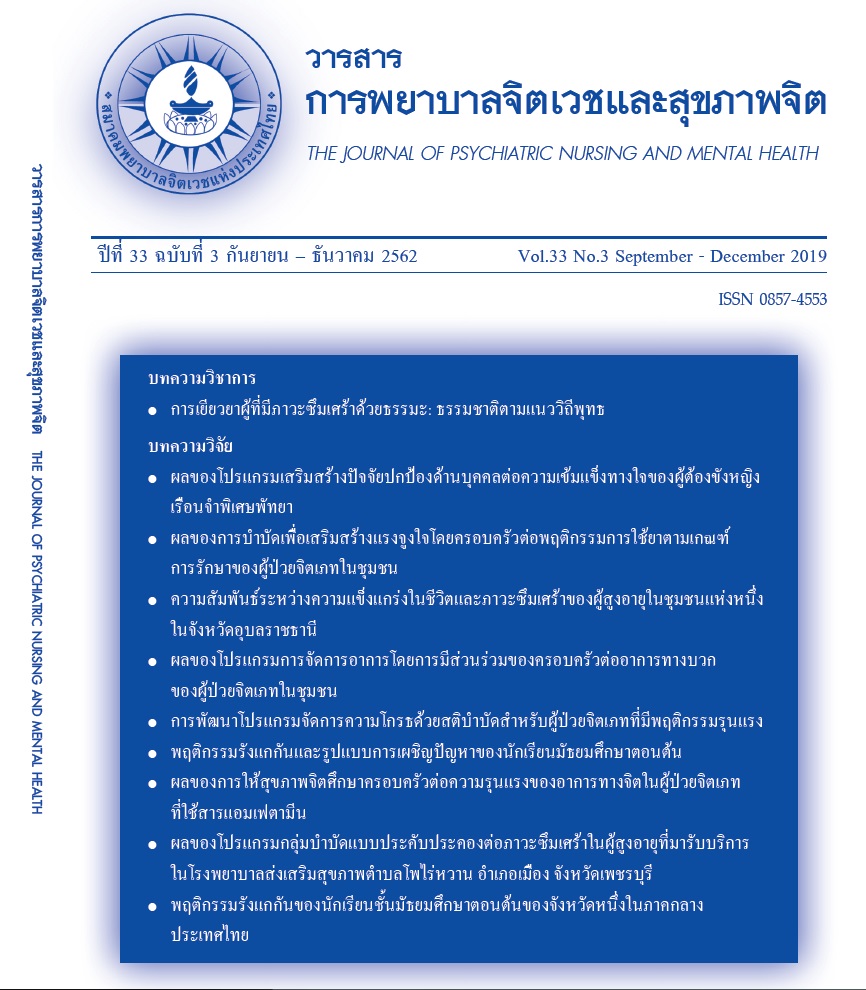
ผลของการบำบัดเพื่อเสริมสร้างแรงจูงใจโดยครอบครัวต่อพฤติกรรมการใช้ยา ตามเกณฑ์การรักษาของผู้ป่วยจิตเภทในชุมชน
Article Sidebar
Main Article Content
บทคัดย่อ
วัตถุประสงค์: การวิจัยนี้มีวัตถุประสงค์เพื่อ ศึกษาผลของการบำบัดเพื่อเสริมสร้างแรงจูงใจโดย ครอบครัวต่อพฤติกรรมการใช้ยาตามเกณฑ์การ รักษาของผู้ป่วยจิตเภทในชุมชน
วิธีการศึกษา: การวิจัยนี้เป็นการวิจัยกึ่ง ทดลอง กลุ่มตัวอย่างคือครอบครัวของผู้ป่วยจิตเภท ที่รักษาในแผนกผู้ป่วยนอก โรงพยาบาลสามชุก ซึ่งมีคุณสมบัติตามเกณฑ์ 40 ครอบครัว จับคู่ตัวอย่าง ด้วยอายุและคะแนนพฤติกรรมการใช้ยาตามเกณฑ์ การรักษา และสุ่มเข้ากลุ่มทดลองและควบคุม กลุ่มละ 20 ครอบครัว กลุ่มทดลองได้รับการบำบัด เพื่อเสริมสร้างแรงจูงใจโดยครอบครัวและกลุ่ม ควบคุมได้รับการพยาบาลตามปกติ เครื่องมือ การวิจัยคือ 1) การบำบัดเพื่อเสริมสร้างแรงจูงใจ โดยครอบครัว 2) แบบวัดพฤติกรรมการใช้ยาตาม เกณฑ์การรักษา 3) แบบวัดขั้นตอนความพร้อม ในการเปลี่ยนแปลง 4) แบบประเมินการเสริมสร้าง แรงจูงใจของผู้ดูแล และ 5) แบบสังเกตผู้ดูแลในการ ใช้เทคนิคเสริมสร้างแรงจูงใจ ตรวจสอบความตรง เชิงเนื้อหาจากผู้ทรงคุณวุฒิ 5 คน เครื่องมือชุดที่ 2, 3 และ4 มีค่าความเที่ยงสัมประสิทธิ์แอลฟาของ ครอนบาคเท่ากับ 0.83, 0.82 และ 0.81 ชุดที่ 5 มีค่า ความเที่ยงสัมประสิทธิ์สหสัมพันธ์แบบเพียร์สัน เท่ากับ 0.99 วิเคราะห์ข้อมูลด้วยสถิติทดสอบที
ผลการศึกษา: 1) พฤติกรรมการใช้ยาตาม เกณฑ์การรักษาของผู้ป่วยจิตเภทหลังได้รับการบำบัดเพื่อเสริมสร้างแรงจูงใจโดยครอบครัวดีกว่า ก่อนได้รับการบำบัดอย่างมีนัยสำคัญทางสถิติที่ ระดับ .05 และ 2) หลังการทดลอง พฤติกรรมการ ใช้ยาตามเกณฑ์การรักษาของผู้ป่วยจิตเภทกลุ่ม ที่ได้รับการบำบัดเพื่อเสริมสร้างแรงจูงใจโดย ครอบครัวดีกว่ากลุ่มที่ได้รับการพยาบาลตามปกติ อย่างมีนัยสำคัญทางสถิติที่ระดับ .05
Article Details
บทความที่ได้รับการตีพิมพ์แล้ว เป็นลิขสิทธิ์ของสมาคมพยาบาลจิตเวชแห่งประเทศไทย
เอกสารอ้างอิง
พิชัย แสงชาญชัย, ดรุณี ภู่ขาว, สังวร สมบัติใหม่, ณัฐนาฏ สระอุบล, สายรัตน์ นกน้อย, และ เพ็ญพักตร์ อุทิศ. (2553). การให้คำปรึกษาและการบำบัดเพื่อเสริมสร้างแรงจูงใจในผู้ป่วยที่มีปัญหาการดื่มสุรา. เชียงใหม่: วนิดาการพิมพ์.
เพชรี คันธสายบัว. (2544). การวิเคราะห์ตัวแปรจำแนกกลุ่มผู้ป่วยจิตเภทที่ป่วยซ้ำและไม่ป่วยซ้ำ. วิทยานิพนธ์ปริญญามหาบัณฑิต, สาขาการพยาบาลสุขภาพจิตและจิตเวช คณะ พยาบาลศาสตร์ จุฬาลงกรณ์มหาวิทยาลัย.
มาโนช หล่อตระกูล และปราโมทย์ สุคนิชย์. (2552). จิตเวชศาสตร์รามาธิบดี (พิมพ์ครั้งที่ 2). กรุงเทพมหานคร: บียอนด์เอ็นเตอร์ไพรซ์.
สมภพ เรืองตระกูล. (2553). ตำราจิตเวชศาสตร์ (พิมพ์ครั้งที่ 7). กรุงเทพมหานคร: เรือนแก้ว การพิมพ์.
สรินทร เชี่ยวโสธร. (2545). ผลของการเสริมสร้างพลังอำนาจในผู้ป่วยจิตเภทต่อพฤติกรรมการใช้ยาตามเกณฑ์การรักษา. ปริญญามหาบัณฑิต. สาขาการพยาบาลสุขภาพจิตและจิตเวช คณะพยาบาลศาสตร์ จุฬาลงกรณ์ มหาวิทยาลัย.
Agarwal, M. R., Sharma, V. K., KV, K. K., & Lowe, D. (1998). Non-compliance with treatment in patients suffering from schizophrenia: A study to evaluate possible contributing factors. International Journal of Social Psychiatry, 44(2), 92-106.
Burn, N., & Grove, S. K. (2009). The Practice of Nursing Research: Conduct, Critique and Utilization (6th ed.). St. Louise: W.B. Saunders. Cullum, N.
Cain, C. I., & Wick, M. N. (2002). Care giving attitudes as correlates of burden in family caregiver coping with chronic obstructive pulmonary disease. Journal of Family Nursing, 6, 46-47.
Chien, W. T. (2008). Effectiveness of Psychoedu¬cation and Mutual Support Group Program for Family Caregiver of Chinese People with Schizophrenia. The open nursing Journal, 2, 28-39.
Drymaski, W. M., & Campbell, T. C. (2009). A review of motivational interviewing to enhance adherence to antipsychotic medication in patients with schizophrenia: Evidence and recommendations. Journal of Mental Health, 8, 6-15.
Faerden, A., Finset, A., Friis, S., Agartz, I., Barrett, E.A., Nesvag, R., et al. (2010). Apathy in first episode psychosis patients: one year follow up. Schizophrenia Research, 116, 20-26.
Farragher, B., (1999). Treatment compliance in the mental health service. Irish Medication Journal, 92(6), 1-3.
Gilmer, T. P., Dolder, C. R., Lacro, J. P., Folsom, D. P., Lindamer, L., Garcia, P., et al. (2004). Adherence to treatment with antipsychotic medication and health care cost among Medicaid beneficiaries with schizophrenia. American Journal of Psychiatry, 161, 692-699.
Horwath, E., & Cournos, F. (1999). Psychiatry. Philadelphia: W.B. Saunders.
Kane, J. M. (2007). Treatment strategies to prevent relapse and encourage remission. The Journal of Clinical Psychiatry, 68, 27-30.
Kazadi, N. J. B., Moosa, M. Y. H., & Jeenah, F. Y. (2008). Factors associated with relapse in Schizophrenia. South African Joural of Psychiatry, 4(2), 52-62.
Kumar, S., & Sedgwick, P. (2001). Non-compliance to psychotropic medication in Eastern India: Clients’ perspective. Journal of Mental Health, 10(3), 279-284.
Lacro, J. P., Dunn, L. B., Dolder, C. R., Leckband, S. G., & Jeste, D. V. (2002). Prevalence of and risk factors for medication nonadherence in patients with schizophrenia: A comprehensive review of recent literature. Journal of Clinical Psychiatry, 63, 892-909.
Maneesakorn, S., Robso, D., Gourna, K., & Gray, A. (2007). An RCT of adherence therapy for people with schizophrenia in Chiang Mai Thailand. Journal of clinical Nurse, 16, 1302-1312.
Miller, W. R., & Rollnick, S. (2002). Motivational interview in: preparing people to change addictive behavior. New York: Guilford Press.
Miller, W. R., & Tonigan, J. S. (1996). Assessing drinkers’ motivation for change: The stage of change readiness and treatment eagerness scale (SOCRATES). Psychology of Addictive Behavior, 10, 81-89.
Nakonezny, P. A., & Byerly, M. J. (2006). Electronically monitored adherence in outpatients with schizophrenia or schizoaffective disorder: A comparison of first vs second generation antipsychotics. Schizophrenia Research, 82, 107-114.
Novick, D., Haro, J. M., Duarez, D., Perez, V., Dittmann, R.W., & Haddad, P. M. (2010). Predictors and clinical consequences of non-adherence with antipsychotic medication in the outpatient treatment of schizophrenia. Psychiatry Research, 173(2), 109-113.
Smeerdijk, A. M., Keet, R., Dekker, N., van Raaij, B., Krikke, M., Koeter, M., et al. (2011). Motivational interviewing and interaction skills training for parents to change cannabis use in young adults with recent-onset schizophrenia: a randomized controlled trial. Psychology Medicine, 42(8), 1627-1636.
Smeerdijk, A. M., Keet, R., de Haan, L., Barrowclough, C., Linszen, D., & Schippers, G. (2014). Feasibility of teaching motivational interviewing to parent of young adults with recent-onset schizophrenia and co-occurring cannabis use. Journal of Substance Abuse Treatment, 46, 340-345.
Smeerdijk, A. M., Linszae, D., Kuipers, T., & Keet, R. (2009). Family Motivational Intervention in Early Psychosis and Cannabis Misuse. In Lobban, F., & Barrowclough, C. (Eds.). A casebook of family interventions for psychosis. Chi Chester: John Wiley & Sons.
Spirito, A., Sindelar-Manning, H., Colby, S. M., Barnett, N. P., Lewander, W., Rohsenow, D. J., et al. (2011). Individual and family motivational interventions for alcohol positive adolescents treated in an emergency department. Archives of Pediatrics and Adolescent Medicine journal, 165(3), 269-274.
Wagner, C. C., & Ingersoll, K. S. (2013). Motivational Interviewing in Groups. New York: Guilford Press.
Wu, E. Q., Birnbaum, H. G., Shi, L., Ball, D. E., Kessler, R. C., & Moulis, M. (2005). The economic burden of schizophrenia in the United States in 2002. Journal of Clinical Psychiatry, 66, 1122-1129.
