
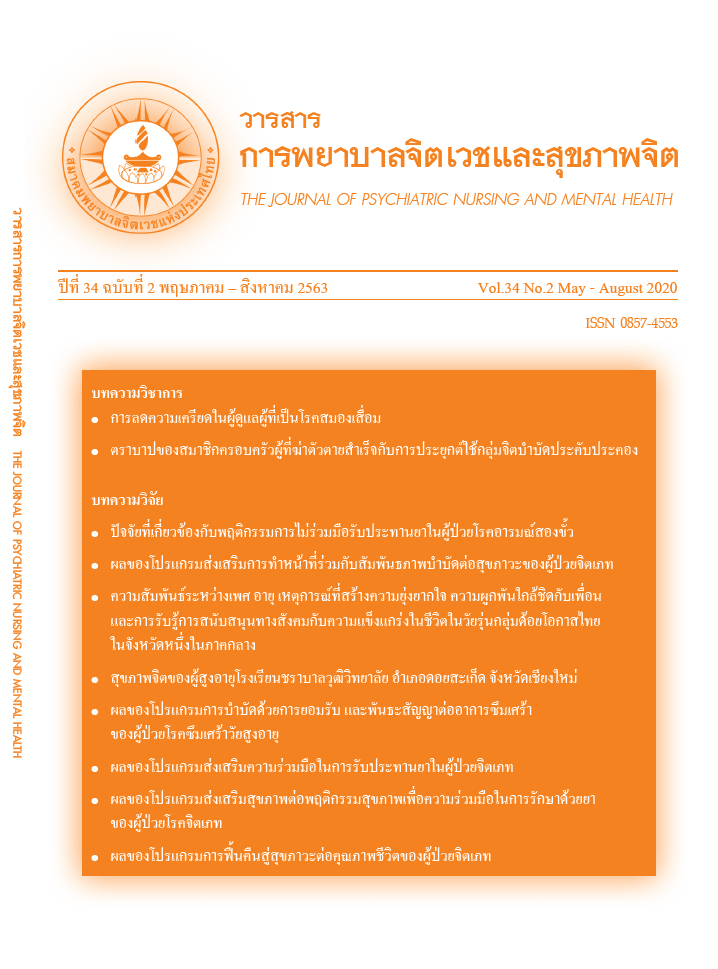
REDUCING STRESS IN CAREGIVERS OF PERSON WITH DEMENTIA
Article Sidebar
Main Article Content
Abstract
Abstract
Dementia is an important problem for the elderly population because when any person has this disease, it will directly affect the quality of life for those with dementia themselves and their families. Currently, the number of people with dementia is increasing all over the world including Thailand. Dementia is a disease of degenerative condition of various functions with many levels of severity and is also the major cause of incompetence in the final stages of life characterized by the inability of communication through speech and movement, even after being helped. The daily activities of people with dementia must completely dependent on their caregivers causing many impacts, including physical, psychological, social, and economic, on people with dementia themselves and their families who are their caregivers. Caregivers will experience stress from having to care for people with dementia all the time and for a long time. Therefore, nurses should have care methods to reduce caregivers’ stress in order to help caregivers have the potential to continue to care for people with dementia.
Article Details
บทความที่ได้รับการตีพิมพ์แล้ว เป็นลิขสิทธิ์ของสมาคมพยาบาลจิตเวชแห่งประเทศไทย
References
กระทรวงการพัฒนาสังคมและความมั่นคงของ มนุษย์. (2557). ประชากรสูงอายุไทย: ปัจจุบันและอนาคต. เอกสารประมวลสถิติ ด้านสังคม 1/2558 (พฤศจิกายน). กรุงเทพฯ: ศูนย์เทคโนโลยีสารสนเทศและการสื่อสาร สำนักงานปลัดกระทรวงการพัฒนาสังคม และความมั่นคงของมนุษย์.
กานดา วรคุณพิเศษ และศิริพันธ์ สาสัตย์. (2558). ผลของโปรแกรมการจัดสิ่งแวดล้อม ที่บ้านร่วมกับการผ่อนคลายกล้ามเนื้อ แบบก้าวหน้าต่อภาวะเครียดของผู้ดูแล ผู้สูงอายุที่มีภาวะสมองเสื่อม. วารสาร เกื้อการุณย์, 22(1), 82-97.
ชัชวาล วงศ์สาลี และศุภลักษณ์ พื้นทอง. (2561). ภาวะสมองเสื่อมในผู้สูงอายุ: การพยาบาล และการดูแลญาติผู้ดูแล.วารสาร มฉก. วิชาการ, 22(43-44), 166-179.
นันทพร ศรีนิ่ม และธารินี นนทพุทธ. (2560). ดูแลผู้มีภาวะสมองเสื่อมที่บ้านอย่างมือ อาชีพ.วารสารวิชาการมหาวิทยาลัยอีสเทิร์น เอเชีย, 11(2), 83-89.
พัฒน์ศรี ศรีสุวรรณ. (2561). แผนการดูแลแบบ องค์รวมสำหรับภาวะสมองเสื่อม. วารสาร อายุรศาสตร์ มหาวิทยาลัยขอนแก่น, 4(3), 28-35.
พาวุฒิ เมฆวิชัย และสุรินทร์ แซ่ตัง. (2556). ผลกระทบการดูแลผู้ป่วยภาวะสมองเสื่อม ในประเทศไทย.วารสารสมาคมจิตแพทย์ แห่งประเทศไทย, 58(1), 101-110.
วรรณนิภา บุญระยอง. (2543). ภาระของครอบครัว ในการดูแลผู้สูงอายุสมองเสื่อม. วารสาร พฤฒาวิทยาและเวชศาสตร์ผู้สูงอายุ, 1(1), 11-17.
วีรศักดิ์ เมืองไพศาล. (2558). ภาวะสมองเสื่อมใน ผู้สูงอายุและการป้องกัน. ใน: ประเสริฐ อัสสันตชัย. (บรรณาธิการ) ปัญหาสุขภาพ ที่พบบ่อยในผู้สูงอายุ.พิมพ์ครั้งที่ 5. กรุงเทพฯ: ยูเนี่ยน ครีเอชั่น.
สถาบันประสาทวิทยา กรมการแพทย์. (2557). แนวทางเวชปฏิบัติภาวะสมองเสื่อม. กรุงเทพฯ: บริษัท ธนาเพรส จำกัด.
สมจิต หนุเจริญกุล. (2537). ความเครียดกับการ ดูแลตนเอง.ใน สมจิต หนุเจริญกุล (บก.), การดูแลตนเอง: ศาสตร์และศิลปทางการ พยาบาล (พิมพ์ครั้งที่ 3). กรุงเทพฯ: วีเจ พริ้นติ้ง.
สมศักดิ์ ชุณหรัศมิ์. (2553). รายงานประจำปี สถานการณ์ผู้สูงอายุไทย. สืบค้นเมื่อ 27 ตุลาคม 2555, จาก http://www. m-society.go.th/document/statistic/ statistic_7722.pdf
สมาคมโรคสมองเสื่อมแห่งประเทศไทย. (2554). สรุปการประชุมระดมสมองเพื่อพัฒนา นโยบายการป้องกัน รักษาและดูแลผู้ป่วย สมองเสื่อมในประเทศไทย. นนทบุรี: เดอะ กราฟฟิ โก ซิสเต็มส์.
สิรินทร ฉันทศิริกาญจน. (2558). สมองเสื่อม. เอกสารโรเนียวประกอบการประชุม ณ โรงแรมมารวยการ์เด้นท์ วันที่ 2-6 พฤศจิกายน 2558.
อุมาพร ตรังคสมบัติ. (2554). จิตวิทยาชีวิตคู่และ การบำบัดคู่สมรส. กรุงเทพฯ: ซันต้า การพิมพ์.
Aloysi, A. S., & Callahan, E. H. (2020). Behavioral and Psychiatric Symptoms in Dementia (BPSD). In Geriatric Practice (pp. 223-236). Springer, Cham.
Alzheimer’s Association. (2019). Alzheimer’s disease facts and figures. Alzheimer’s &dementia: The Journal of the Alzheimer’s Association, 15(3), 321-387.
American Psychiatric Association. (2013). Diagnostic and statistical manual of mental
disorders (5th ed.). Washington, DC: Publisher.
Brandt, P. A., & Weinert, C. (1981). The PRQ-a social support measure. Nursing research, 30(5), 277–280.
Bruce, D. G., Paley, G. A., Nichols, P., Roberts, D., Underwood, P. J., & Schaper, F. (2005). Physical disability contributes to caregiver stress in dementia caregivers. Journal of Gerontology: Medical Sciences, 60A(3), 345–9
Carbonneau, H., Caron, C., & Desrosiers, J. (2010). Development of a conceptual framework of positive aspects of caregiving in dementia. Dementia, 9(3), 327–353.
Carretero, S., Garces, J., Rodenas, F., & Sanjose, V. (2009). The informal caregiver’s burden of dependent people: Theory and empirical review. Archives of Gerontology and Geriatrics, 49, 74–79.
Chou, K. R. (2000). Caregiver burden: A concept analysis. Journal of Pediatric Nursing, 15(6), 398-407.
Cohen-Mansfield, J., Werner, P., & Reisberg, B. (1995). Temporal order of cognitive and functional loss in a nursing home population. Journal of the American Geriatrics Society, 43(9), 974–978.
Downs, M., & Bowers, B. J. (2008). Excellence in dementia care: Research into practice. United Kingdom: Open University Press.
Finkel, S. I. (2001). Behavioral and psychological symptoms of dementia: a current focus for clinicians, researchers, and caregivers. The Journal of Clinical Psychiatry, 62 (Suppl 21), 3–6.
Hunt, C. K. (2003). Concept in caregiver research. Journal of Nursing Scholarship, 35, 27-32.
Keir, S. T., Farland, M. M., Lipp, E. S., & Friedman, H. S. (2009). Family appraisal of caregiving in a brain cancer model. Journal of Hospice and Palliative Nursing, 11(1),60–66.
Lazarus, R., & Folkman, S. (1984). Stress, appraisal, and coping. New York: Springer.
Leow, M. Q. H., & Chan, W. S. (2011). Factors affecting caregiver burden of terminally ill adults in the home setting–A systematic review. JBI Library of Systematic Reviews, 9(45), 1883-1916.
Morris, T., & Edward, L. D. (2006). Family caregivers. In I. M. Lubkin & P. D. Larson (Eds.), Chronic illness: Impact and intervention (5th ed., pp. 253-284). Boston: Jones and Barlett.
Ory, M. G., Hoffman, R. R., Yee, J. L., Tennstedt, S., & Schulz, R. (1999). Prevalence and impact of care giving: A detailed comparison between dementia and non Dementia caregivers. The Gerontologist, 39(2),177-185.
Papastavrou, E., Kalokerinou, A., Papacostas, S. S., Tsangari, H., & Sourtzi, P. (2007). Caring for a relative with dementia: family caregiver burden. Journal Compilation, 446-457.
Peacock, S., Forbes, D., Markle-Reid, M., Hawranik, P., Morgan, D., Jansen, L., Leipart, B., & Henderson, S. (2010). The positive aspects of the caregiving journey with dementia: Using a Strengths-Based Perspective to Reveal Opportunities. Journal of Applied Gerontology, 29, 640 – 659.
Pearlin, L. I., Mullan, J. T., Semple, S. J., & Akaff, M. M. (1990). Caregiving and the stress process: An overview of concepts and their measures. The Gerontologist, 30(5), 583-594.
Schoenmakers, B., Buntinx, F., & Delepeleire, J. (2010). Supporting the dementia family caregiver: The effect of home care intervention on general well-being. Aging & Mental Health, 14(1), 44-56.
Scott, C. B. (2010). Alzheimer’s disease caregiver burden: Does resilience matter? Tennessee: University of Tennessee.
Semple, S. J. (1992). Conflict in Alzheimer’s caregiving families: Its dimensions and consequences. The Gerontologist, 32(5), 648–655.
Sherwood, P. R., Given, B. A., Given, C. W., Schiffman, R. F., Murman, D. L., Lovely, M., Von Eye, A., Rogers, L. R., & Remer, S. (2006). Predictors of distress in caregivers of persons with a primary malignant brain tumor. Research in Nursing and Health, 29(2), 105-120.
Sorensen, S., & Conwell, Y. (2011). Issues in dementia caregiving: effects on mental and physical health, intervention strategies, and research needs. The American Journal of Geriatric Psychiatry: Official Journal of the American Association for Geriatric Psychiatry, 19(6), 491–496.
Tremont, G. (2011). Family caregiving in dementia. Medicine and health, Rhode Island, 94(2), 36–38.
Verma, S., Sayal, A., Vijayan, V. K., Rizvi, S. M., & Talwar, A. (2016). Caregiver’s burden in pulmonary arterial hypertension: a clinical review. Journal of Exercise Rehabilitation, 12(5), 386–392.
World Health Organization (WHO). (2011). WHO report on the global tobacco epidemic, 2011: warning about the dangers of tobacco. Retrive 15 June, 2013, from http://www. who.int/tobacco/global_report/2011/en/ index.html, accessed).
Zarit, S. H., Reever, K. E., & Bach-Peterson, J. (1980). Relatives of the impaired elderly: Correlates of feelings of burden. The Gerontologist, 20(6), 649-655.
