
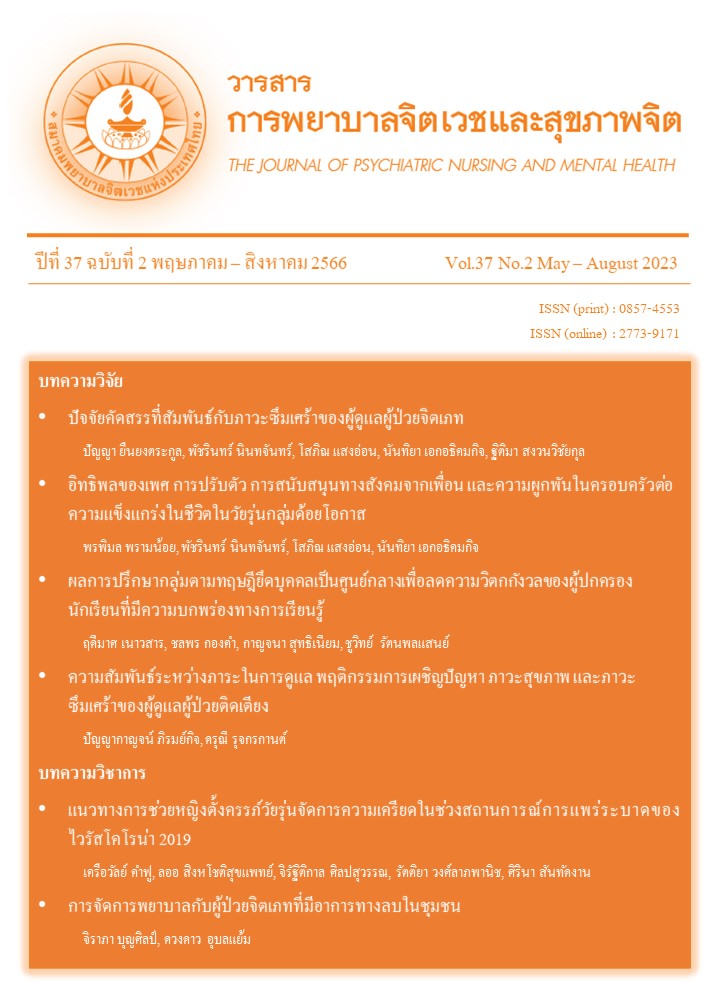
RELATIONSHIPS BETWEEN CARE BURDEN, COPING BEHAVIORS, HEALTH STATUS, AND DEPRESSION OF FAMILY CAREGIVERS OF BEDRIDDEN PATIENTS
Article Sidebar
Main Article Content
Abstract
Objective: This research examined the relationships between care burden, coping behavior, health status and depression among caregivers of bedridden patients.
Methods: The sample consisted of 270 caregivers of bedridden patients in a northeastern province of Thailand. Data were collected using a personal information questionnaire, the Jalowiec Stress Coping Scale, Zarit Burden Interview (ZBI), Caregiver Depression assessment (HRSR-Scale), and Short Form Health Survey (SF-12). Data were analyzed using descriptive statistics and Pearson's correlation coefficients.
Results: The relationship between depression and coping behavior was negative and of low value (r = -.27, p < .01). The relationship between depression and care burden was positive and high (r = .64, p < .01). The relationship between depression and health status was negative and moderate (r = -.57, p < .01).
Conclusion: The results of this study support Pearlin's concept of stress processes and may be used in promoting, preventing, and reducing depression in caregivers of bedridden patients.
Article Details

This work is licensed under a Creative Commons Attribution-NonCommercial-NoDerivatives 4.0 International License.
บทความที่ได้รับการตีพิมพ์แล้ว เป็นลิขสิทธิ์ของสมาคมพยาบาลจิตเวชแห่งประเทศไทย
